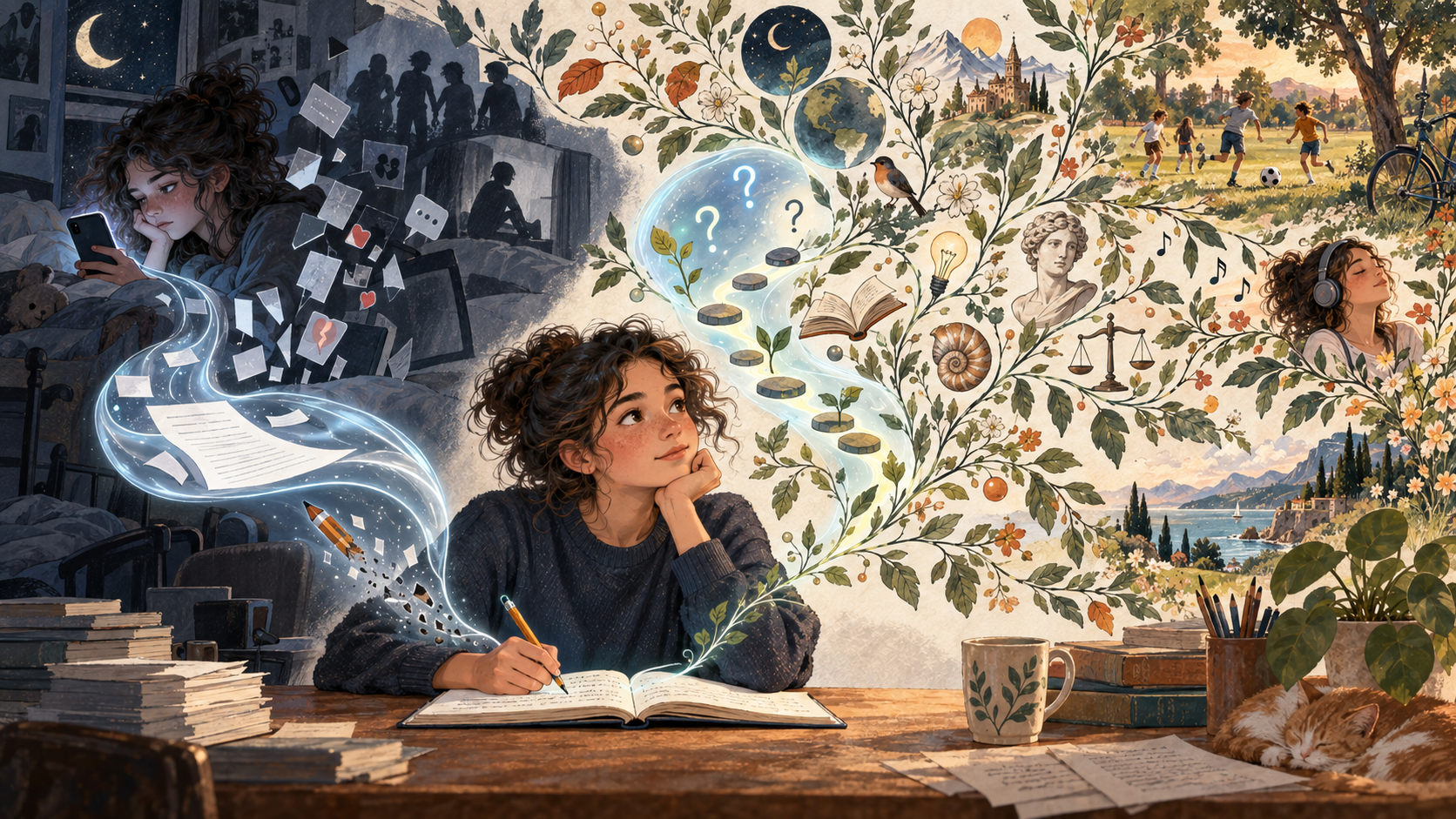
The central claim in Jonathan Haidt’s The Anxious Generation is that in little more than a decade, childhood went from mostly play-based to mostly phone-based. Children spent less time together, unsupervised and in the physical world, and far more time in digital environments designed to hold their attention. Haidt links that shift to the sharp decline in young people’s mental health since the early 2010s.
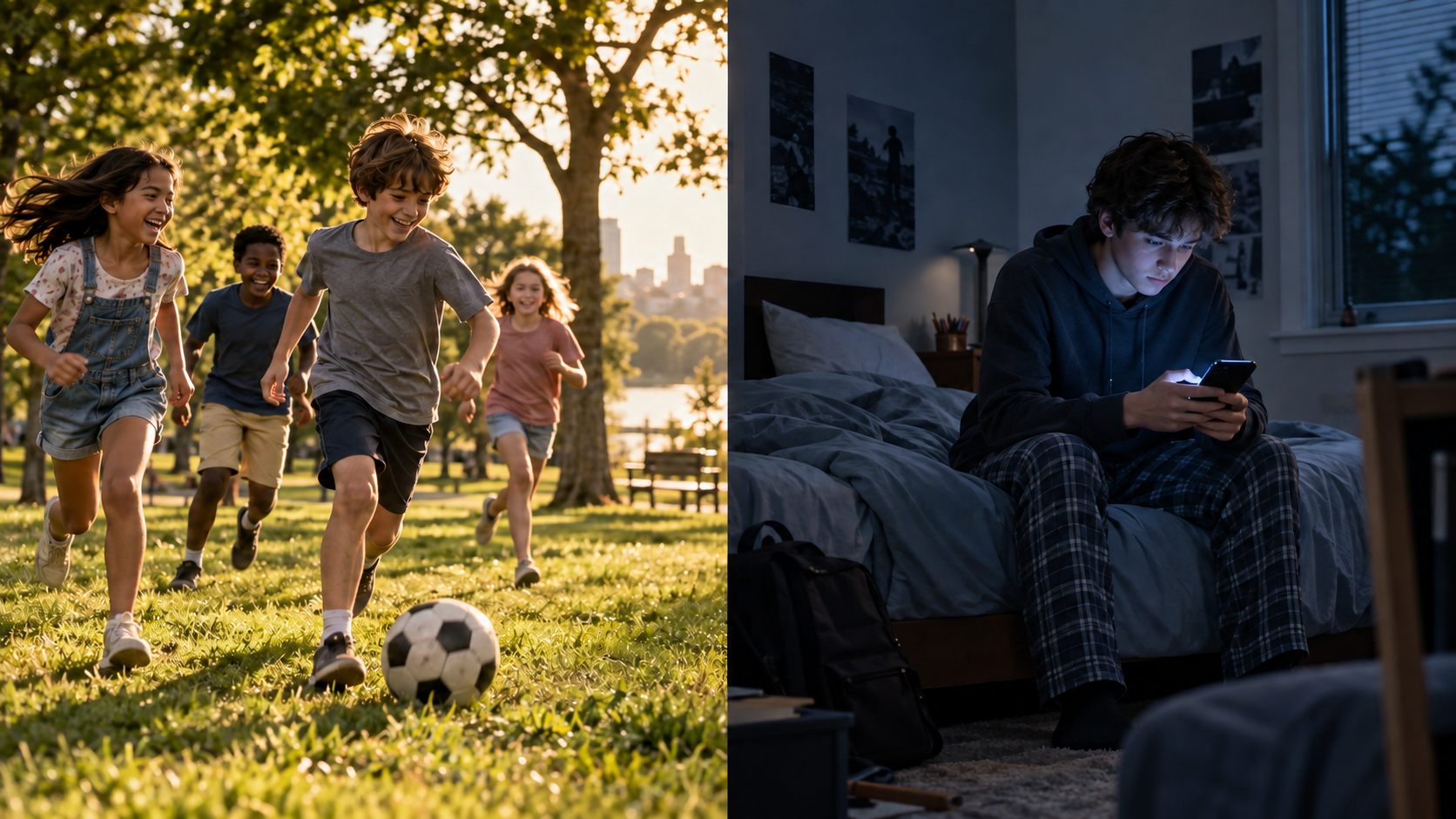
The decline is well documented. Whether phones caused it is still argued, since some of the evidence is correlational. Even so, I find Haidt’s case persuasive. Given the critical nature of the harm, the evidence is strong enough to act on. The burden of proof should sit with the technology, not with children, just as it sits with the pharmaceutical company and not the patient. If we wait for certainty, we will run the experiment on another generation first.
Four Foundational Harms
Haidt names four foundational harms: social deprivation, sleep deprivation, attention fragmentation and addiction. They feed each other, and together they displace the experiences through which children develop into resilient adults.
The book makes the case that the great rewiring of childhood is causing an epidemic of mental illness. I suspect the same thesis holds, at least in part, for learning. Average PISA scores peaked around 2012 and have fallen ever since, and the slide began well before the pandemic. Other explanations compete, and I would not put all of it on phones. But the timing and much of the extensive evidence is very hard to ignore.
Social media is probably the main culprit behind the four harms in girls, with pornography and online gaming also having a large impact on boys. This is why I think Haidt is right to describe the change as “from play to phone”, rather than “from play to social media”. The phone is omnipresent, and there is typically only one of them, carrying several potentially harmful agents.
AI is on the Phone
That phone is of course now also carrying AI.
Will it turn out to be one more harmful agent, or a cognitive probiotic?
AI does have the potential to deprive children of embodied social contact, to disrupt sleep, to fragment attention and to be addictive. Time and research will tell how much.
My instinct is that a general-purpose homework assistant is probably less harmful to the four foundational harms than social media, pornography or gaming. Companion chatbots, built to be a friend at midnight, are another matter, and I would not make the same assumption.
Where AI seems more likely to matter is in the cognitive health and learning of a child. Here the early evidence suggests that it depends on how it is used. In one field experiment with nearly a thousand high school maths students, those given a ChatGPT-style tutor did far better on practice problems. Once the tool was taken away, they scored 17% lower than students who never had it. A version designed to safeguard learning largely avoided that damage. The students with the plain chatbot also felt they had learned just as much as the others.
Productive Struggle
There are two very different ways a child can use AI. A fifteen-year-old asked to write a poem for homework can ask an AI to explain how a poem is built, write her own first version, and ask for feedback that sends her back to rethink it. Or she can ask it to write the poem. Only the first involves the “productive cognitive struggle” in which learning happens. In the second, she might hand in something more polished and have learned a lot less.
Adults can usually tell the two apart. Children whose self-control is still forming, and who have already learned from other apps to take the frictionless option, will find it much harder. The maths study points that way, but I know of no evidence that tests it directly. It is, though, the pattern Haidt describes, applied to thinking instead of play.
I have spent many years in businesses serving education, and technology typically reaches schools on the strength of a promise, rather than proof. Products get adopted because teachers and students like them. Engagement is easy to measure. Learning is not.
The Engagement Trap in Learning
Social media was built to maximise engagement. One of the core metrics used to sell AI to schools will likely also be engagement. But engagement can mean very different things. High engagement with productive struggle is likely to boost learning. High engagement with what I call cognitive surrender, handing the thinking over to the machine, will do the opposite. Usually you get what you measure, so we need to measure the right thing: how much thinking the child does, not how long they spend in the tool.
What I liked most about Haidt’s thinking around solutions is that he does not leave this to individual parents. One family holding back while everyone else carries on can leave their child isolated. This is a collective-action problem, and schools are where norms can change for a whole group at once. His proposals are a sensible start: no smartphone before high school, no social media before sixteen, phone-free schools, and far more independence and free play.
Fifth Proposal
I would add a fifth. Schools should decide deliberately where AI belongs and what each use is for.
Does it help the child think, or save them from thinking?
We were too slow to ask what smartphones were displacing. We should not make the same mistake with AI.
A Tale of Three Poems
Suppose the fifteen-year-old’s own poem is this:
Roses are red.
Violets are blue.
Social media sucks.
Will AI too?
Four lines, a bit rough but unmistakably hers.
Ask AI to challenge her rather than rewrite it. What did social media take from her and what AI might take? She might write:
Roses are red.
My screen glows blue.
TikTok stole my sleep.
Will AI steal my thinking too?
The thinking is still hers. AI has helped her take it a step further without taking it over.
Ask AI to write it and you might get this:
Roses Are Red, Violets Are Blue: A Nuanced Exploration of the Digital Landscape ✨
Roses are red, a vibrant crimson bloom,
Violets are blue, dispelling the gloom,
Social media, it’s true, is a double-edged sword,
But will AI, too, be thoughtfully explored?
Longer, smoother, apparently more intelligent, and empty.