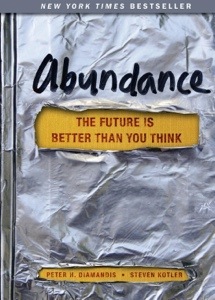
Last month I saw Peter Diamandis speak in Amsterdam and was inspired by his vision and approach to creating a world where we live in abundance rather than scarcity. Together with Steven Kotler he has earlier articulated this case in the excellent book ‘Abundance: The Future is Better Than You Think’.
The Abundance Pyramid
Diamandis and Kotler describe abundance by means of a pyramid, structured with three tiers of ‘goods’ (inspired by Maslow’s ‘hierarchy of needs’). The base of the pyramid concerns the essential needs of water, food and shelter: these resources enable life itself. The middle tier in the pyramid includes energy, education and ICT: they contribute directly to improved living standards and can also catalyze further growth. The top tier of the pyramid is reserved for freedom and health: they support the well-being of the individuals and enable them to reach their full potential and make the maximum impact for a better world. The authors describe the goal of abundance as a sustainable world in which every person on the planet has the opportunity to access the goods in the three tiers.
Progress through technology
The authors make the case that expontential advances in technology will allow us within twenty-five years to create abundance on these three tiers for a world of nine billion people. How about that for a Big Hairy Audacious Goal: global abundance within twenty-five years! They believe that these advances will be supported by three driving forces. Firstly, the rise of DIY innovation, enabling individuals and small organisations to tackle problems previously only addressable by governments, thereby massively opening up the talent pool working on solutions. Secondly, the rise of the technophilanthopist, whereby very wealthy individuals commit a major part of their wealth and talent to helping the world’s less fortunate. Thirdly, what they term ‘the rising billion‘ – the world’s poorest (in fact, closer to four billion today) who have made rapid progress in improving there positions in recent years, largely supported by mobile technology, and will soon be able to pull themselves out of poverty.
Concrete cases
Diamandis describes for each of the goals in the abundance pyramid, the technologies that could contribute to a more abundant world and in which way. He makes a convincing case!
Accelerating the pace of change
They conclude the book by suggesting that the best way for businesses and governments to achieve abundance goals is to use open incentive prizes – they believe that such competitions are the most effective method to motivate the smartest people in the world to develop new solutions. They puts forward some powerful cases to demonstrate the point.
Inspiring work
I was inspired by the optimism of this book and the concreteness of the supporting arguments. The failings of our world are well covered in the media (rightly so) and we are in any case biologically programmed to be on high alert to them. It was good to see the other side of the coin and I experienced this as a well-founded articulation of a positive scenario. I respect that a lot. Arguably there are parts of the book that go too far, and some of the downsides of the journey to abundance could be ugly. Nevertheless, I would like to recommend this book to readers looking for inspiration about a positive future for our planet.
Sanoma can make a difference through education
About a week before seeing Diamandis, I joined a group of innovation leaders for lunch with the former PM of The Netherlands, Jan-Peter Balkenende, to discuss innovation and sustainability. He emphasized the importance of the business of sustainability: how can we create new business opportunities (with a profit incentive) by helping to build a more sustainable world? He referred also to Abundance in this context.
In the case of Sanoma, I believe we can best support sustainable abundance through our Learning business. As described above, education is part of the middle tier of the abundance pyramid, contributing directly to improved living standards and catalyzing new growth. Through our strong positions in developed economies, I believe we can further progress personal and societal development by personalising the process of learning, to help individuals to realise the full potential of their unique talents. Maybe an even more audacious goal would be to bring access to high quality online education to the rising (four) billion people in developing economies. I don’t yet know the extent to which Sanoma is ready, willing and able to play a role in this. Even if we could fulfil but a part of that task, it would surely be a worthwhile (and profitable) contribution to a more abundant future! Wouldn’t that be a terrific mission to work on?!
Imagine
Imagine that you could be part of a movement that could create an abundant world within twenty-five years. What would you do? Sanoma Learning can help to provide access to high quality education and I am personally passionate about that goal. Care to join us on that journey? Or to create a new journey to abundance of your own? I’m interested to hear your thoughts on this.


 John Martin