Being close to a problem can make it hard to see, for management and for boards alike.
Management knows the business in detail, which is a strength and can also be a limitation. Boards see the numbers but not always what sits behind them. Investors often have a view but not the time to test it. The result is that the first explanation for a performance gap tends to stick, even when it is only part of the story.
I’ve been a CEO and Chairman in learning and edtech, and I have seen how these conversations work from both seats. I’m now open to taking on a new strategic advisory assignment, particularly in education, publishing and information services.
What the work involves
Working out what is driving the performance gap. This means looking past the headline metrics to the commercial and organisational causes underneath them.
Testing the business plan, including assumptions nobody has questioned for a while. Assumptions that were reasonable at the time of the deal or the last strategy review are worth checking again.
Identifying the changes that matter most. Usually that is a short list, and it helps just as much to be clear about what should be left alone.
How I work
I work as an independent, directly with the CEO and the investor or Chairman, so everyone sees the same analysis. I start with a few conversations and the numbers, and I give an honest view of what I find, including where I think the plan or the diagnosis needs to change. The aim is a clear set of priorities the team can act on.
Who it suits
It tends to suit CEOs who want an experienced sparring partner, and investors who want an independent view before or after a deal. It can also help boards that want a fresh read on a question they have been discussing for some time.
If you run or back a business where that would help, send me a message, either here, on LinkedIn, or through www.executive-mentor.com. A first conversation is easy to arrange, and it is fine if the outcome is that no outside help is needed.
I work with CEOs and investors in content, data and workflow companies, mostly in education, science, healthcare and business information.
Some of these companies tend to think in products: a journal or a database, a textbook or a course, a subscription, an assessment. That is natural, because products are what they build, price and sell. But customers don’t want a product for its own sake. They want a job done.
A teacher wants pupils to reach their learning goals, to save preparation time, and to be confident the materials are high quality and cover the curriculum. A scientist wants to know what is already established, judge the evidence and decide what to investigate next. A hospital wants its staff to have the right information at the moment they decide with a patient about a treatment. A business wants to know what a new regulation means for it and what it has to do.
The work around the content
Whatever the field, professionals go through broadly similar steps. Here is a simplified version for three of them.
Step
Teacher
Doctor
Scientist
1. Understand the objective
Define what pupils should learn
Establish the patient’s needs and goals
Define the research question
2. Assess the situation
Check prior knowledge and difficulties
Take history, examine and gather findings
Review existing evidence and available resources
3. Access relevant knowledge
Consult curriculum, materials and teaching approaches
Consult clinical evidence and guidance
Consult literature, methods and datasets
4. Interpret in context
Judge what this class needs
Interpret findings for this patient
Develop an explanation or hypothesis
5. Decide what to do
Choose the lesson and support
Agree investigations or treatment
Design the study or experiment
6. Do it
Teach and set work
Deliver care
Conduct the research
7. Evaluate what happened
Assess understanding and progress
Review response and outcomes
Analyse results and uncertainty
8. Adjust
Reteach or change the approach
Revise the assessment or care plan
Refine the hypothesis or method
9. Conclude
Close the topic and identify gaps
Close an episode or arrange continuing care
Draw and communicate conclusions
Content and data are often used at one or more of the steps above. What happens around that is interpretation: working out what the evidence means for this pupil, this patient or this experiment, and what to do next. Until now that has been done mostly by the professional, often in consultation with the client. Professionals are skilled and know the situation, but nobody can hold the whole body of evidence, including the latest insights, in their head, and most are short of time.
AI can now help with that interpretation, at several steps on the journey. I don’t suggest it replaces the professional’s judgement at steps 4 and 5 (in healthcare, within the limits regulation sets), but it could significantly support it.
At Sanoma I held the view that Sanoma Learning was not a content company but a workflow company. I believe education is among the least digitalised professional segments, and yet one where the publisher is most embedded in the professional’s core workflow, which gives it high potential for value creation. Our focus was on student learning outcomes, and time is one outcome teachers care about. Based on teacher feedback, we estimated that for every €100 a school spent on our solutions, teachers saved time worth roughly €1,000, because we supported their core workflows. That is about a 10x return on the school’s spending.
For much of the past, the value of the information sat mostly in the content itself. In the future, I expect it to sit more in how well a solution helps the customer reach the outcome they care about, in their own circumstances. In other words, the context and interpretation around the workflow will become increasingly important.
Past value was largely determined by inputs. Future value will be determined by outcomes.
Excellent content that knows nothing about the situation in which it is used is worth less than content that fits into the work and supports a good outcome.
Take a teacher with a pupil who keeps making the same mistake with fractions. The pupil’s answers are data. Working out what she has misunderstood takes interpretation. Choosing an explanation and exercises draws on content and didactics. Setting the work and reviewing progress has to fit into the teacher’s day. That is content, data, interpretation and workflow in one small task.
Where AI could create value
I see five places, and I would welcome challenge on the list.
How can we improve the product?
Which customers or services could become viable?
How can we improve commercial performance?
How should we distribute and license our content?
Where could we reduce development and delivery costs?
Creating value does not guarantee capturing it.
Customers may benefit from competition, regulation, new procurement models or spending caps, so they may capture much of the value created. Existing and new competitors may cut prices. The value may end up split across many players. The commercial task is to see where these changes could make a material difference to the performance of the business, and what to do about them.
Which platform?
One of the questions I find most important commercially is where the customer will do the work. Is it in your product, or on another platform with your content inside it?
You can build a good business either way, but they are different businesses. In the second, someone else holds the customer relationship and largely sets the terms on which you earn. The more the value moves towards outcomes and context, the more that question matters.
What I think
First, many content companies have a lot to build on: subject expertise, editorial judgement, IP, brands, distribution and customer relationships. In education, pedagogy and didactics are central. In science and healthcare, it is the quality of the evidence and how it is assessed.
Why does a customer choose you? A trusted brand may help. High-quality proprietary content, including data, may be hard to replace, especially if much of the new competition is AI-slop. Deep understanding and embedding in core customer workflows can be a powerful moat. A product used every day may be hard to leave. How much does each matter, and could AI change that?
Second, AI could cut the time and cost it takes to prepare an edition, adapt material for another market or update a product when requirements change. Who will keep those savings? Unless you can sustain a lower cost position than your competitors, it’s possible much of the financial benefit might end up with customers. Competitors will make the same savings, and customers will want to see them in the price. The companies that keep more will be the ones whose products become more valuable (i.e. provide better outcomes), not just cheaper to make.
Third:
Ideas of what you could do with AI are not scarce. The hard thing is to decide what you should do. And the really hard thing is to actually do it.
There is plenty to work with. The task is to choose where AI can improve the customer’s work and the economics of the business, and to invest accordingly.
Why I’m writing this
My career has taken me from scientific research (bioinformatics) to academic publishing, then to leading Sanoma Learning, and since then to board and advisory roles in education and information businesses. AI is part of many of my conversations with CEOs and investors.
In the posts that follow I will look at what customers pay for, who gets the money when costs fall, what protects a business and who holds the customer relationship, and which AI investments deserve funding. I will also look at how people develop expertise when AI does more of the work, what CEOs still need to understand themselves, and what investors should ask before and after a deal.
I expect some of my views to change along the way. I would be interested to hear where yours differ.
A question for you. If a customer asked what they get back for every euro they spend with you, what would you tell them? Would they agree?
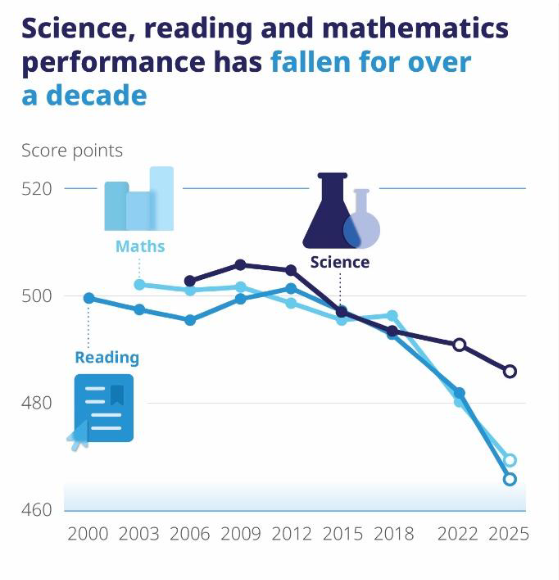
I’ve just spent a few hours reading the PISA 2025 report, and the ongoing decline in performance continues to shock.
Reading scores across the OECD have fallen from 489 to 461 points since 2015, equivalent to more than a full year of learning. Science dropped from 489 to 482. Maths fell from 485 to 463. One in five 15-year-olds across the OECD now can’t reach a basic level of proficiency in any of the three subjects, up from one in six just three years ago. After nine or ten years of formal schooling, a fifth of learners can’t follow a simple text or reliably interpret a graph. What an enormous waste of opportunity (and $100k per child).
Reading has fallen furthest and fastest of the three. Between 2018 and 2025 it dropped in three out of four education systems with comparable data. It wasn’t disadvantaged students who fell hardest, but students from wealthier families. Something is happening to an entire generation, cutting across income lines.
Why reading is falling off a cliff
The report looks at this through four inter-connected dimensions:
Students. There isn’t a uniform decline in ability. There’s a decline in stamina. Students are still fine at locating a single fact in a short passage. Where they’re losing it is on long texts that demand evaluation, reflection, pulling information together across sources. The share of “hasty readers”, kids who blast through a question and get it wrong, grew from 7% in 2018 to 11% in 2025. Fluent, accurate readers dropped by seven percentage points over the same period.
Classrooms. Teachers are spending more time managing disruption and less time teaching. TALIS 2024 puts the number at 16% of class time spent on discipline in 2024, up from 13% in 2018. Bullying and verbal abuse in schools dipped during the pandemic and have since crept back up, and the countries where student-reported threats rose the fastest are the same ones where reading scores fell the hardest.
The system.Classrooms are more mixed than they used to be. There are more refugee students, more non-native speakers, more students with special needs. Diversity isn’t the problem on its own; PISA is explicit that it doesn’t explain the decline by itself. What’s compounding it is that a lot of systems have simultaneously pulled back on using performance data to guide teaching.
Culture.Reading enjoyment has been sliding for over a decade, actually among students and parents. Fewer books, fewer print magazines, less fiction, more short, functional, digital reading. The cohort sitting the 2025 test was born around 2009. They’ve never known a world without a smartphone in the house.
Where AI and screens actually fit
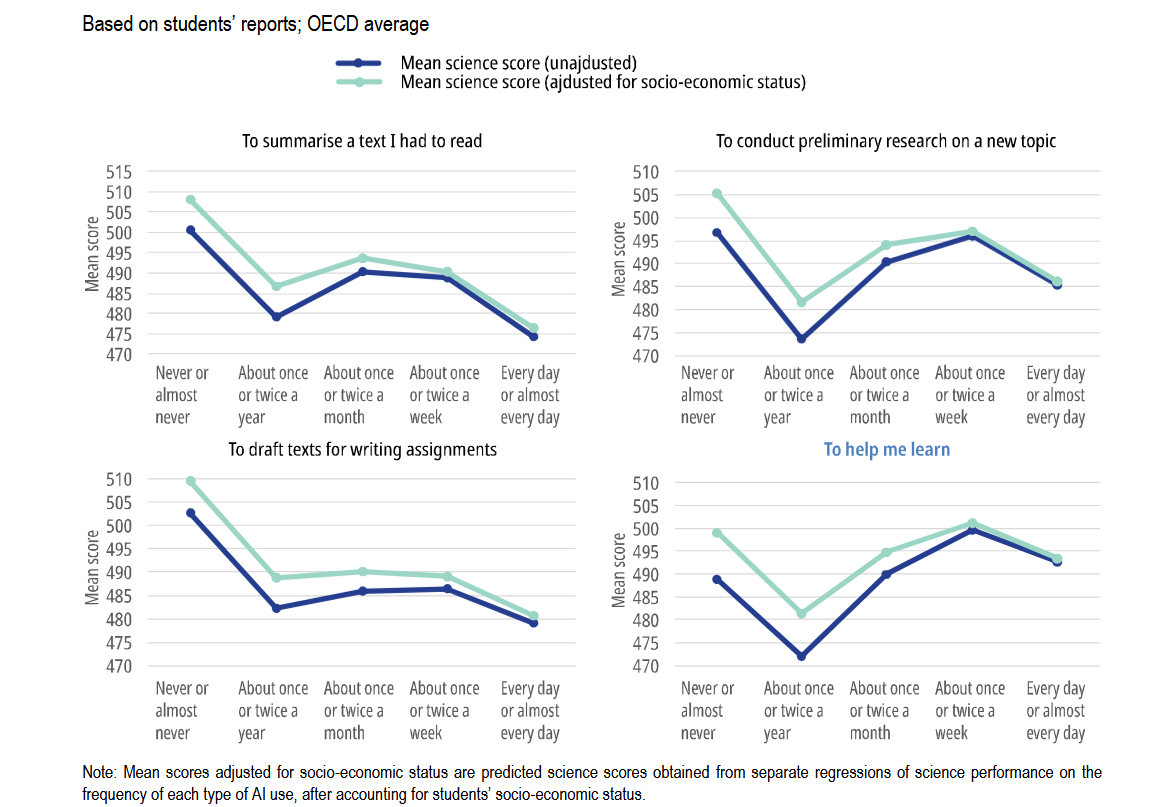
The headline finding on AI chatbots is that students who don’t use them for schoolwork tend to outperform students who do. Among students using AI generally “to help me learn,” it’s the moderate users rather than the heavy users or abstainers, who come out on top.
Mean score in science, by frequency of AI use for schoolwork
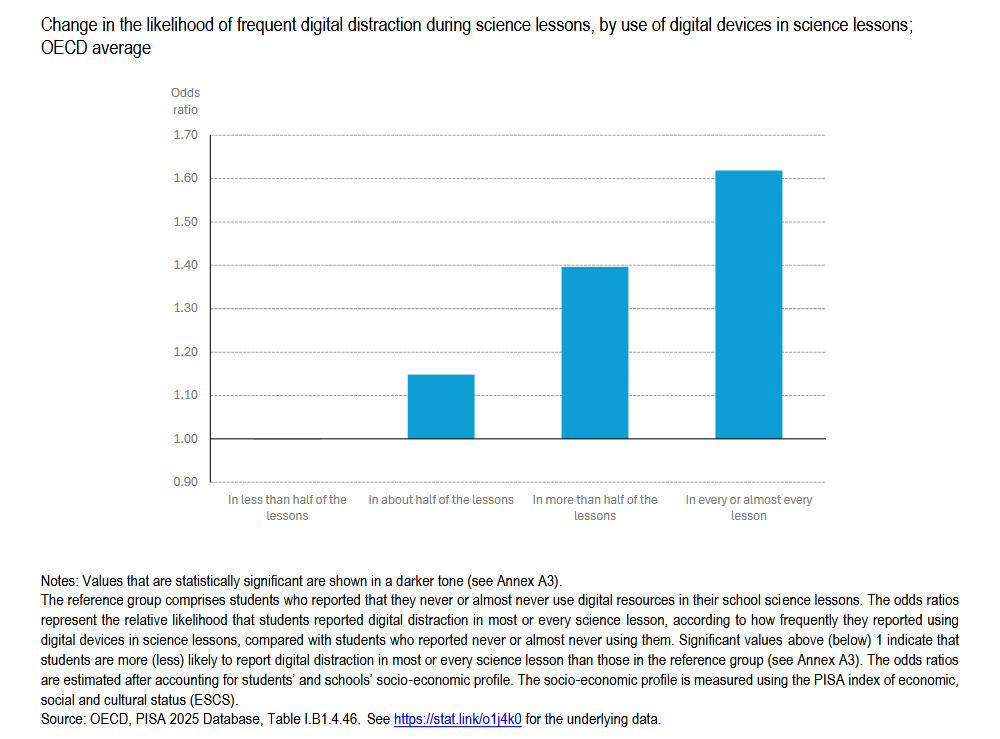
The same pattern shows up with digital devices more broadly: moderate use for learning is associated with better outcomes, heavy use or leisure use during class time is associated with meaningfully worse outcomes. Distraction kills attention kills outcomes. 28% of students across the OECD say their classmates are distracted by devices in most or every science lesson, and in roughly two-thirds of countries, that distraction correlates with lower scores.
Distraction kills attention kills outcomes
The report’s framing of the use of GenAI is worth remembering and quoting directly:
“The patterns are complex, and depend a lot on how GenAI is used, but the bottom line is simple: In the same way that we do not become fit by watching sports but by doing sports, learning does not occur through the consumption of content, but as a productive cognitive struggle of the mind with new material. Where technology enables or enhances that cognitive struggle, students will advance. Where technology short-circuits the productive struggle of learning, it will undercut students’ development. If we get this right, AI becomes a scaffold, not a crutch. A tool for thinking, not a substitute for it. And education remains what it has always been at its best: a human endeavour, powered by judgment, relationships and trust.”
Actually the skills that seem to be deteriorating the most are precisely the skills that require sustained cognitive effort.
This is very close to the argument I’ve been making recently in
If I had school-age children today, I’d protect their reading time fiercely. It would be non-negotiable, daily, and mostly on paper. Students who read fiction and longer texts perform better, and those who read primarily on digital devices or rarely, perform worse, even after accounting for background.
I wouldn’t ban AI. I’d insist it comes after the struggle, not instead of it. Write the draft first, then let AI critique it, not the other way round.
Every device would come with a genuine off switch during homework and during school hours, because the correlation between leisure screen use during lessons and weaker performance is brutally clear.
I’d talk to them about what they read, because the one thing that seems to move the needle across every layer of this is whether an adult remains engaged and interested.
But none of this guarantees anything. The issue at hand here isn’t resources. The kids losing ground fastest right now are disproportionately the wealthy ones with every advantage. The issue is attention. There’s probably not much I could do to fully insulate my own children from a culture built to claim attention. But I would make every effort to set clear boundaries around undisrupted reading and engaging with them on what they have read.
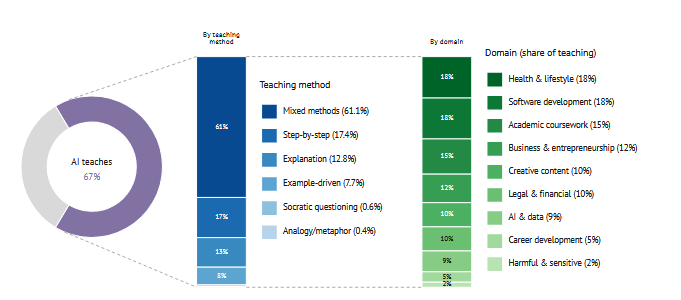
The researchers analysed almost 250,000 real-world conversations with Claude. Rather than looking at what AI could do in a controlled experiment, they looked at what people were actually doing with it.
There’s quite a lot of learning going on.
In 67% of learning and upskilling conversations, Claude engaged in some form of teaching. This wasn’t just school or university work. Software development, health and lifestyle, and business were among the most common areas.
The most common approach was combining conceptual explanation with step-by-step guidance.
So far, so good. But teaching and learning are not the same thing. I can ask AI to explain how something works. I can also ask it to do the work for me. The two interactions might look superficially similar, but the consequences for learning are very different.
Then I read that almost half of the conversations involved some form of friction. The AI misunderstood the question, made a mistake, couldn’t do what the user wanted, or perhaps the user’s instructions weren’t clear enough.
Normally, we think of this as something technology should get better at eliminating. However, in 78.7% of these cases, users tried to recover from the problem, and when people challenged the AI’s reasoning, those attempts were successful 81.5% of the time.
This is much more interesting than the headline that AI can teach.
Resistance is not futile
Use of AI in learning often looks like this: Ask a question. Get an answer. Move on.
There is a more productive version: Ask a question. Get an answer. Notice something doesn’t make sense. Challenge it. Work through the disagreement. Correct the answer.
The second interaction looks rather like learning. There is effort, uncertainty, feedback. There is the possibility of being wrong. The learner still has to think.
Are we using AI to make learning more effective, or to make tasks more efficient?
A student who uses AI to produce a better piece of homework may well get a better piece of homework. But that doesn’t tell us whether the student has become better at the underlying task.
On the other hand, an AI system that helps a student formulate a question, tests their understanding, gives them feedback and challenges their reasoning could potentially be a very powerful learning tool.
The difference is what the human is doing.
The answer isn’t to keep AI away from learning. Quite the opposite. The potential is enormous. But we should be careful about celebrating every reduction in effort.
Effort is the point. Productive effort drives learning.
If AI removes all of it, we may discover that we have superficially made learning “easier” but also thrown the baby out with the bathwater.
AI can teach.
But can we use AI to make learning easier without taking the learning out of it.
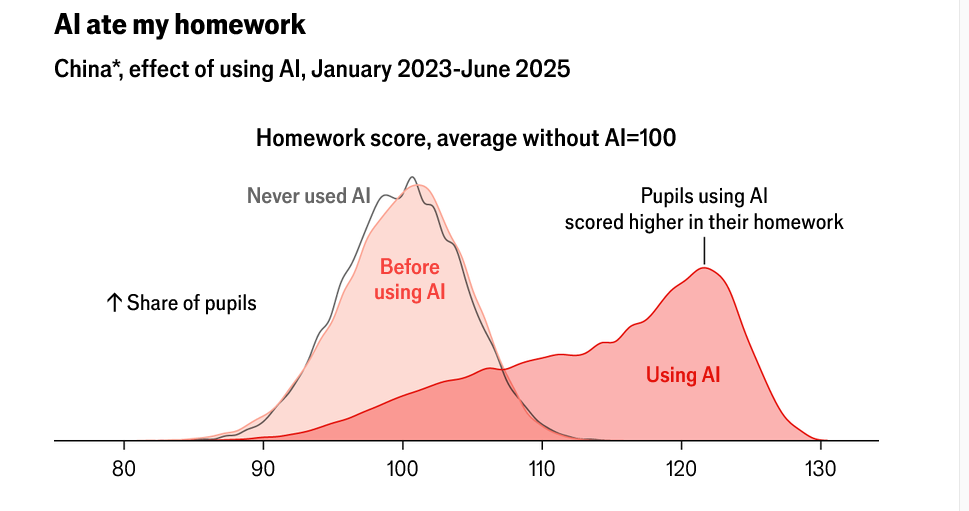
I was struck by a recent article in the Economist about whether AI is stopping children from learning.
The headline finding is extraordinary.
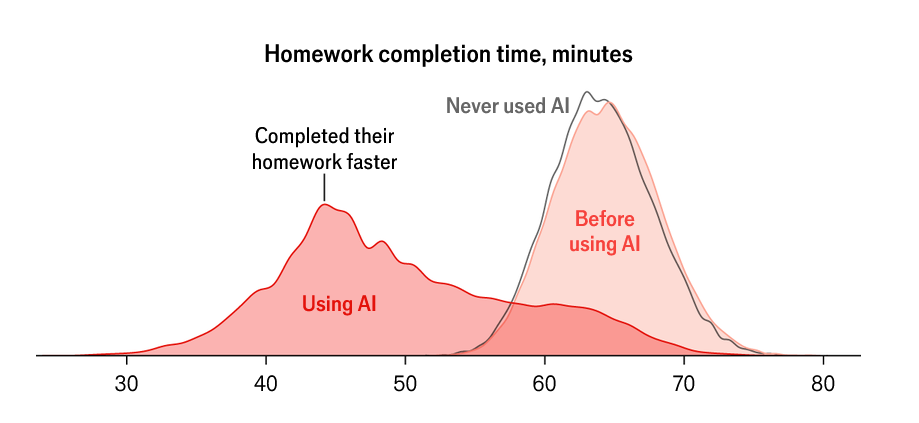
Recent research, based on 30 months of data from 26,811 Chinese secondary-school students, found that after adopting generative AI, students’ homework scores increased (on average by 18%), while the time they spent doing their homework fell (by 30%).
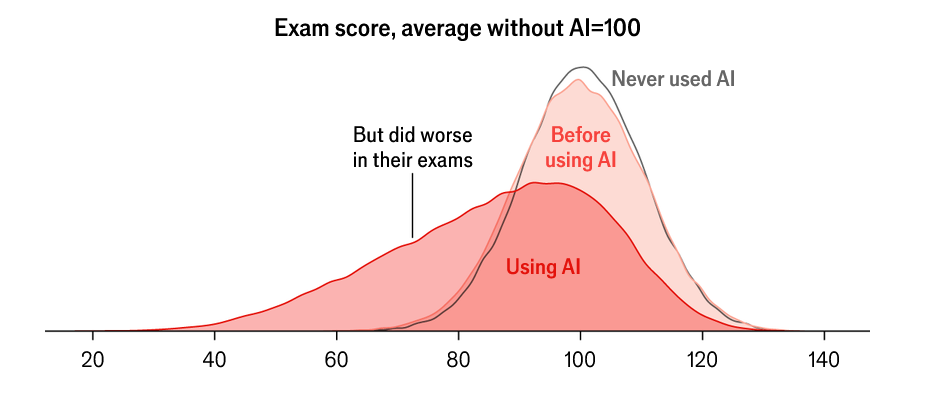
So far, so good. Except that their exam scores subsequently fell by 20%.
In other words, students were producing better homework, faster, but learning less.
The authors found that the problem was concentrated among students whose behaviour was consistent with outsourcing their homework to AI. Those who used AI but continued to spend roughly the same amount of time on their work experienced only small learning losses.
The Power of Productive Struggle
This made me think about productive struggle.
Learning is not simply about getting the right answer. It involves building and retrieving knowledge, making connections, trying something, getting it wrong, receiving feedback, revising your thinking and trying again.
That process requires effort and involves some friction or struggle. In the case of learning, in contrast to that of work, that effort is not a bug in the process but rather a key part of it.
This is consistent with the idea of “desirable difficulties” developed by Robert and Elizabeth Bjork: conditions that make learning feel harder or less efficient in the short term can, under the right circumstances, produce more durable learning.
The Tutoring Paradox
I keep coming back to Benjamin Bloom’s famous “2 sigma” research. Bloom found remarkably large gains from one-to-one tutoring compared with conventional classroom instruction. Shouldn’t using AI (tutors) result in similar learning gains?
That would be the Holy Grail, but maybe we’re not there yet. Tutoring isn’t simply a matter of giving each student the right answer. The tutor continually diagnoses where the learner is, asks questions, provides feedback, adjusts the level of challenge and keeps the learner engaged in the task. There is a human relationship involved too.
This is the question for AI in education. How can AI provide the benefits of a tutor without removing the struggle that makes the learning happen?
Augmentation Works
Interestingly, a recent randomised experiment by Zara Contractor and Germán Reyes found that students using AI to learn an unfamiliar subject performed better on subsequent unaided knowledge tests, with the gains persisting a week later. But the strongest delayed gains came from students who used AI to augment their learning. For example, by asking it to explain concepts rather than using it to automate the production of their work. The authors found that AI users shifted time away from drafting and towards reading and searching for information.
To Be or Not To Be
We should ne distinguishing between AI that does the thinking for you and AI that makes you think better.
If we optimise education for productivity (higher homework scores in less time) we may accidentally optimise away something much more important: the learning itself.
Today was my last day as Chairman of Infinitas Learning — and the end of an important chapter for me in educational publishing, following my earlier years as CEO of Sanoma Learning.
Those who know me well know how passionate I am about learning, and about the role organisations like Infinitas and Sanoma play in supporting learner outcomes and helping teachers in their vitally important work.
Following its acquisition by NPM Capital as lead investor, we have doubled the size of the business, including expanding into Portugal and Poland. Working on that growth — alongside the company’s digital and, more recently, its AI transformations — has been especially rewarding. There are enormous opportunities ahead to better support both teachers and students.
Most of all, I’ve valued the people. My colleagues at Infinitas and NPM Capital have been outstanding, and I’m genuinely grateful to have been part of the journey. I wish them every success for the future.
Over the past 15 years leading and chairing organisations in edtech and learning, I’ve accumulated hard-won experience in leadership, transformation, and what it takes to grow — both as an organisation and as a person. And I’m still very much learning. What continues to fascinate me is how much of leadership ultimately comes down to learning.
In the next phase, I want to put that experience to work more directly through coaching and mentoring, alongside my ongoing board commitments in edtech, including as Chairman of Ovivio.
Where I’d most like to help: > Executive transition coaching — supporting leaders stepping into C-suite or senior roles for the first time. > Strategic leadership — working through the real complexity of leading organisations through change. > Personal effectiveness — helping leaders perform at their best.
For mentoring, my focus will naturally remain close to education and edtech (while avoiding conflicts with Infinitas or Ovivio). For coaching, the methodology is different, and I am keen to work more broadly across sectors — including healthtech and business services.
If any of this resonates, or if you simply want to catch up, feel free to reach out here or directly at: johnmartin@contentconnected.com
AI in education is often framed as a battle between humans and machines. Based on conversations with teachers, founders and investors over the past year, I believe the real opportunities lie in partnership, not replacement.
The OECD’s Digital Education Outlook 2026 frames AI’s role in relation to teachers across three paradigms: replacement, complementarity and augmentation. But there’s a second often overlooked dimension: institutional embedding. Moats in education aren’t built on technology or data alone, but on alignment with pedagogical goals, curricula, regulations & governance, procurement processes and professional practice.
1. Replacement — The Productivity Play
In replacement, AI automates tasks historically done by teachers. For example, grading, summarising texts, preparing lessons, generating worksheets and providing basic feedback loops.
This is where much of today’s AI attention is focused. Tasks that were once labour-intensive can now be executed quickly using general-purpose large language models.
However, technology that replaces discrete tasks can be easy to replicate. Application-layer companies that don’t control workflow, data or distribution potentially become interchangeable.
2. Complementarity — Enhancing the Teacher
Complementarity is where AI does not replace teachers but meaningfully enhances their capacity. For example:
turning classroom data into real-time insights
tracking student progress against goals
flagging risks and opportunities
designing targeted interventions
Here, teachers retain judgement while AI expands insights and sharpens execution. The result? More impactful and stickier solutions because:
the solution integrates with daily workflows
the value is tied to teacher judgement, not automation
switching costs rise as the technology adapts to context
integration with existing systems (LMS, assessment frameworks, schedules) deepens.
In Europe especially, where education systems are fragmented by language, standards and national curriculum requirements, this tailored integration is the key to durability.
3. Augmentation — Supercharging the Teacher
Augmentation involves human–AI co‑evolution: AI learns from teacher feedback over time, adapts to their pedagogical style, and augments their professional practice in ways that produce outcomes neither could achieve alone.
In theory, this is the next frontier.
But the evidence suggests caution. Recent cross‑sector analyses have found that human–AI teams often underperform the better solo performer — not because AI is weak, but because synergy is hard to design and requires:
structured feedback loops
task‑specific modelling
data that is pedagogically meaningful
long‑term usage and refinement.
These conditions are relatively rare — and do not emerge automatically from generic chatbots. Consequently, many augmentation efforts risk failing before a few succeed spectacularly.
This layer will be hard to build, slow to monetise, but potentially transformative if it materialises. The Holy Grail, but not for the faint-hearted investor.
But even the most advanced augmentation tools will fail if they don’t address a deeper challenge: institutional embedding.
The Overlooked Dimension: Institutional Embedding
If replacement, complementarity and augmentation describe how AI interacts with the teacher, the moat is arguably how deeply a solution embeds in the system.
Edtech solutions thrive where:
curriculum alignment exists
pedagogical norms reinforce its use
there are many rules and regulations
procurement frameworks are understood and effective go-to-market capabilities are developed and in place
teacher support boosts adoption
governance structures (schools, districts, ministries) endorse and fund it
Know-how about working with institutions and alignment with standards determine durability.
This is particularly true in Europe, where:
education is governed nationally and regionally
language and curriculum diversity creates product differentiation challenges
procurement cycles are long and complex
teacher autonomy is the norm.
A solution that is embedded institutionally — even if technically less advanced — will often outlive and outperform one that is technically stronger but misses the expertise around the institutions it is designed to serve.
This is where real moats are built.
The next edtech winners won’t rely on algorithms alone. They’ll succeed by understanding that the best AI doesn’t replace teachers or even just work for them. It works with them.
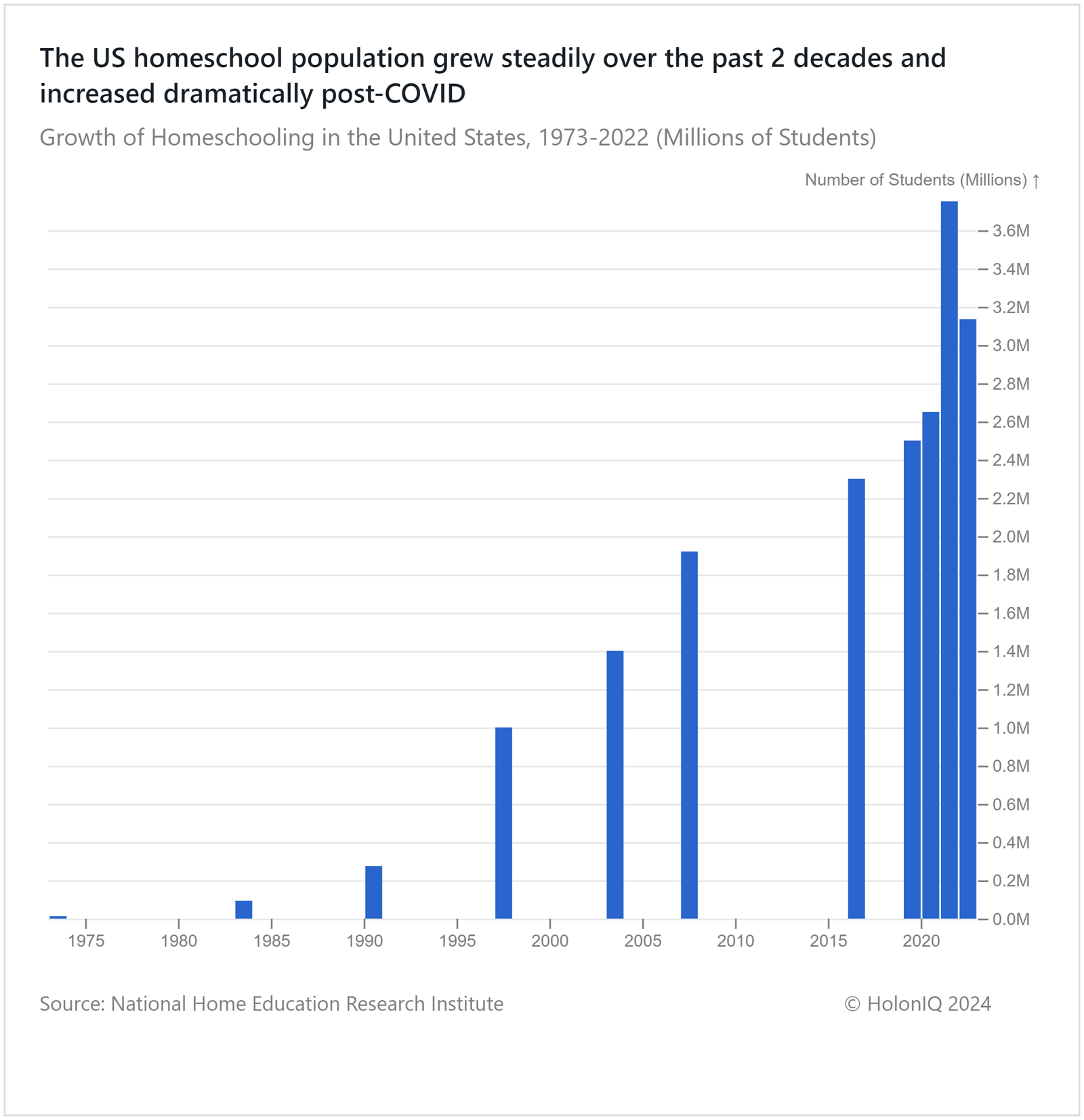
Homeschooling is becoming mainstream in many countries including the USA, Canada, UK, Australia and New Zealand, where demand is increasing and well-established legal frameworks are in place. In the USA about 3 million students (6% of total) were homeschooled in 2021-2022, an increase of 25% from 2019-2022 and a step increase from the trend growth rate of 2-8% per year since the 1990’s.
Why homeschool?
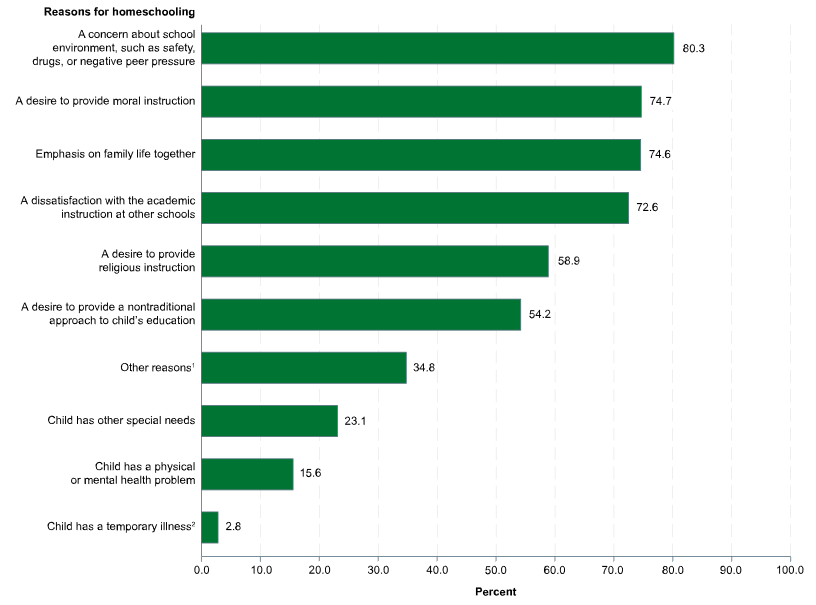
Research from the National Center for Education Statistics from 2022 shows that four of the five most popular reasons why parents decide to homeschool their children are social-cultural rather than academic:
concerns about the school environment (safety, drugs, peer pressure)
wanting to provide moral instruction
emphasis on a family life together
wanting to provide religious instruction.
In the meantime, growth in the market for education technology solutions, in part further stimulated by the pandemic, has ensured that good quality learning resources are available at scale in the home environment, thereby lowering this particular former barrier to homeschooling.
“Old school”, “new school”, “not school”?
The trend towards homeschooling reminded me of the scenario planning we had done at Sanoma about the future of education some 15 years ago, especially considering three main scenarios i) “old school” ii) “new school” and iii) “not school”. I had personally not expected the “not school” model to break through due to the high value-add of the professional teacher and the high economic and organisational implications for the family (typically requiring one parent to stay at home). I had expected technology to underpin the further development of all three scenarios but had not foreseen the pandemic nor the increased polarisation of society at the time, which are surely factors that have made some impact on the growth of homeschooling.
I wonder what the trend to homeschooling might mean for homeschooled children and families? What impact will it have on public education systems and society as a whole?
Should we take the child out of the school, or bring the parent into the pedagogy?
School is in some ways already a limited intervention in the learning and development of a child, after all more than 80% of their time is spent outside of school. To what extent might approaches that encourage greater parental engagement in education help to support the learning of the child and help to remedy some of the social and cultural concerns that some parents have about schools?
It seems likely that more hybrid models might emerge, combining the professional and economic benefits of the school with the social and cultural engagement of the family. Typically, an encouraging home environment, a high level of personal attention and more personalisation, tend to support learning. Have we “outsourced” too much to schools? Especially in a world of increasing teacher shortages, might greater involvement of parents be part of the solution?
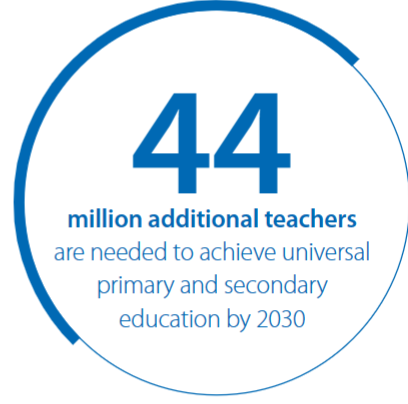
According to UNESCO in a report published this week, we need to attract no less than 44 million additional teachers into the profession to achieve universal primary and secondary education by 2030.
¡Viva la profesora!
Put in to context, that’s more than half the size of the current global workforce of teachers (about 77M) and roughly the population of Spain!
Hello, Goodbye
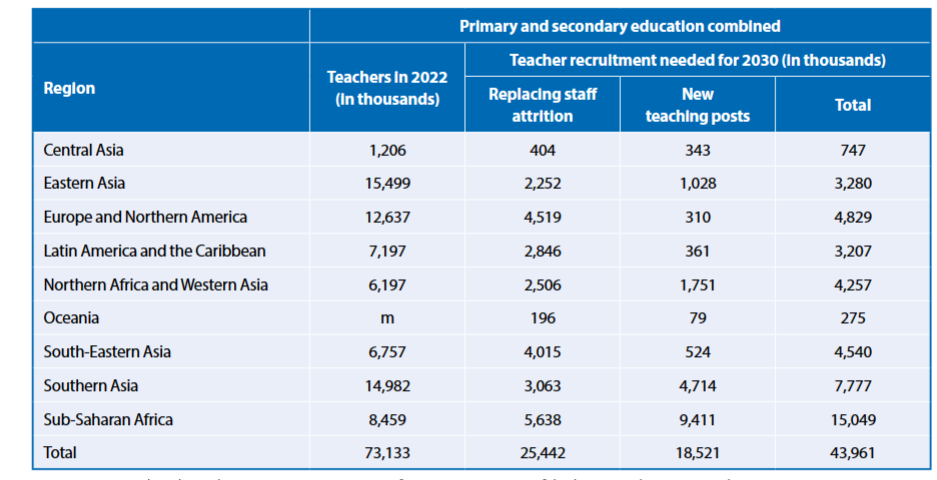
The gap is caused by two main factors (with the impact and underlying drivers differing significantly by country):
Expansion as demographics push education systems to grow (42% of the 44M), and
Attrition due to teachers leaving the profession (58% of the 44M).
About 1/3 of the total demand for new teachers by 2030 comes from Sub-Saharan Africa (15M additional teachers). This is driven to a significant extent by demographics and growing access to secondary education (62% of the gap is to fill new teaching posts). However 93% of the 4.8M additional teachers required in Europe and North America, are needed because of attrition.
Push, Pull, Personal
There are clearly many factors that affect teacher recruitment, retention, job satisfaction and productivity, often driven by local dynamics. Broadly, the report highlights several “push factors” (e.g. working conditions, teacher well-being), “pull factors” (e.g. remuneration and professional development) and “personal reasons” (e.g. retirement, health, family circumstances) that influence whether people join the profession and how long they stick with it.
Can AI solve the problem?
There isn’t going to be a one-size-fits-all answer to finding 44M new teachers in the coming years. AI can surely help in many areas, such as optimising the recruitment and deployment of the teaching workforce, and saving time on administrative tasks for teachers so they can focus on teaching (about half of the working time of a typical teacher is spent on non-teaching tasks outside the classroom).
However, beware of solutions that completely substitute teachers. The human teacher plays an essential role in the process of learning and coaching. Parents are unlikely to leave their (especially younger) children in the hands of a robot. Larger class sizes will likely exacerbate the negative “push factors” in the teacher workplace.
In my view, solutions that super-charge rather than disintermediate teachers are most likely to succeed.
Imagine all the Teachers
Imagine the positive impact we can make on the prosperity, well-being and sustainability of the next generation across the globe when we ensure universal access to primary and secondary education. On the other hand, imagine what declining levels of literacy and numeracy might mean, not only in a faraway land but in your own neighbourhood.
This is a high impact, solvable challenge. We should give it the priority it needs.
Last week, Brighteye Ventures, a leading European investor in education technology, published the fifth edition of its European Edtech Funding Report. It looks like 2023 might be the trough of the cycle that peaked with the pandemic in 2021, and there are increasingly strong signals of a resurgence in investor appetite in 2024.
Reasons to be Cheerful
After a period of decline, overall new venture funding for European edtech in 2023 surpassed the levels reached in 2020 ($1.2B vs $951M) and the number of deals increased on 2022 (288 vs 256).
About 1/3 of all global edtech deals took place in Europe in 2023 (a record high proportion, up from 21% in 2019), indicating a high level of investor interest in the European market.
International private equity and venture capital investors are currently holding a record amount of dry power, with $2586B ready for deployment at the top 25 PE investors globally.
Resilience?
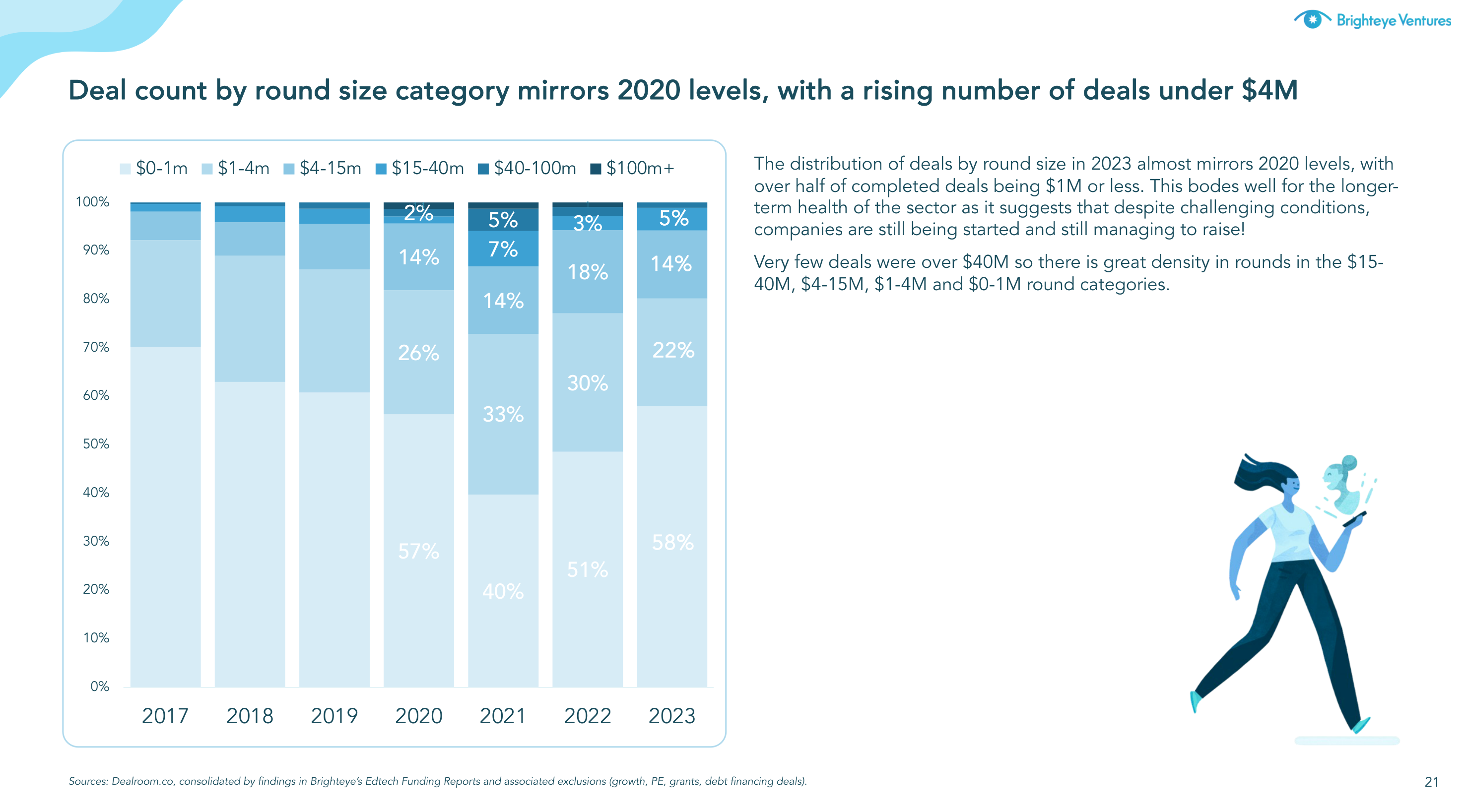
From a European perspective, “resilience in the volume of deals” was driven by a rising number of deals under $4M, with over half of the completed deals being done at $1M or less.
On the micro level of individual businesses, this thinly spread funding might make some sense, yet on the macro level of the industry and the customer, it also highlights part of the European challenge, namely lack of scale. You have to wonder if something substantial and world-class will be built out of some of these tiny deals. Usually “recessions” (possibly a relative term in tech) are a good opportunity for industries to restructure, with strong firms building on their strengths and weaker firms going out of business in what is typically a healthy evolutionary process.
Enable and simplify the work of the teacher
According to some estimates there are currently about 27,500 edtech companies in the K-12 sector, obviously not all deployed in all schools, but it’s not uncommon for schools to use hundreds of digital products. Imagine the life of a teacher. Her first concern is leading a classroom of 25-30 children, which is no mean feat in itself. When she deploys a digital solution it needs to:
a) positively impact learner outcomes
b) be easy to use and
c) ideally save time that she can use for interacting with students.
A teacher is best served by a smaller number of well-performing and frequently-used solutions than a huge toolbox of occasionally-used options.
Build a European Champion
In my view, investors in European edtech should focus on increasing scale and building a handful of segment-specific European/International Champions. At scale, a European Champion has the resources in terms of talent, know-how and money to develop and deploy top-notch learning solutions, yielding excellent learning impact and delivering good financial returns. It’s my hope (and expectation) that a group of investors will take the opportunity at this early stage in the new economic cycle to take our industry and the services we provide to schools to the next level.