Tag Archives: PISA

PISA 2025: Reading is collapsing. AI isn’t the villain.

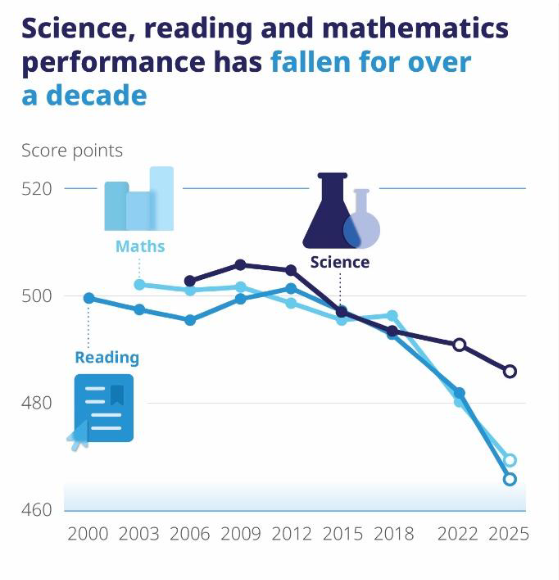
I’ve just spent a few hours reading the PISA 2025 report, and the ongoing decline in performance continues to shock.

Reading scores across the OECD have fallen from 489 to 461 points since 2015, equivalent to more than a full year of learning. Science dropped from 489 to 482. Maths fell from 485 to 463. One in five 15-year-olds across the OECD now can’t reach a basic level of proficiency in any of the three subjects, up from one in six just three years ago. After nine or ten years of formal schooling, a fifth of learners can’t follow a simple text or reliably interpret a graph. What an enormous waste of opportunity (and $100k per child).

Reading has fallen furthest and fastest of the three. Between 2018 and 2025 it dropped in three out of four education systems with comparable data. It wasn’t disadvantaged students who fell hardest, but students from wealthier families. Something is happening to an entire generation, cutting across income lines.

Why reading is falling off a cliff

The report looks at this through four inter-connected dimensions:

Students. There isn’t a uniform decline in ability. There’s a decline in stamina. Students are still fine at locating a single fact in a short passage. Where they’re losing it is on long texts that demand evaluation, reflection, pulling information together across sources. The share of “hasty readers”, kids who blast through a question and get it wrong, grew from 7% in 2018 to 11% in 2025. Fluent, accurate readers dropped by seven percentage points over the same period.

Classrooms. Teachers are spending more time managing disruption and less time teaching. TALIS 2024 puts the number at 16% of class time spent on discipline in 2024, up from 13% in 2018. Bullying and verbal abuse in schools dipped during the pandemic and have since crept back up, and the countries where student-reported threats rose the fastest are the same ones where reading scores fell the hardest.

The system. Classrooms are more mixed than they used to be. There are more refugee students, more non-native speakers, more students with special needs. Diversity isn’t the problem on its own; PISA is explicit that it doesn’t explain the decline by itself. What’s compounding it is that a lot of systems have simultaneously pulled back on using performance data to guide teaching.

Culture. Reading enjoyment has been sliding for over a decade, actually among students and parents. Fewer books, fewer print magazines, less fiction, more short, functional, digital reading. The cohort sitting the 2025 test was born around 2009. They’ve never known a world without a smartphone in the house.

Where AI and screens actually fit

The headline finding on AI chatbots is that students who don’t use them for schoolwork tend to outperform students who do. Among students using AI generally “to help me learn,” it’s the moderate users rather than the heavy users or abstainers, who come out on top.
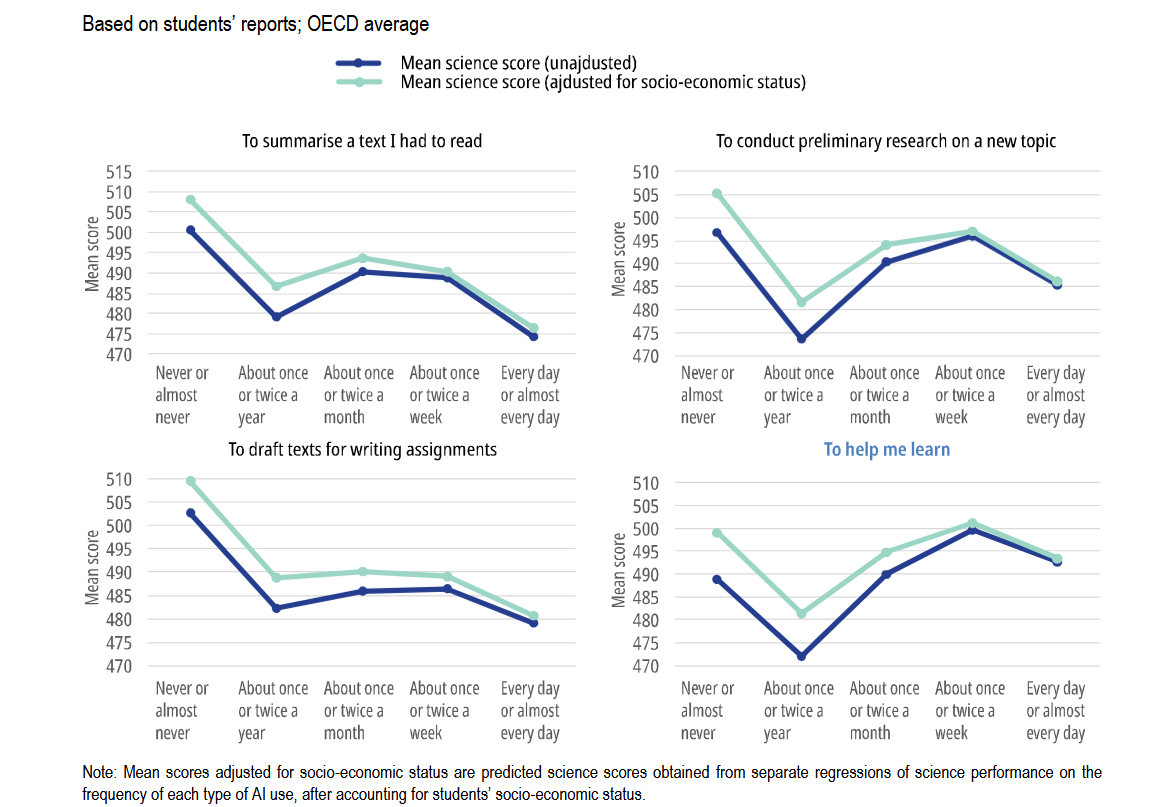
Mean score in science, by frequency of AI use for schoolwork

The same pattern shows up with digital devices more broadly: moderate use for learning is associated with better outcomes, heavy use or leisure use during class time is associated with meaningfully worse outcomes. Distraction kills attention kills outcomes. 28% of students across the OECD say their classmates are distracted by devices in most or every science lesson, and in roughly two-thirds of countries, that distraction correlates with lower scores.

Distraction kills attention kills outcomes
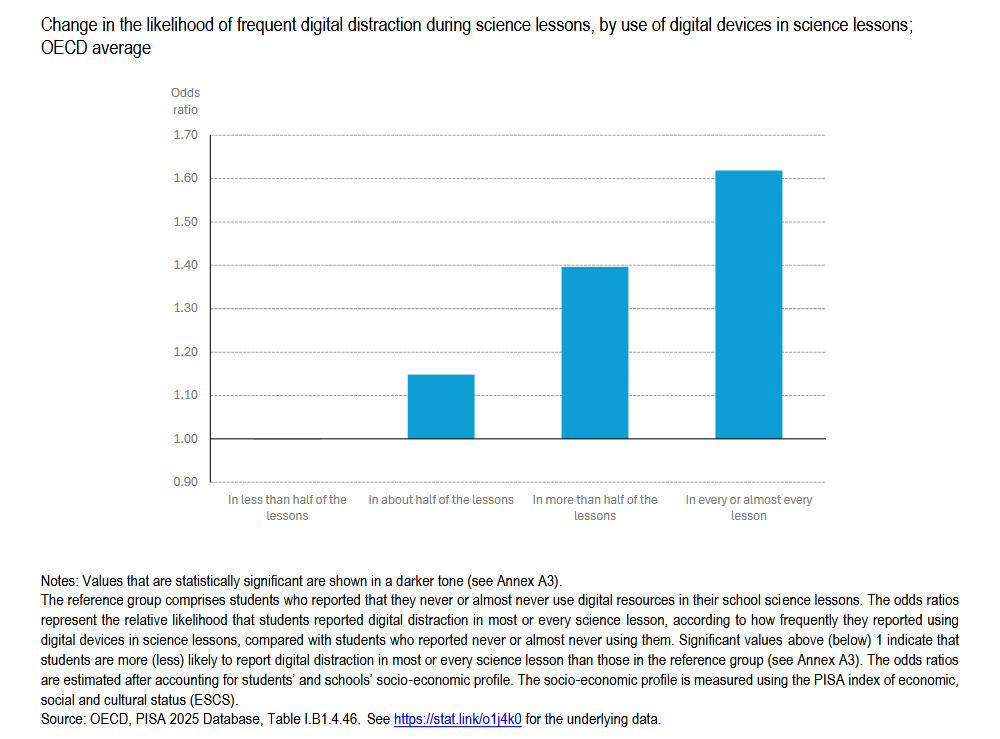
The report’s framing of the use of GenAI is worth remembering and quoting directly:

“The patterns are complex, and depend a lot on how GenAI is used, but the bottom line is simple: In the same way that we do not become fit by watching sports but by doing sports, learning does not occur through the consumption of content, but as a productive cognitive struggle of the mind with new material. Where technology enables or enhances that cognitive struggle, students will advance. Where technology short-circuits the productive struggle of learning, it will undercut students’ development. If we get this right, AI becomes a scaffold, not a crutch. A tool for thinking, not a substitute for it. And education remains what it has always been at its best: a human endeavour, powered by judgment, relationships and trust.”

Actually the skills that seem to be deteriorating the most are precisely the skills that require sustained cognitive effort.

This is very close to the argument I’ve been making recently in

AI in Education: Are We Automating Learning or Augmenting Learners?,

AI and Learning: There’s a Fraction Too Little Friction, and

Cognitive Surrender.

What would I do with my own school-age children?

If I had school-age children today, I’d protect their reading time fiercely. It would be non-negotiable, daily, and mostly on paper. Students who read fiction and longer texts perform better, and those who read primarily on digital devices or rarely, perform worse, even after accounting for background.

I wouldn’t ban AI. I’d insist it comes after the struggle, not instead of it. Write the draft first, then let AI critique it, not the other way round.

Every device would come with a genuine off switch during homework and during school hours, because the correlation between leisure screen use during lessons and weaker performance is brutally clear.

I’d talk to them about what they read, because the one thing that seems to move the needle across every layer of this is whether an adult remains engaged and interested.

But none of this guarantees anything. The issue at hand here isn’t resources. The kids losing ground fastest right now are disproportionately the wealthy ones with every advantage. The issue is attention. There’s probably not much I could do to fully insulate my own children from a culture built to claim attention. But I would make every effort to set clear boundaries around undisrupted reading and engaging with them on what they have read.

Tick Tock, the clock is ticking for a literate society.

“An unprecedented drop in literacy and numeracy across the OECD”

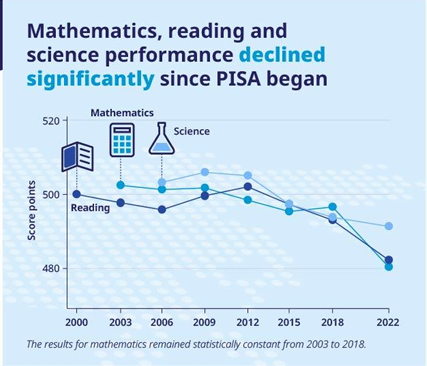
There has been an unprecedented and disturbing drop in average performance for literacy and numeracy in the OECD, as evidenced by recently published research based on data from 2022. https://www.oecd.org/pisa/. Mean performance in mathematics fell by 15 points (equivalent to nine months of learning) and in reading by 10 points (six months of learning loss). Fortunately, average scores for science were maintained.

One in three functionally illiterate

In my home country, The Netherlands, which is one of the richest and most socially progressive places on Earth, with a high commitment to education, the data indicate that one in three students are at risk of being functionally illiterate when they leave school. One in three! That’s up from one in four in the research from 2018. What an enormous loss of potential for these children and our society.  It also makes you wonder how we can spend 12 years and €100,000 per student on education with an outcome that one in three cannot read at the level required to function at school or in society at the end of the journey.

Problem pre-dates pandemic

It would be logical to think that COVID-19 might be the primary cause of this negative development. However, the trend analysis indicates that the decline had begun before the pandemic and peak performance was 10-15 years ago. There are longer-term issues at play. 

Resilience factors could guide the way forward

Some education systems (especially in East Asia and the Baltics) showed both resilience to the disruption from the pandemic, and structurally high learning outcomes. PISA observed 10 factors that contributed to this resilience, and could be helpful in bolstering future approaches, three of which particularly relate to digital, namely:

  1. They ensured good access to skilled teachers, high-quality digital learning materials and devices and developed guidelines for their use.
  2. They limited distractions from digital devices in the classroom (particularly from smartphones and social media) by policies at school.
  3. They prepared students for autonomous and remote learning.

(Screen)-time well spent?

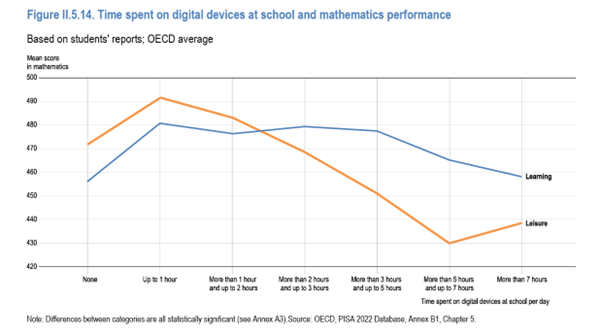
Overall, the evidence shows that using digital/devices for learning purposes in schools yields higher outcomes than not doing so, with the effect tapering off after about five hours per day.  Somewhat surprisingly, the impact of using devices for leisure purposes at school was also correlated with higher learning outcomes, although this turns more sharply negative after about two hours per day.

Most schools have articulated policies about using digital devices on site. However, the least common practices were i) not allowing the use of cell phones (34% of students attended such schools), and ii) having a specific policy about using social networks (51% of students).  In The Netherlands (2022 data), less than 10% of students attended schools where the use of cell phones was not allowed and one in three reported that every or most lessons were disturbed by digital devices.

Tick Tock, the clock is ticking to maintain a fully literate and numerate society

With good quality materials, a focus on learning outcomes and sensible rules of engagement, the use of digital in classrooms enables a positive impact on learning.  

However, smartphones and social media are disturbing the classroom and learning experience and this is likely contributing to why one in three of the kids around here could be functionally illiterate when they leave school.

No time to lose

We need to think again how we systemically approach this better for current and future students and what we can do to bolster the life-chances of this cohort of students with lower literacy and numeracy skills.  Education is a long play, with impact not only on individual lives but crossing generations. There is no time to lose.

Education reform in Finland

kirsi

This week I caught up with Kirsi Harra-Vauhkonen, Managing Director of Sanoma Pro, market leader in Finland. The Finnish market is currently undergoing both a major curriculum change and digital transformation.  I asked Kirsi to explain more about what’s going on.

You’ve got an interesting background Kirsi, including positions at Nokia and Google. Tell us more.

Continuous learning is my passion, and I have been fortunate to be able to gain experience from many different positions. I have worked for example in recent years in telecommunications (Nokia), digital media (Google) and now in educational publishing. During my career, I have worked mostly in commercial and business development leadership roles. Mostly I have been leading change – be it new opportunities in the market, new ways of working or digital transformation.  I am driven by working with great people and teams.

Finnish education has a world class reputation. Why is that?

Finnish pupils have scored highly in the PISA surveys for many years. This is a result of the high quality public education system in Finland. Excellent teachers are one of the most important cornerstones of the system. All teachers have a university degree, and being a teacher is a highly respected profession. The fact that high quality education is available for everyone, is very important for Finland. High quality, versatile learning materials also play an important role in helping pupils and teachers to achieve excellent learning outcomes.

What role does Sanoma Pro play in Finnish education and why are our methods popular?

Sanoma Pro is a major publisher with a very good reputation and the most extensive offering in the Finnish educational market. We publish learning materials for all grades K-12 and also for vocational education. In addition we also have the Oppi & Ilo edutainment line for the consumers as well as tutoring services by Tutorhouse.

Our learning materials are used in almost every school and class, and our digital learning environment has more than 100 000 active teacher and pupil users. Our solutions are developed through very intensive collaboration with our customers, and our authors are the best professionals in their own subjects.

Our solutions are popular because they are high quality, they fit the curriculum perfectly, they are easy to use, and they have a good mix of print and digital elements that match the ways and needs of the classroom.

And they provide excellent benefits by enabling learning impact: they help pupils to achieve good learning outcomes, they engage and motivate pupils to learn, and they save time for teachers in their professional work.


There’s curriculum reform coming this year and next. What’s happening and how are we supporting the change?

The reform is a combination of driving change in the pedagogy and in the learning goals and related learning contents. First of all the reform is encouraging strong engagement of pupils and thus changing the role of the teacher to become more like a coach for the active pupil learners. Another theme is to update the learning objectives to equip children with such skills and knowledge that better meet their needs of the future. Also the need for more theme-based learning is emphasized as well as the aim to bring digital into the everyday work at schools.

We have integrated these themes in our methods, in addition to the new learning contents, and provide a lot of supporting tips and tools to help the teachers to adapt to the new ways of teaching.


What are the most important digital initiatives we are working on?

We are very excited about our new digital learning solutions. It’s now possible to use fully digital learning materials for teaching and learning in all of the primary subjects in the new curriculum. In addition, for the teachers who prefer a hybrid solution, we are launching the gamified, curriculum-fit exercise environment Bingel. Bingel supports seamlessly the Sanoma Pro learning methods and makes exercising engaging and inspiring for pupils.

In upper secondary we have Kompassi, the digital testing and assessment tool that provides teachers an easy way to create and assess tests, saving a considerable amount of their time and providing students with the opportunity to get familiar with the digital testing. The first national digital matriculation tests in Finland will take place this Autumn.

What are you most proud about with Sanoma Pro?

I am very proud of our extremely professional and talented team. Going through a phase of digital transformation in the market simultaneously with the very intensive curriculum change is not an easy task, but the team has shown great effort and we have been able to bring all the print and digital products to the market, while also innovating new concepts.

Our new learning solutions bring a lot of new opportunities and support for the teachers to renew their way of teaching, and to engage and inspire the pupils. I am very proud of this achievement, and having delivered this as a team!


Exciting times

Thanks for talking us through this Kirsi.  These are exciting times in Finnish education and it’s great to hear more about our commitment to working together with our customers in bringing new innovations to the marketGood luck to all our people in Finland!