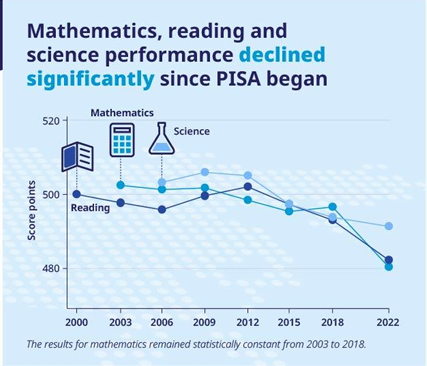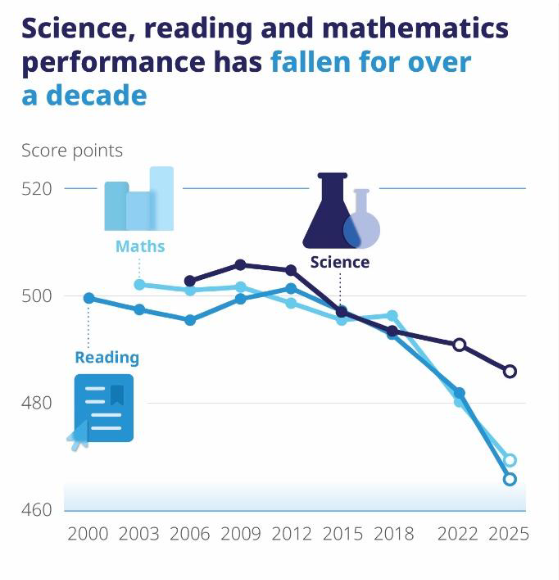
I’ve just spent a few hours reading the PISA 2025 report, and the ongoing decline in performance continues to shock.
Reading scores across the OECD have fallen from 489 to 461 points since 2015, equivalent to more than a full year of learning. Science dropped from 489 to 482. Maths fell from 485 to 463. One in five 15-year-olds across the OECD now can’t reach a basic level of proficiency in any of the three subjects, up from one in six just three years ago. After nine or ten years of formal schooling, a fifth of learners can’t follow a simple text or reliably interpret a graph. What an enormous waste of opportunity (and $100k per child).
Reading has fallen furthest and fastest of the three. Between 2018 and 2025 it dropped in three out of four education systems with comparable data. It wasn’t disadvantaged students who fell hardest, but students from wealthier families. Something is happening to an entire generation, cutting across income lines.
Why reading is falling off a cliff
The report looks at this through four inter-connected dimensions:
Students. There isn’t a uniform decline in ability. There’s a decline in stamina. Students are still fine at locating a single fact in a short passage. Where they’re losing it is on long texts that demand evaluation, reflection, pulling information together across sources. The share of “hasty readers”, kids who blast through a question and get it wrong, grew from 7% in 2018 to 11% in 2025. Fluent, accurate readers dropped by seven percentage points over the same period.
Classrooms. Teachers are spending more time managing disruption and less time teaching. TALIS 2024 puts the number at 16% of class time spent on discipline in 2024, up from 13% in 2018. Bullying and verbal abuse in schools dipped during the pandemic and have since crept back up, and the countries where student-reported threats rose the fastest are the same ones where reading scores fell the hardest.
The system. Classrooms are more mixed than they used to be. There are more refugee students, more non-native speakers, more students with special needs. Diversity isn’t the problem on its own; PISA is explicit that it doesn’t explain the decline by itself. What’s compounding it is that a lot of systems have simultaneously pulled back on using performance data to guide teaching.
Culture. Reading enjoyment has been sliding for over a decade, actually among students and parents. Fewer books, fewer print magazines, less fiction, more short, functional, digital reading. The cohort sitting the 2025 test was born around 2009. They’ve never known a world without a smartphone in the house.
Where AI and screens actually fit
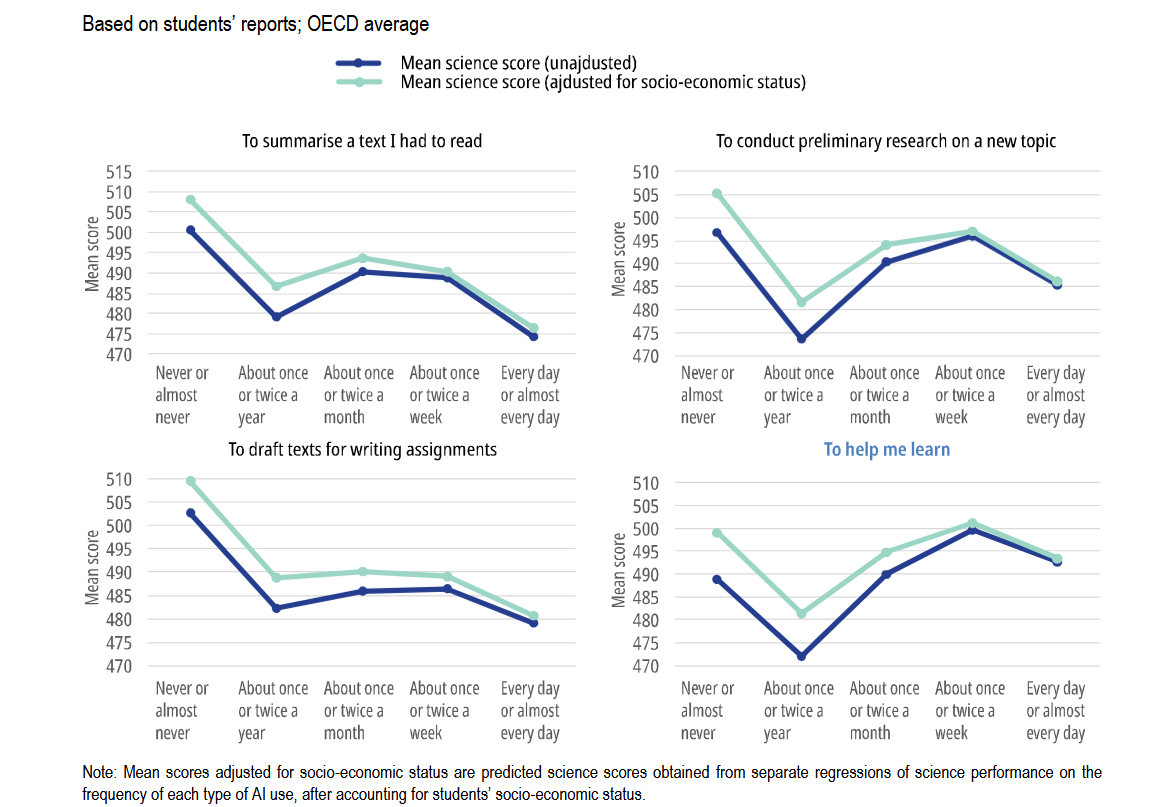
The headline finding on AI chatbots is that students who don’t use them for schoolwork tend to outperform students who do. Among students using AI generally “to help me learn,” it’s the moderate users rather than the heavy users or abstainers, who come out on top.
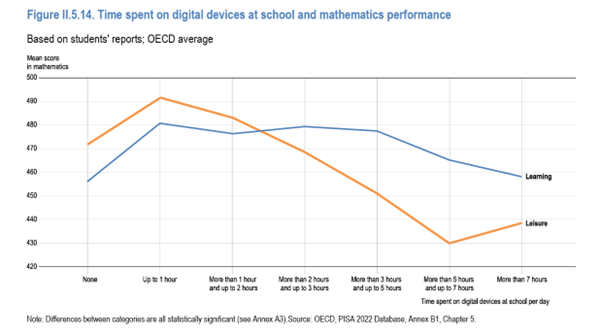
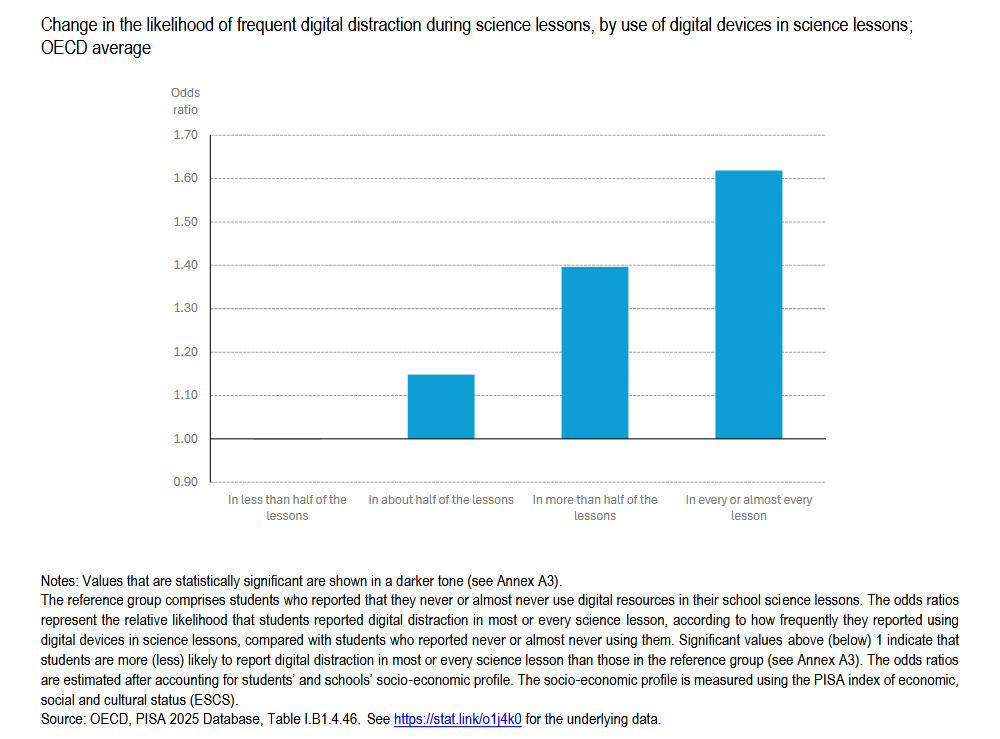
The same pattern shows up with digital devices more broadly: moderate use for learning is associated with better outcomes, heavy use or leisure use during class time is associated with meaningfully worse outcomes. Distraction kills attention kills outcomes. 28% of students across the OECD say their classmates are distracted by devices in most or every science lesson, and in roughly two-thirds of countries, that distraction correlates with lower scores.
Distraction kills attention kills outcomes
The report’s framing of the use of GenAI is worth remembering and quoting directly:
“The patterns are complex, and depend a lot on how GenAI is used, but the bottom line is simple: In the same way that we do not become fit by watching sports but by doing sports, learning does not occur through the consumption of content, but as a productive cognitive struggle of the mind with new material. Where technology enables or enhances that cognitive struggle, students will advance. Where technology short-circuits the productive struggle of learning, it will undercut students’ development. If we get this right, AI becomes a scaffold, not a crutch. A tool for thinking, not a substitute for it. And education remains what it has always been at its best: a human endeavour, powered by judgment, relationships and trust.”
Actually the skills that seem to be deteriorating the most are precisely the skills that require sustained cognitive effort.
This is very close to the argument I’ve been making recently in
AI in Education: Are We Automating Learning or Augmenting Learners?,
AI and Learning: There’s a Fraction Too Little Friction, and
What would I do with my own school-age children?
If I had school-age children today, I’d protect their reading time fiercely. It would be non-negotiable, daily, and mostly on paper. Students who read fiction and longer texts perform better, and those who read primarily on digital devices or rarely, perform worse, even after accounting for background.
I wouldn’t ban AI. I’d insist it comes after the struggle, not instead of it. Write the draft first, then let AI critique it, not the other way round.
Every device would come with a genuine off switch during homework and during school hours, because the correlation between leisure screen use during lessons and weaker performance is brutally clear.
I’d talk to them about what they read, because the one thing that seems to move the needle across every layer of this is whether an adult remains engaged and interested.
But none of this guarantees anything. The issue at hand here isn’t resources. The kids losing ground fastest right now are disproportionately the wealthy ones with every advantage. The issue is attention. There’s probably not much I could do to fully insulate my own children from a culture built to claim attention. But I would make every effort to set clear boundaries around undisrupted reading and engaging with them on what they have read.