Tag Archives: Artificial Intelligence

Cognitive Surrender

Human beings have always used technology to boost their life chances. Initially, we used technology to support our physical needs, through tools and later farming. About 5,500 years ago we started writing, which was built on language and may have been one of the first technologies to support our cognitive capabilities. In more recent times we have given arithmetic to the calculator, navigation to GPS, and retrieval of information to the search engine. Each time, something was lost and something was gained, and mostly we haven’t mourned the loss. I don’t miss doing long division by hand.

AI think therefore AI am

AI is different. It reaches further into the layer of reasoning itself. It can generate the hypothesis, build the argument, critique its own plan, weigh the evidence, and decide what question to ask next. Calculators did arithmetic. AI does some of the thinking.

This can happen in several ways, and the distinction between them is meaningful:

  • Cognitive assistance.Help me solve this problem.” The thinking is still mine; I’ve brought in a tool to sharpen it.
  • Cognitive delegation.Work this out for me and give me the answer.” I’ve handed over the task, but I chose to, and I could take it back.
  • Cognitive dependence.I don’t really want to think this through myself; I’ll ask AI.” The choosing has started to erode. It’s becoming the default, not the decision.
  • Cognitive surrender.AI is better at this than I am, so I’ll defer to it.” A judgement, however implicit, that the machine’s answer is simply more trustworthy than my own thinking would be.
  • Cognitive substitution.I can no longer do this, so will get AI to do it.” This isn’t really a choice anymore. The capacity itself has begun to disappear.

One of the stories we tell ourselves about AI is that it will make people less intelligent. The more likely story is that people gradually stop exercising certain cognitive muscles because they no longer experience any need to. Yet their output keeps rising.

Cognitive Wealth

Should that trouble us? Adam Smith might have recognised the argument. In The Wealth of Nations, he showed how specialisation and the right tools could dramatically increase productivity. A worker doing one narrow task, with the right machinery, could produce far more than a generalist.

If the AI produces a better answer, why mourn the fact that we didn’t work it out ourselves?

But Smith didn’t think rising output settled the matter. In the same book, he warned that a worker confined to a few operations had little occasion to exercise his understanding and could become “as stupid and ignorant as it is possible for a human creature to become.” Smith saw both things as true. Specialisation made us more productive, and it could also make us less capable.

There is an important difference with AI, though. Smith’s worker became narrow in one part of his working life. His broader capacity for judgement remained intact. With AI, what we’re potentially outsourcing isn’t one particular task. It’s the act of reasoning itself. Losing long division doesn’t cost me my ability to think through a difficult decision. Losing the habit of thinking difficult things through might.

Use It, Or Lose It

This is no longer only a philosophical worry. Early evidence points in this direction. A 2025 survey of 666 participants found heavier AI use correlated with lower critical thinking scores (Gerlich, 2025). An MIT Media Lab study using EEG compared essay-writers working unaided, with a search engine, or with an AI assistant, and found the AI-assisted group had the weakest neural connectivity and the lowest sense of ownership over their own work (Kosmyna et al., 2025). Both build on an older, well-established finding: that offloading mental effort onto external tools shapes what a mind stays practised at (Risko & Gilbert, 2016).

Yet, this does not mean decline is inevitable. The flaw in the historical parallel is that Smith’s factory workers were cogs in a physical system they did not control. AI is not a conveyor belt; it is a collaborative partner. The erosion of our critical thinking isn’t an inevitable consequence of the technology. It depends, at least in part, on how we choose to deploy it.

Imagine two people working the same hard problem with AI. The first treats the system as a cognitive replacement: they ask a question, accept the first 30-second response without friction, and paste the output. They have chosen cognitive substitution.

The second treats the system as a cognitive sparring partner. They use the AI to generate counterarguments to their own hypotheses, to stress-test their logic, and to explore blind spots they couldn’t see alone. They might solve the problem in a fraction of the time, but their brain has been actively engaged in an intellectual heavy-lifting session. They have chosen cognitive expansion.

AI has the profound potential to strip away the mechanical, administrative cognitive load we currently carry. By automating the grunt work, it can free up mental space for higher-order judgement, curiosity, creativity, and the fundamental human task of deciding what is actually worth doing in the first place.

The real dividing line of the AI era is not between the technology and us. It is the boundary between using AI to extend cognition versus using it instead of cognition. If we treat AI as an escape from the challenge of thinking, substitution is likely. But if we use it to push our reasoning further than we could go alone, the technology could become a powerful amplifier of human agency.

If AI makes me more capable in practice, while making me less capable without it, have I actually become more capable? The answer depends entirely on which of us is steering the machine.


Notes

  • Gerlich, M. (2025). AI tools in society: Impacts on cognitive offloading and the future of critical thinking. Societies, 15(1), 6.
  • Kosmyna, N., Hauptmann, E., Yuan, Y. T., et al. (2025). Your brain on ChatGPT: Accumulation of cognitive debt when using an AI assistant for essay writing task. arXiv preprint 2506.08872.
  • Risko, E. F., & Gilbert, S. J. (2016). Cognitive offloading. Trends in Cognitive Sciences, 20(9), 676–688.

AI and Learning: There’s a Fraction too Little Friction

I’ve been thinking quite a lot recently about what happens to learning when we introduce generative AI.

My concern is that if AI makes it easier to complete a task, are we also making it easier to avoid the thinking that gets us there?

That’s why I was interested in a recent paper looking at human-AI collaboration at scale.

AI, Claudius

The researchers analysed almost 250,000 real-world conversations with Claude. Rather than looking at what AI could do in a controlled experiment, they looked at what people were actually doing with it.

There’s quite a lot of learning going on.

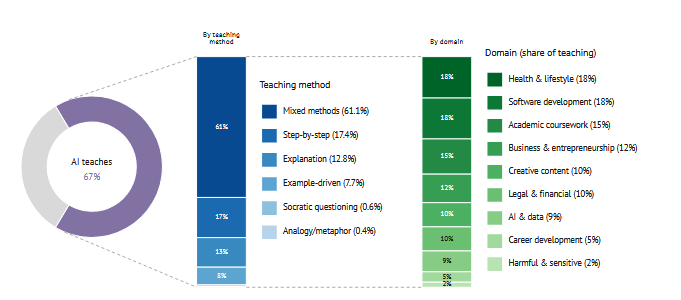
In 67% of learning and upskilling conversations, Claude engaged in some form of teaching. This wasn’t just school or university work. Software development, health and lifestyle, and business were among the most common areas.

The most common approach was combining conceptual explanation with step-by-step guidance.

So far, so good. But teaching and learning are not the same thing. I can ask AI to explain how something works. I can also ask it to do the work for me. The two interactions might look superficially similar, but the consequences for learning are very different.

Then I read that almost half of the conversations involved some form of friction. The AI misunderstood the question, made a mistake, couldn’t do what the user wanted, or perhaps the user’s instructions weren’t clear enough.

Normally, we think of this as something technology should get better at eliminating. However, in 78.7% of these cases, users tried to recover from the problem, and when people challenged the AI’s reasoning, those attempts were successful 81.5% of the time.

This is much more interesting than the headline that AI can teach.

Resistance is not futile

Use of AI in learning often looks like this: Ask a question. Get an answer. Move on.

There is a more productive version: Ask a question. Get an answer. Notice something doesn’t make sense. Challenge it. Work through the disagreement. Correct the answer.

The second interaction looks rather like learning. There is effort, uncertainty, feedback. There is the possibility of being wrong. The learner still has to think.

Are we using AI to make learning more effective, or to make tasks more efficient?

A student who uses AI to produce a better piece of homework may well get a better piece of homework. But that doesn’t tell us whether the student has become better at the underlying task.

On the other hand, an AI system that helps a student formulate a question, tests their understanding, gives them feedback and challenges their reasoning could potentially be a very powerful learning tool.

The difference is what the human is doing.

The answer isn’t to keep AI away from learning. Quite the opposite. The potential is enormous. But we should be careful about celebrating every reduction in effort.

Effort is the point. Productive effort drives learning.

If AI removes all of it, we may discover that we have superficially made learning “easier” but also thrown the baby out with the bathwater.

The interesting question isn’t whether AI can teach: it can.

The question is whether we can use AI to make learning easier without taking the learning out of it.

AI in Education: Are We Automating Learning or Augmenting Learners?

I was struck by a recent article in the Economist about whether AI is stopping children from learning.

The headline finding is extraordinary.

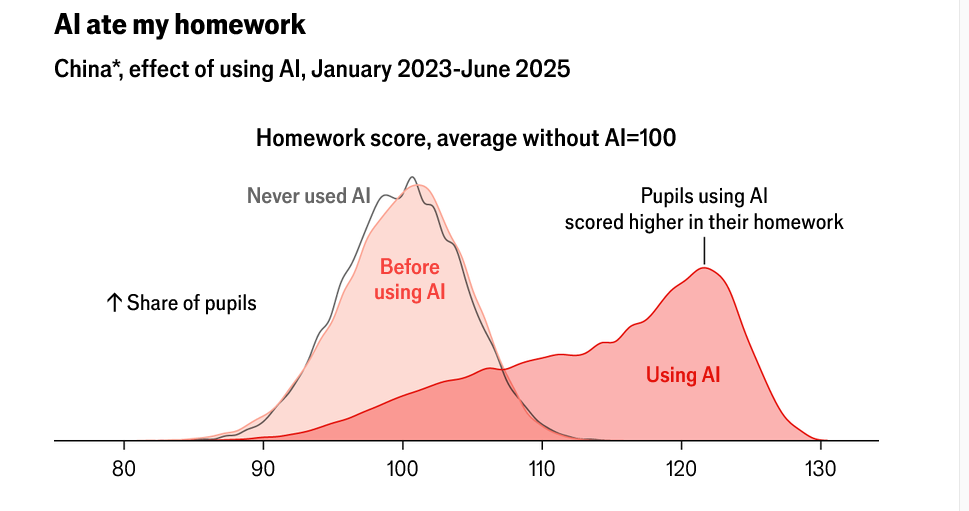
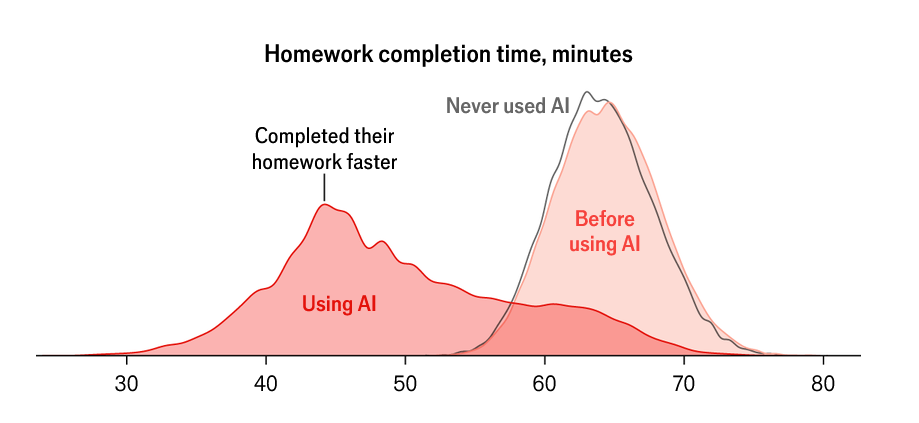
Recent research, based on 30 months of data from 26,811 Chinese secondary-school students, found that after adopting generative AI, students’ homework scores increased (on average by 18%), while the time they spent doing their homework fell (by 30%).

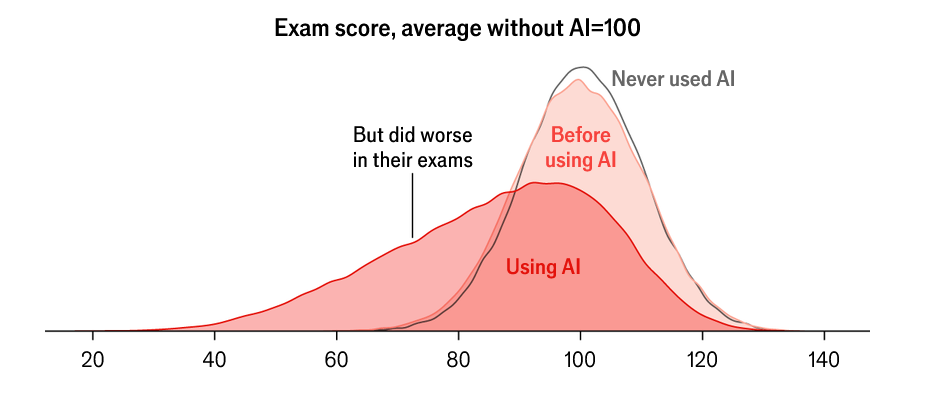
So far, so good. Except that their exam scores subsequently fell by 20%.

In other words, students were producing better homework, faster, but learning less.

The authors found that the problem was concentrated among students whose behaviour was consistent with outsourcing their homework to AI. Those who used AI but continued to spend roughly the same amount of time on their work experienced only small learning losses.

The Power of Productive Struggle

This made me think about productive struggle.

Learning is not simply about getting the right answer. It involves building and retrieving knowledge, making connections, trying something, getting it wrong, receiving feedback, revising your thinking and trying again.

That process requires effort and involves some friction or struggle. In the case of learning, in contrast to that of work, that effort is not a bug in the process but rather a key part of it.

This is consistent with the idea of “desirable difficulties” developed by Robert and Elizabeth Bjork: conditions that make learning feel harder or less efficient in the short term can, under the right circumstances, produce more durable learning.

The Tutoring Paradox

I keep coming back to Benjamin Bloom’s famous “2 sigma” research. Bloom found remarkably large gains from one-to-one tutoring compared with conventional classroom instruction. Shouldn’t using AI (tutors) result in similar learning gains?  

That would be the Holy Grail, but maybe we’re not there yet.  Tutoring isn’t simply a matter of giving each student the right answer. The tutor continually diagnoses where the learner is, asks questions, provides feedback, adjusts the level of challenge and keeps the learner engaged in the task. There is a human relationship involved too.

This is the question for AI in education.  How can AI provide the benefits of a tutor without removing the struggle that makes the learning happen?

Augmentation Works

Interestingly, a recent randomised experiment by Zara Contractor and Germán Reyes found that students using AI to learn an unfamiliar subject performed better on subsequent unaided knowledge tests, with the gains persisting a week later. But the strongest delayed gains came from students who used AI to augment their learning. For example, by asking it to explain concepts rather than using it to automate the production of their work. The authors found that AI users shifted time away from drafting and towards reading and searching for information.

To Be or Not To Be

The real distinction we should be looking at isn’t between “AI” and “no AI”.

It is between AI that does the thinking for you and AI that makes you think better.

If we optimise education for productivity (higher homework scores in less time) we may accidentally optimise away something much more important: the learning itself.

Is the teacher still the ‘killer app’ in the age of AI?

AI in education is often framed as a battle between humans and machines. Based on conversations with teachers, founders and investors over the past year, I believe the real opportunities lie in partnership, not replacement.

The OECD’s Digital Education Outlook 2026 frames AI’s role in relation to teachers across three paradigms: replacement, complementarity and augmentation. But there’s a second often overlooked dimension: institutional embedding.  Moats in education aren’t built on technology or data alone, but on alignment with pedagogical goals, curricula, regulations & governance, procurement processes and professional practice.

1. Replacement — The Productivity Play

In replacement, AI automates tasks historically done by teachers. For example, grading, summarising texts, preparing lessons, generating worksheets and providing basic feedback loops.

This is where much of today’s AI attention is focused. Tasks that were once labour-intensive can now be executed quickly using general-purpose large language models.

However,  technology that replaces discrete tasks can be easy to replicate.  Application-layer companies that don’t control workflow, data or distribution potentially become interchangeable.

2. Complementarity — Enhancing the Teacher

Complementarity is where AI does not replace teachers but meaningfully enhances their capacity. For example:

  • turning classroom data into real-time insights
  • tracking student progress against goals
  • flagging risks and opportunities
  • designing targeted interventions

Here, teachers retain judgement while AI expands insights and  sharpens execution. The result? More impactful and stickier solutions because:

  • the solution integrates with daily workflows
  • the value is tied to teacher judgement, not automation
  • switching costs rise as the technology adapts to context
  • integration with existing systems (LMS, assessment frameworks, schedules) deepens.

In Europe especially, where education systems are fragmented by language, standards and national curriculum requirements, this tailored integration is the key to durability.

3. Augmentation — Supercharging the Teacher

Augmentation involves human–AI co‑evolution: AI learns from teacher feedback over time, adapts to their pedagogical style, and augments their professional practice in ways that produce outcomes neither could achieve alone.

In theory, this is the next frontier.

But the evidence suggests caution. Recent cross‑sector analyses have found that human–AI teams often underperform the better solo performer — not because AI is weak, but because synergy is hard to design and requires:

  • structured feedback loops
  • task‑specific modelling
  • data that is pedagogically meaningful
  • long‑term usage and refinement.

These conditions are relatively rare — and do not emerge automatically from generic chatbots. Consequently, many augmentation efforts risk failing before a few succeed spectacularly.

This layer will be hard to build, slow to monetise, but potentially transformative if it materialises. The Holy Grail, but not for the faint-hearted investor.

But even the most advanced augmentation tools will fail if they don’t address a deeper challenge: institutional embedding.

The Overlooked Dimension: Institutional Embedding

If replacement, complementarity and augmentation describe how AI interacts with the teacher, the moat is arguably how deeply a solution embeds in the system.

Edtech solutions thrive where:

  • curriculum alignment exists
  • pedagogical norms reinforce its use
  • there are many rules and regulations
  • procurement frameworks are understood and effective go-to-market capabilities are developed and in place
  • teacher support boosts adoption
  • governance structures (schools, districts, ministries) endorse and fund it

Know-how about working with institutions and alignment with standards determine durability.

This is particularly true in Europe, where:

  • education is governed nationally and regionally
  • language and curriculum diversity creates product differentiation challenges
  • procurement cycles are long and complex
  • teacher autonomy is the norm.

A solution that is embedded institutionally — even if technically less advanced — will often outlive and outperform one that is technically stronger but misses the expertise around the institutions it is designed to serve.

This is where real moats are built.

The next edtech winners won’t rely on algorithms alone.  They’ll succeed by understanding that the best AI doesn’t replace teachers or even just work for them. It works with them.

Where do you see the biggest opportunities?

Looking forward >>

How will AI impact teachers?

Super-charger

ChatGPT has recently triggered tremendous excitement about AI and its potential impact on education. Much interest has focused on the learner experience, including the ability to personalise learning. There have of course also been concerns around cheating and plagiarism.

However, AI also has the potential to super-charge teachers.

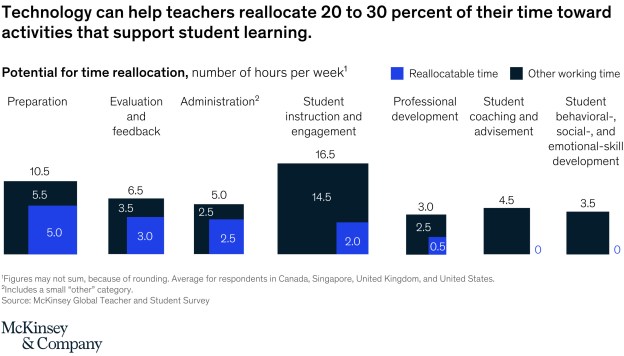
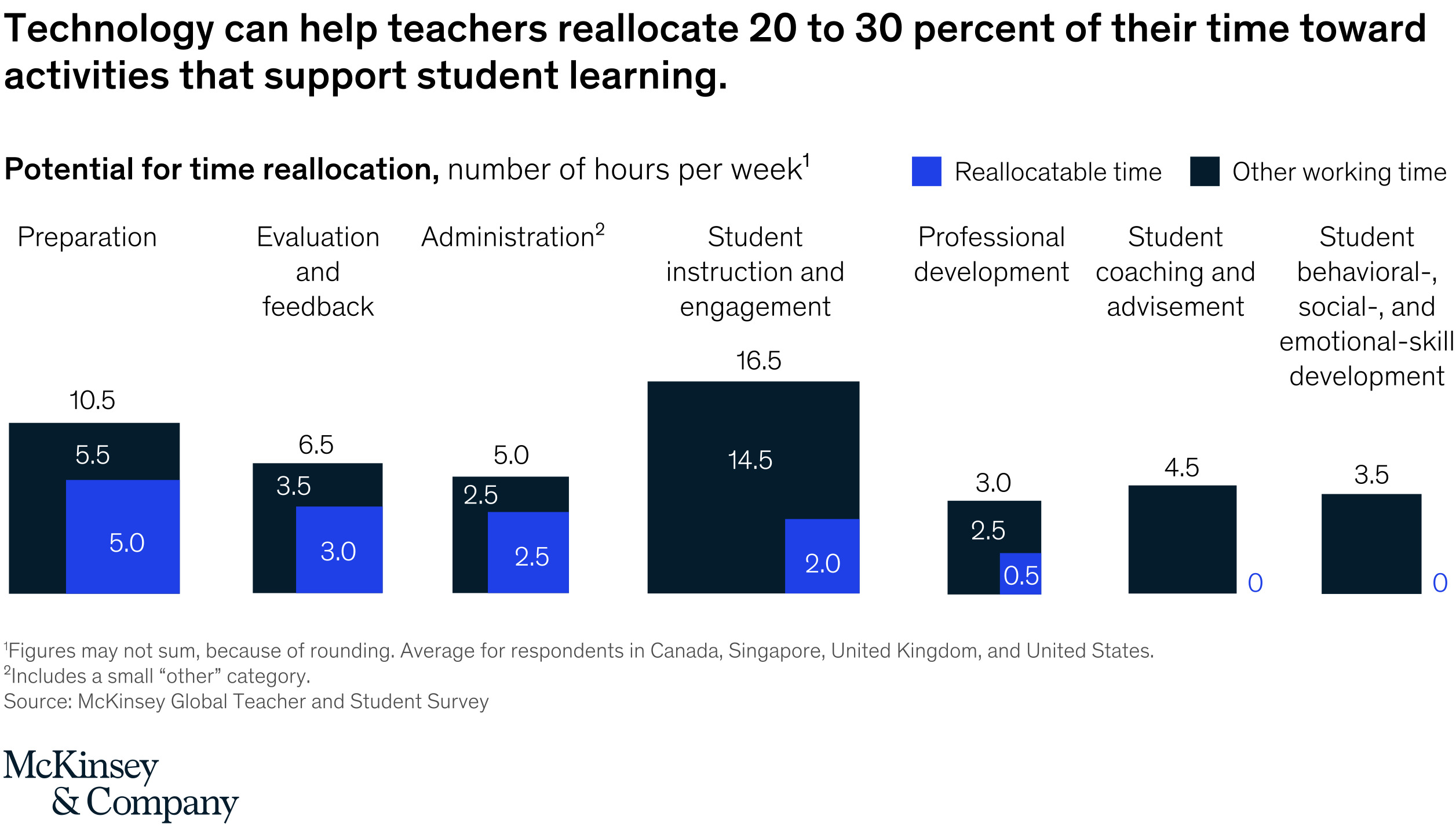
According to McKinsey, 20-40% of current teacher time comprises tasks that could be automated. They estimate that teachers could re-direct approximately 13 hours per week towards activities that raise student outcomes and increase teacher satisfaction.  The tasks of preparing lessons, administration, evaluation and feedback are flagged as high potential for AI.

Love’s Labour’s Lost

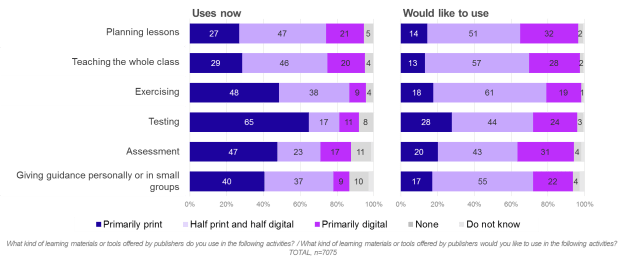
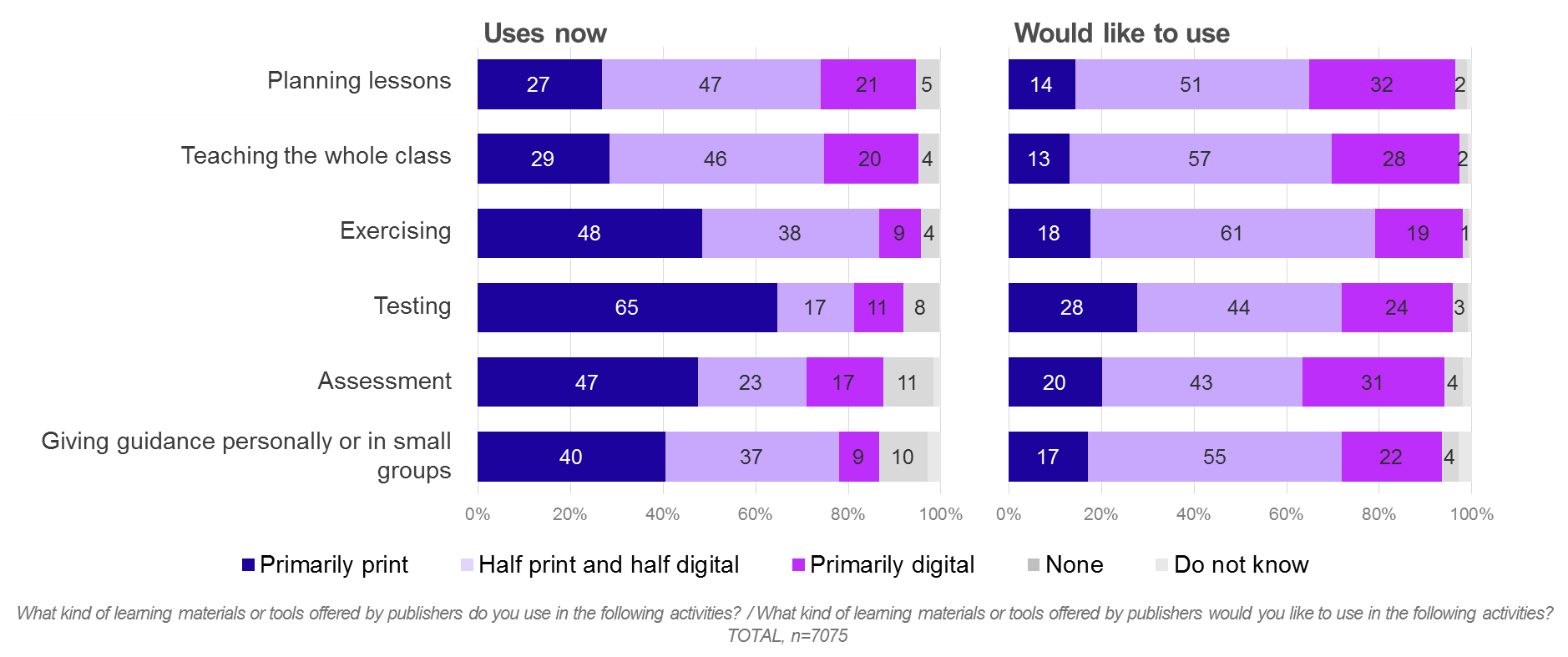
These results echo those of Sanoma’s Learning Impact Survey, in which teachers indicate a desire to go digital in those areas which were most labour intensive, flagging essentially the same areas.  This suggests both that the opportunity is in these tasks and that the profession is looking for solutions.

present_vs_ideal

Teaching profession under pressure

The teacher is arguably the most positive intervention in education.  However the teaching profession faces significant challenges.  UNESCO estimates an additional 69m teachers need to enter the profession by 2030 to fulfil global demand.  In some parts of the world, teacher turnover is high, for example in parts of the USA annual teacher turnover exceeds 15%.  In the UK more than 80% of teachers are considering leaving the profession due to dis-satisfaction.

Higher impact & happier teachers needed!

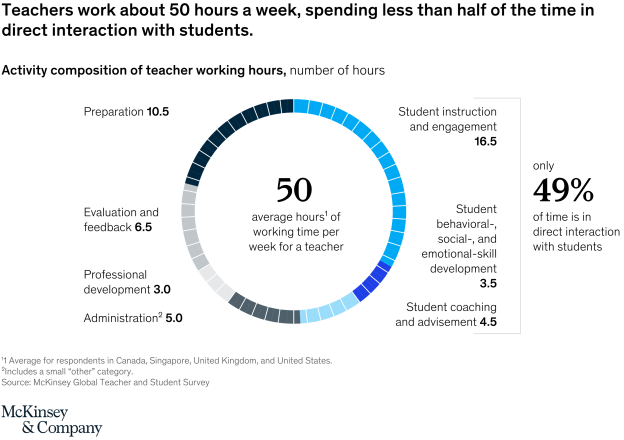
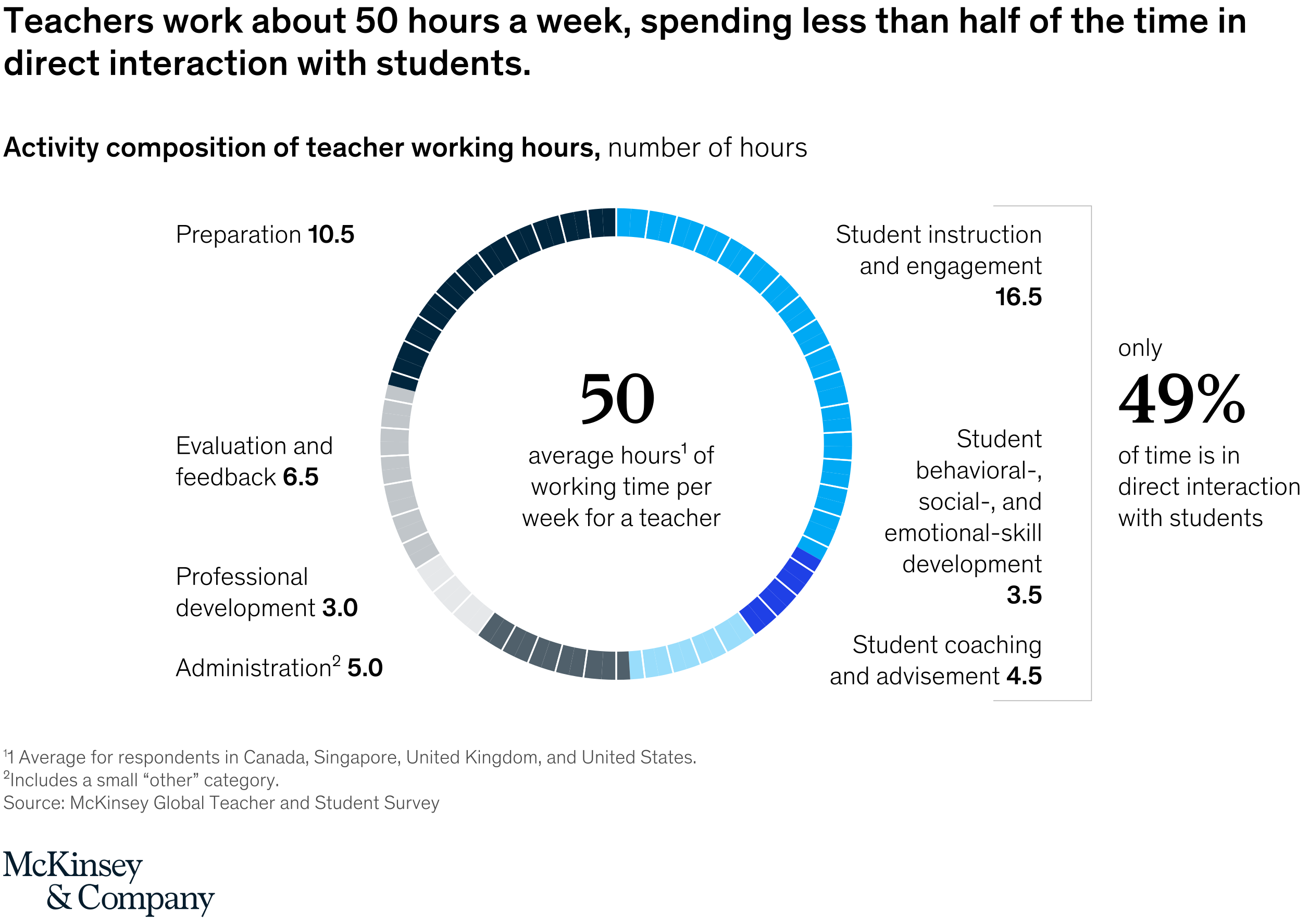
Furthermore, on average teachers spend only half of their time actually teaching.  This represents not only lost productivity from the core task but is also demotivating for many teachers whose passion is to teach rather than the ancillary tasks around it.  Enabling teacher workflow could therefore not only increase productivity but also make the profession more attractive.

SVGZ-AI-boon-Ex1.svgz

$400bn impact & opportunity

The opportunity to solve this productivity gap is huge.  Measured in terms of financials, assuming global spending on education to be some $6trn, of which 45% is on K-12 education,  and of which 75% is spent on staff salaries, this implies a global spend on teaching/staff salaries of some $2trn per year.  A 20-40% uplift in productivity through AI could arguably be worth some $400-800bn per year in terms of paid and unpaid output!  Which is not to say that this is a saving governments could make or a revenue that education companies could earn, because a significant slice of that value should rightfully return to teachers through higher salaries and quality of life, and another part would rightfully get re-directed to teacher-student interaction to increase outcomes and professional satisfaction.

20%

Help the teacher to focus on teaching!

It’s my belief that the teacher will continue to be the killer app in education, and that the biggest opportunity to make not only a positive impact on learning and teaching in K-12 but also to build a successful business, is to enable the workflow of the teacher.  Probably by combining it with the other side of the same coin: the learn-flow (learning experience) of the student.  

Looking forward >>

It will be exciting to see how we deploy AI in the coming years for a positive impact on learning. Looking forward >>.

DeepMind uses AI to understand life.

Life at the molecular level that is.

Last week saw the breakthrough news that Google has essentially solved the protein folding problem with AlphaFold from DeepMind. I was especially interested in this since this was the area of my PhD.

Function follows structure

Proteins carry out a variety of functions from DNA replication to catalysis to structuring the cytoskeleton.  Each protein is built up from a unique sequence formed from 20 different amino acids. Some 200M sequences are currently known, growing by about 30M per year. The chain of amino acids folds into a unique 3D structure.  This structure determines its functionality.

Prediction: the shape of things to come

Some 170,000 protein structures have been determined to date, and DeepMind has used this dataset to create an algorithm which can predict the 3D structure of a protein based only on its sequence of amino acids, to the same level of accuracy as if actually measured using a technique such as X-ray crystallography.  A reasonably sized protein might take as many as 10300 different shapes, so that’s quite a prediction!

This is relevant because understanding the 3D structure of a protein can inform its function and arguably mis-function, thereby potentially accelerating the rational design of interventions such as drugs against disease states for example.  With 200M proteins in scope, the potential for scientific discovery is massive.

Now we can look to Google not only in search of pizza, but also for the elixir of life.

Determined structures

25 years ago I calculated the 3D structure of a protein essentially by hand (serine proteinase human stefin A, see below) – with a simulated annealing protocol using distance and angle constraints obtained from high-resolution Nuclear Magnetic Resonance spectroscopy.  This took 2.5 years! Multiplied by 200M proteins, it would take quite some effort to map the universe of proteins. The task has now been reduced from years to hours!

Family of 17 solution structures showing the backbone atoms of serine proteinase human stefin A. The protein has a well-defined global fold consisting of five anti-parallel β-strands wrapped around a central five-turn α-helix. There are two flexible regions in this structure which are two of the components of the “tripartite wedge” that docks into the active site of the target proteinase. These regions, which are shown to be mobile in solution, are the five N-terminal residues and the second binding loop. In the bound conformation they form a turn and a short helix, respectively.

The future of education services for schools is in workflow

How will artificial intelligence impact K-12 teachers?

This week McKinsey published a new report addressing the question of how AI will impact K-12 teachers.  The research suggests that 20-40% of current teacher time comprises tasks that could be automated. They estimate that teachers could re-direct approximately 13 hours per week towards activities that raise student outcomes and increase teacher satisfaction.  The tasks of preparing lessons, administration, evaluation and feedback are flagged as high potential for automation.

Be selective

These results echo those of last year’s Learning Impact Survey of Sanoma, in which teachers indicated a desire to go digital in those areas which were most labour intensive, flagging essentially the same areas.  This suggests that not only is the opportunity in these tasks but that the profession is also ready for solutions.

present_vs_ideal

Teaching profession under pressure

The teacher is by far the most positive intervention in education.  However the teaching profession faces significant challenges.  UNESCO estimates an additional 69m teachers need to enter the profession by 2030 to fulfil global demand.  In some parts of the world, teacher turnover is high, for example in parts of the USA annual teacher turnover reaches 16%.  In the UK 81% of teachers are considering leaving the profession due to dis-satisfaction.

Higher impact & happier teachers needed!

Furthermore, on average teachers spend only half of their time actually teaching.  This represents not only lost productivity from the core task but is also demotivating for many teachers whose passion is to teach rather than the ancillary tasks around it.  Enabling teacher workflow could therefore not only increase productivity but also make the profession more attractive.

SVGZ-AI-boon-Ex1.svgz

$400bn impact & opportunity

Make no mistake, the opportunity to solve this productivity gap is huge.  Measured in terms of financials, assuming global spending on education to be some $6trn, of which 45% is on K-12 education,  and of which 75% is spent on staff salaries, this implies a global spend on teaching/staff salaries of some $2trn per year.  A 20-40% uplift in productivity through AI could arguably be worth some $400-800bn per year in terms of paid and unpaid output!  Which is not to say that this is a saving governments could make or a revenue that education companies could earn, because a significant slice of that value should rightfully return to teachers through higher salaries and quality of life, and another part would rightfully get re-directed to teacher-student interaction to increase outcomes and professional satisfaction.

20%


Help the teacher to focus on teaching!

Nevertheless, it’s my belief that the teacher will continue to be the killer app in education, and that the biggest opportunity to make not only a positive impact on learning and teaching in K-12 but also to build a successful business, is to enable the workflow of the teacher.   Probably by combining it with the other side of the same coin: the learn-flow of the pupil.  What other opportunities at this scale of potential impact are possible in K-12 within the next 5 years?