Tag Archives: Artificial Intelligence

Is the teacher still the ‘killer app’ in the age of AI?

AI in education is often framed as a battle between humans and machines. Based on conversations with teachers, founders and investors over the past year, I believe the real opportunities lie in partnership, not replacement.

The OECD’s Digital Education Outlook 2026 frames AI’s role in relation to teachers across three paradigms: replacement, complementarity and augmentation. But there’s a second often overlooked dimension: institutional embedding.  Moats in education aren’t built on technology or data alone, but on alignment with pedagogical goals, curricula, regulations & governance, procurement processes and professional practice.

1. Replacement — The Productivity Play

In replacement, AI automates tasks historically done by teachers. For example, grading, summarising texts, preparing lessons, generating worksheets and providing basic feedback loops.

This is where much of today’s AI attention is focused. Tasks that were once labour-intensive can now be executed quickly using general-purpose large language models.

However,  technology that replaces discrete tasks can be easy to replicate.  Application-layer companies that don’t control workflow, data or distribution potentially become interchangeable.

2. Complementarity — Enhancing the Teacher

Complementarity is where AI does not replace teachers but meaningfully enhances their capacity. For example:

  • turning classroom data into real-time insights
  • tracking student progress against goals
  • flagging risks and opportunities
  • designing targeted interventions

Here, teachers retain judgement while AI expands insights and  sharpens execution. The result? More impactful and stickier solutions because:

  • the solution integrates with daily workflows
  • the value is tied to teacher judgement, not automation
  • switching costs rise as the technology adapts to context
  • integration with existing systems (LMS, assessment frameworks, schedules) deepens.

In Europe especially, where education systems are fragmented by language, standards and national curriculum requirements, this tailored integration is the key to durability.

3. Augmentation — Supercharging the Teacher

Augmentation involves human–AI co‑evolution: AI learns from teacher feedback over time, adapts to their pedagogical style, and augments their professional practice in ways that produce outcomes neither could achieve alone.

In theory, this is the next frontier.

But the evidence suggests caution. Recent cross‑sector analyses have found that human–AI teams often underperform the better solo performer — not because AI is weak, but because synergy is hard to design and requires:

  • structured feedback loops
  • task‑specific modelling
  • data that is pedagogically meaningful
  • long‑term usage and refinement.

These conditions are relatively rare — and do not emerge automatically from generic chatbots. Consequently, many augmentation efforts risk failing before a few succeed spectacularly.

This layer will be hard to build, slow to monetise, but potentially transformative if it materialises. The Holy Grail, but not for the faint-hearted investor.

But even the most advanced augmentation tools will fail if they don’t address a deeper challenge: institutional embedding.

The Overlooked Dimension: Institutional Embedding

If replacement, complementarity and augmentation describe how AI interacts with the teacher, the moat is arguably how deeply a solution embeds in the system.

Edtech solutions thrive where:

  • curriculum alignment exists
  • pedagogical norms reinforce its use
  • there are many rules and regulations
  • procurement frameworks are understood and effective go-to-market capabilities are developed and in place
  • teacher support boosts adoption
  • governance structures (schools, districts, ministries) endorse and fund it

Know-how about working with institutions and alignment with standards determine durability.

This is particularly true in Europe, where:

  • education is governed nationally and regionally
  • language and curriculum diversity creates product differentiation challenges
  • procurement cycles are long and complex
  • teacher autonomy is the norm.

A solution that is embedded institutionally — even if technically less advanced — will often outlive and outperform one that is technically stronger but misses the expertise around the institutions it is designed to serve.

This is where real moats are built.

The next edtech winners won’t rely on algorithms alone.  They’ll succeed by understanding that the best AI doesn’t replace teachers or even just work for them. It works with them.

Where do you see the biggest opportunities?

Looking forward >>
How will AI impact teachers?

Super-charger

ChatGPT has recently triggered tremendous excitement about AI and its potential impact on education. Much interest has focused on the learner experience, including the ability to personalise learning. There have of course also been concerns around cheating and plagiarism.

However, AI also has the potential to super-charge teachers.

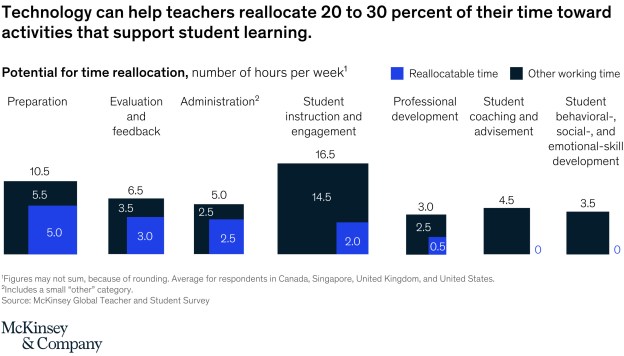
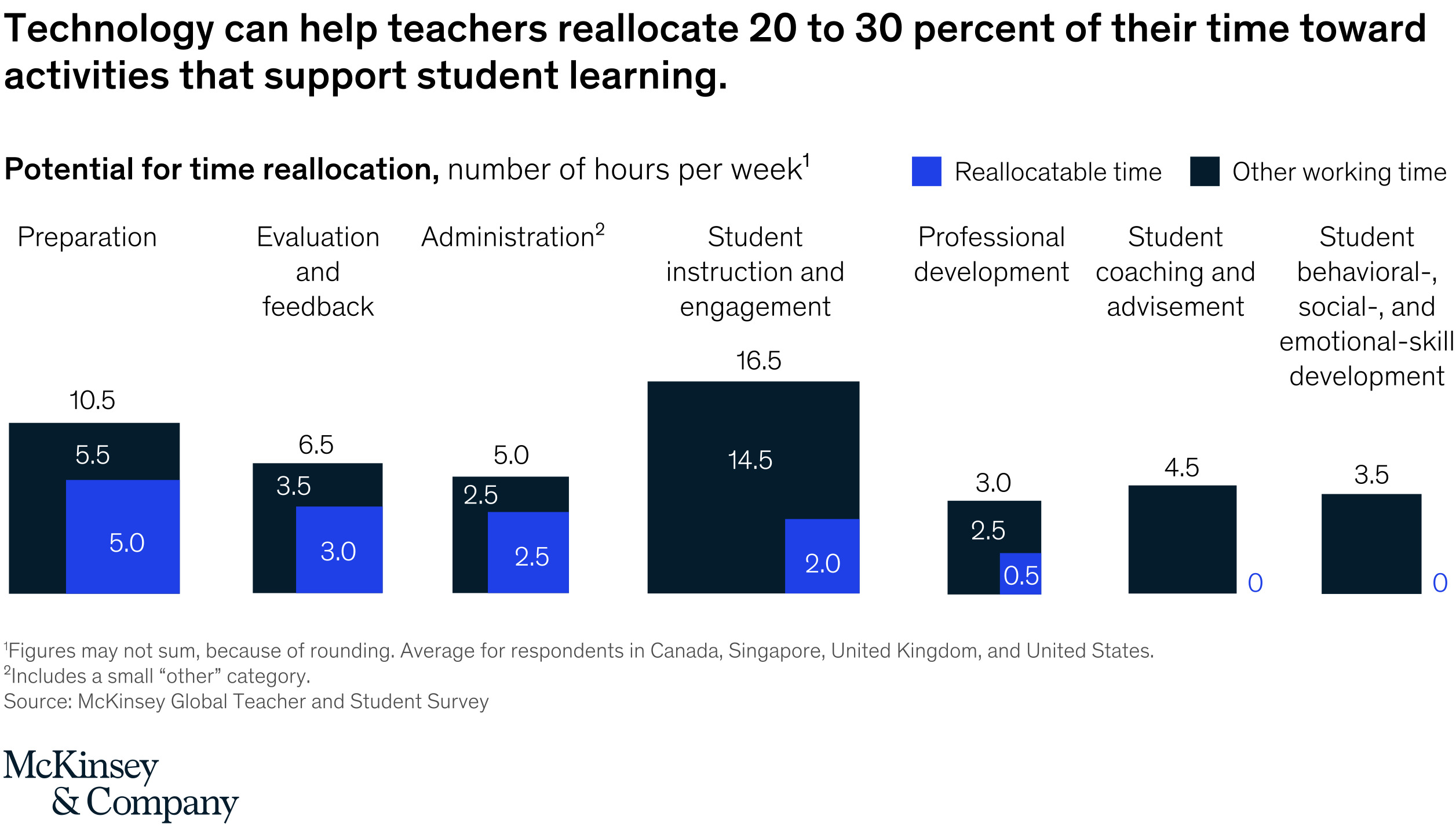
According to McKinsey, 20-40% of current teacher time comprises tasks that could be automated. They estimate that teachers could re-direct approximately 13 hours per week towards activities that raise student outcomes and increase teacher satisfaction.  The tasks of preparing lessons, administration, evaluation and feedback are flagged as high potential for AI.

Love’s Labour’s Lost

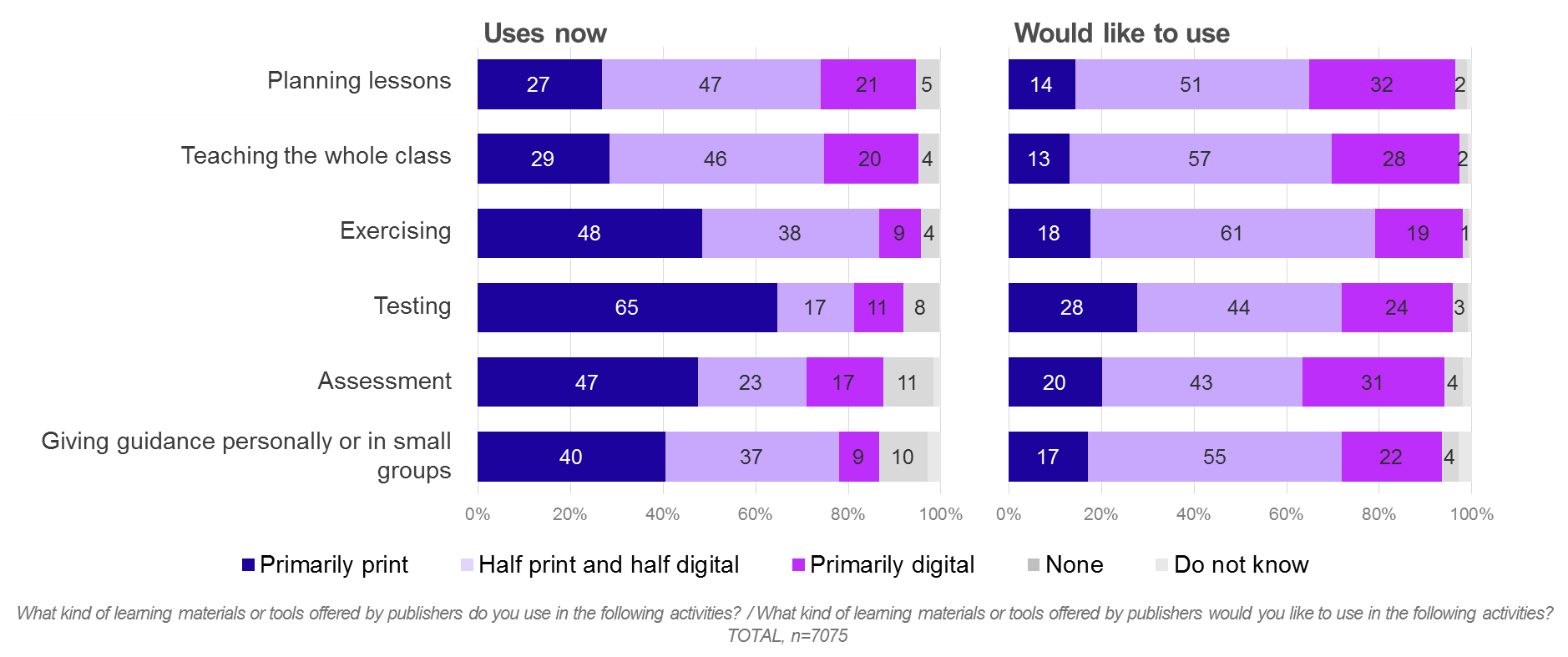
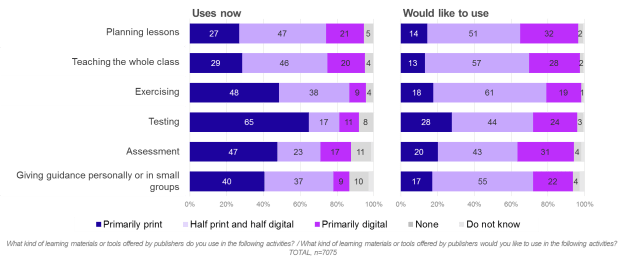
These results echo those of Sanoma’s Learning Impact Survey, in which teachers indicate a desire to go digital in those areas which were most labour intensive, flagging essentially the same areas.  This suggests both that the opportunity is in these tasks and that the profession is looking for solutions.

present_vs_ideal

Teaching profession under pressure

The teacher is arguably the most positive intervention in education.  However the teaching profession faces significant challenges.  UNESCO estimates an additional 69m teachers need to enter the profession by 2030 to fulfil global demand.  In some parts of the world, teacher turnover is high, for example in parts of the USA annual teacher turnover exceeds 15%.  In the UK more than 80% of teachers are considering leaving the profession due to dis-satisfaction.

Higher impact & happier teachers needed!

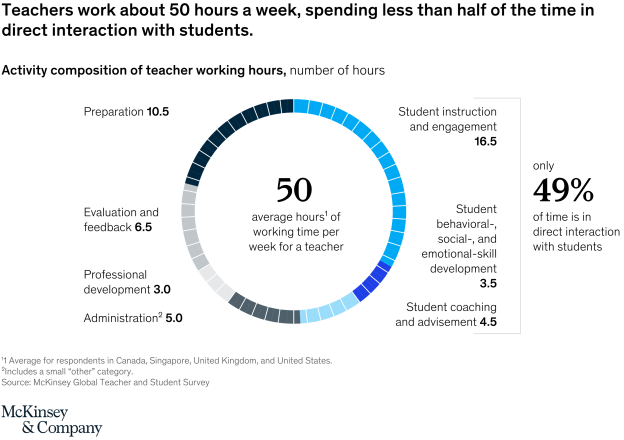
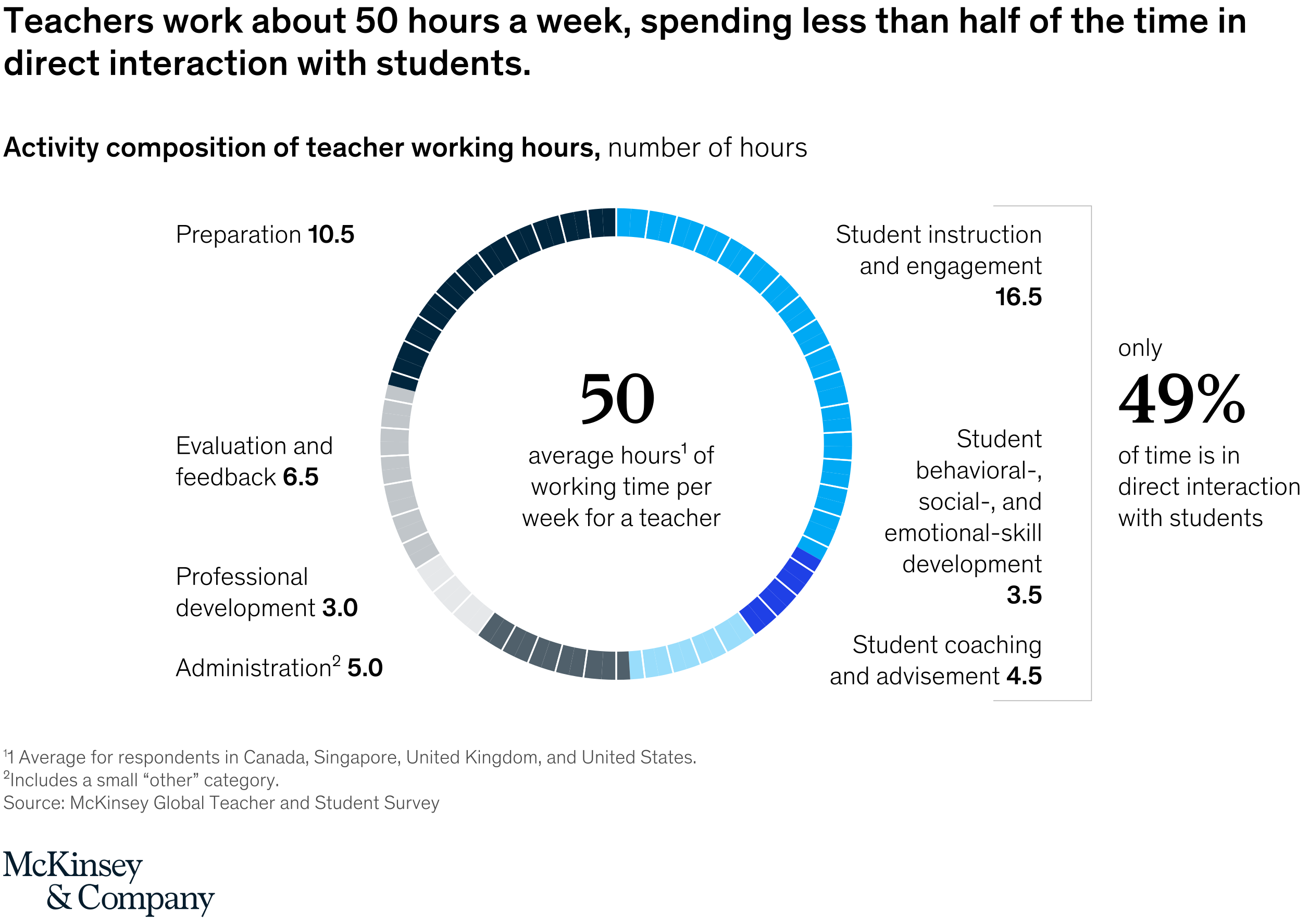
Furthermore, on average teachers spend only half of their time actually teaching.  This represents not only lost productivity from the core task but is also demotivating for many teachers whose passion is to teach rather than the ancillary tasks around it.  Enabling teacher workflow could therefore not only increase productivity but also make the profession more attractive.

SVGZ-AI-boon-Ex1.svgz

$400bn impact & opportunity

The opportunity to solve this productivity gap is huge.  Measured in terms of financials, assuming global spending on education to be some $6trn, of which 45% is on K-12 education,  and of which 75% is spent on staff salaries, this implies a global spend on teaching/staff salaries of some $2trn per year.  A 20-40% uplift in productivity through AI could arguably be worth some $400-800bn per year in terms of paid and unpaid output!  Which is not to say that this is a saving governments could make or a revenue that education companies could earn, because a significant slice of that value should rightfully return to teachers through higher salaries and quality of life, and another part would rightfully get re-directed to teacher-student interaction to increase outcomes and professional satisfaction.

20%

Help the teacher to focus on teaching!

It’s my belief that the teacher will continue to be the killer app in education, and that the biggest opportunity to make not only a positive impact on learning and teaching in K-12 but also to build a successful business, is to enable the workflow of the teacher.  Probably by combining it with the other side of the same coin: the learn-flow (learning experience) of the student.  

Looking forward >>

It will be exciting to see how we deploy AI in the coming years for a positive impact on learning. Looking forward >>.

DeepMind uses AI to understand life.

Life at the molecular level that is.

Last week saw the breakthrough news that Google has essentially solved the protein folding problem with AlphaFold from DeepMind. I was especially interested in this since this was the area of my PhD.

Function follows structure

Proteins carry out a variety of functions from DNA replication to catalysis to structuring the cytoskeleton.  Each protein is built up from a unique sequence formed from 20 different amino acids. Some 200M sequences are currently known, growing by about 30M per year. The chain of amino acids folds into a unique 3D structure.  This structure determines its functionality.

Prediction: the shape of things to come

Some 170,000 protein structures have been determined to date, and DeepMind has used this dataset to create an algorithm which can predict the 3D structure of a protein based only on its sequence of amino acids, to the same level of accuracy as if actually measured using a technique such as X-ray crystallography.  A reasonably sized protein might take as many as 10300 different shapes, so that’s quite a prediction!

This is relevant because understanding the 3D structure of a protein can inform its function and arguably mis-function, thereby potentially accelerating the rational design of interventions such as drugs against disease states for example.  With 200M proteins in scope, the potential for scientific discovery is massive.

Now we can look to Google not only in search of pizza, but also for the elixir of life.

Determined structures

25 years ago I calculated the 3D structure of a protein essentially by hand (serine proteinase human stefin A, see below) – with a simulated annealing protocol using distance and angle constraints obtained from high-resolution Nuclear Magnetic Resonance spectroscopy.  This took 2.5 years! Multiplied by 200M proteins, it would take quite some effort to map the universe of proteins. The task has now been reduced from years to hours!

Family of 17 solution structures showing the backbone atoms of serine proteinase human stefin A. The protein has a well-defined global fold consisting of five anti-parallel β-strands wrapped around a central five-turn α-helix. There are two flexible regions in this structure which are two of the components of the “tripartite wedge” that docks into the active site of the target proteinase. These regions, which are shown to be mobile in solution, are the five N-terminal residues and the second binding loop. In the bound conformation they form a turn and a short helix, respectively.

The future of education services for schools is in workflow

How will artificial intelligence impact K-12 teachers?

This week McKinsey published a new report addressing the question of how AI will impact K-12 teachers.  The research suggests that 20-40% of current teacher time comprises tasks that could be automated. They estimate that teachers could re-direct approximately 13 hours per week towards activities that raise student outcomes and increase teacher satisfaction.  The tasks of preparing lessons, administration, evaluation and feedback are flagged as high potential for automation.

Be selective

These results echo those of last year’s Learning Impact Survey of Sanoma, in which teachers indicated a desire to go digital in those areas which were most labour intensive, flagging essentially the same areas.  This suggests that not only is the opportunity in these tasks but that the profession is also ready for solutions.

present_vs_ideal

Teaching profession under pressure

The teacher is by far the most positive intervention in education.  However the teaching profession faces significant challenges.  UNESCO estimates an additional 69m teachers need to enter the profession by 2030 to fulfil global demand.  In some parts of the world, teacher turnover is high, for example in parts of the USA annual teacher turnover reaches 16%.  In the UK 81% of teachers are considering leaving the profession due to dis-satisfaction.

Higher impact & happier teachers needed!

Furthermore, on average teachers spend only half of their time actually teaching.  This represents not only lost productivity from the core task but is also demotivating for many teachers whose passion is to teach rather than the ancillary tasks around it.  Enabling teacher workflow could therefore not only increase productivity but also make the profession more attractive.

SVGZ-AI-boon-Ex1.svgz

$400bn impact & opportunity

Make no mistake, the opportunity to solve this productivity gap is huge.  Measured in terms of financials, assuming global spending on education to be some $6trn, of which 45% is on K-12 education,  and of which 75% is spent on staff salaries, this implies a global spend on teaching/staff salaries of some $2trn per year.  A 20-40% uplift in productivity through AI could arguably be worth some $400-800bn per year in terms of paid and unpaid output!  Which is not to say that this is a saving governments could make or a revenue that education companies could earn, because a significant slice of that value should rightfully return to teachers through higher salaries and quality of life, and another part would rightfully get re-directed to teacher-student interaction to increase outcomes and professional satisfaction.

20%


Help the teacher to focus on teaching!

Nevertheless, it’s my belief that the teacher will continue to be the killer app in education, and that the biggest opportunity to make not only a positive impact on learning and teaching in K-12 but also to build a successful business, is to enable the workflow of the teacher.   Probably by combining it with the other side of the same coin: the learn-flow of the pupil.  What other opportunities at this scale of potential impact are possible in K-12 within the next 5 years?