Author Archives: johnrichardmartin

Unknown's avatar

About johnrichardmartin

Former CEO at Sanoma Learning.

Sanoma Digital to boost transformation on three fronts: growth, innovation and capabilities

nu-labSanoma recently announced the planned launch of Sanoma Digital as part of an overall accelerated transformation program.

We see many opportunities in digital and have in the meantime built a substantial and growing digital business.  We intend to boost digital by creating this new business unit which will focus on pure-play digital assets in consumer media in Finland and The Netherlands, and will include brands such as oikotie.fi, NU.nl and kieskeurig.nl.  Digital brand extensions such as hs.fi and libelle.nl will be run directly by Sanoma Media Finland and The Netherlands. Sanoma Learning will drive all Learning activities.

Focus

A core element of the overall transformation program is to bring more focus to the business and to ensure that each part has a clear mandate and objectives.  This also holds true for Sanoma Digital.  Growing and innovating pure-play digital businesses in consumer media is a different assignment than transforming a portfolio of magazines, winning viewers for television, taking newspapers to their next level or building digital workflow solutions for learning.  Each of these assignments needs dedicated management attention to focus on making it happen.

Digital enjoys a unique role within the portfolio and will for that reason also work very closely with the other platforms to enable cross-media solutions for consumers and advertisers – shared sales, insights & analytics and ICT teams will help us to achieve that.

Goals

Sanoma Digital will have three main goals:

  1. The first goal is to growgrowthWe intend to significantly grow the digital consumer media business in the next 5 years. Part of that growth will come from working closely with the local business in Finland and the Netherlands, including adding new verticals, new media (mobile and video) and new services to our performance-based (lead-generation, e-commerce, online classifieds) and pure-play digital content businesses. Another part of the growth will come from scaling successful concepts created in The Netherlands and Finland to new markets.  We have been investing in the early part the product pipeline recently with quite some new launches in the final quarter this year.  We expect this to bear fruits during the course of the coming years.
  2. The second goal is to boost innovation and to strengthen skills across the organisation on lean development methods. Commerce-Accelerator-logo To achieve this we will establish a new innovation lab which will nurture the winning concepts borne out of our ongoing series of innovation accelerators.  Furthermore, we will continue to invest in external digital enterprises via Sanoma Ventures. We want to fill the pipeline with new business lines – to plant the seeds of the next generation Sanoma.

  3. The third goal is to strengthen our capabilities on data insights & analytics. We will bundle our resources on insights and analytics, boost them, and deploy them across Sanoma, to help the whole company to succeed in the digital transformation.


Positive outcomes

From the perspective of digital, we hope this will position us to better serve our customers. If we are successful, we will grow digital and this should help us to provide attractive new opportunities for employees and improved returns for shareholders.

Two passions

From a personal perspective, my next assignment is to establish Sanoma Digital. I’m excited about this and believe setting up Sanoma digital is a good step to boost the digital transformation. We’re now in the process of setting up a new team to drive this agenda.  I’m really proud of the talented people who are joining this team and who will work at Sanoma Digital!  During Q1 next year I will succeed Jacques Eijkens as CEO of Sanoma Learning.  My two passions are digital and learning.  Sanoma has a strong and successful international Learning business that is also going through a digital transformation.  I hope and believe that I will be able to contribute to the further success of Sanoma Learning by boosting the leadership of digital and innovation there.


Enabling commerce through open innovation: the #CommerceAccelerator

New launch

This week we launched the #CommerceAccelerator in Helsinki and Amsterdam. This is the third accelerator so far in the series. We began in the Autumn last year with the #MobileAccelerator and continued in the Spring with the #ContentAccelerator.

Intrapreneur Nikky Hofland at the Helsinki launch

Intrapreneur Nikky Hofland at the Helsinki launch

I notice the Finnish contingent of the team in particular has become increasingly creative in finding launch venues. The first round was in the auditorium at Sanoma House. The second round was at Adams and was the first time I have given a corporate presentation under a disco ball. This round was at cultural arena “Gloria” where Finnish Eurovision Song Contest 2006 winner “Lordi” has recorded some music video – I will spare you the footage of that here. We are considering video and vlogging as the focus for the fourth accelerator – I am already wondering with some trepidation where we will meet for that kick-off.

New business and new skills

We have two big goals for our Innovation Accelerators: i) to build new business lines and ii) to learn new skills.  As a direct result of the first two accelerators we have established six new start-ups and by the end of this accelerator almost 450 of our most talented employees will have learned new skills about Lean Innovation.  Learning by doing.

This accelerator has two new aspects.

Enabling commerce

Firstly, we are focusing on developing concepts that can “enable commerce” – “content” is not necessarily central to our thinking in this accelerator.  How can we use our ability to reach, inspire and engage consumers to enable commerce?

Open innovation

Secondly, we have opened up the process.  We are joined on this journey by approximately 70 students from 6 European universities, along with a handful of participants from a leading e-commerce player and leading telecoms operator.  We are looking to the outside world and want to bring in new talent and ideas.

Positive spirit

I felt excited at the kick-offs– the same way I used to feel when starting a new academic year – a time of new beginnings and new opportunities.  Program leaders Lassi Kurkijärvi (@lassi, Director of Innovation & Development at Sanoma) and Joris van Heukelom (@jorisheuk, Partner at Makerstreet) were in good form and inspiring as always.  What I especially liked at both kick-offs was the positive and optimistic spirit of the participants. I can sense the ambition of my colleagues, an eagerness to learn and to develop something new.  It felt good.

Good luck!

So, after the kick-offs we will be moving on to the ideation and learning experience and then taking the best 5 ideas to bootcamp to build functional prototypes. I am extremely curious to see what this accelerator brings us.  Good luck to all participants and respect to you for going for it!

MOOC meets Big Data in Education

Big Data in Education

Big Data in Education

Two of the hottest developments in education at the moment are the MOOCs (Massively Open Online Courses) and Big Data.

Peak of Inflated Expectations in the Hype Cycle

Peak of Inflated Expectations in the Hype Cycle

Some have argued that both are currently at the “Peak of Inflated Expectations” in the Hype Cycle. Expectations are indeed high, maybe rightly so. Imagine my pleasure this weekend when I discovered the course about “Big Data in Education” at the MOOC Coursera by Ryan Baker from Columbia University. I registered immediately. What a great way to kill two birds with one stone!  I can experience one of the leading MOOCs first hand and learn more about big data in education at the same time.

MOOCs

MOOCs emerged from the Open Educational Resources movement in the second half of the noughties. Leading players include edX, Coursera and Udacity, which are all well-funded and have excellent connections to world-class institutions. Two things in particular excite me about them: opening up access and improving quality in education.

Access to world-class education has historically been restricted to the happy few. However, anyone (with access to the internet) can take a course on a MOOC, unrestricted by price, the requirement to commit to several years of full time study, geography, or capped class-sizes. As Time put it. ”MOOCs open the door to the Ivy League for the Masses.”  Imagine the possibilities that his will give to improve the life chances of individuals across the globe.  And also the benefits to society as a whole of broad access to exceptionally good education.

The quality of education can also be boosted by the success of the MOOCs. Competition should play its part in raising teaching standards and spurring innovation.  Everyone should get access to the most talented professors with the highest quality content and best teaching methods, leading to a focus on excellent teaching and the weeding out of mediocrity. And the ability to mine the data created through participation in the MOOCs should bring new insights in teaching and learning that can drive further improvements in quality and efficiency.

Big Data

In my opinion, insights derived from big data will eventually transform education through personalisation.  By this I mean the tailoring of pedagogy, curriculum and learning support to the needs and aspirations of the individual.  I believe this will help learners to achieve better outcomes, in more efficient ways. And about subjects that both play to their strengths and support the development of their core life skills. Big data will be a core ingredient in that transformation.

Sanoma Learning (I am employed by Sanoma Group) is predominantly active in K-12 markets in Europe at this time. The amount of data available in K-12 education today is limited, and the insights offered rather poor. One reason for this is the still low availability of technology in schools (typically of the order of one device per 5-10 pupils) and the lack of any platform with real scale in collecting, analysing and providing insights from data. This will probably improve significantly in the coming years as schools take further strides in adopting technology.

Three sorts of data particularly interest me in this coming transformation journey: inferred student data, inferred content data and system-wide data. Put another way: how do students, content and education systems perform, why is that so, and what can we do to improve that performance?  I believe the next generation of Learning will be engineered from the insights derived from the interplay between these three datasets.  The promise is significant, although given the sometimes slow pace of change in education, I think it will be a long journey.

Passion for learning

I consider myself lucky to have been born with a passion for learning. I think technology will enable teachers (who are central to achieving success in learning) to transform education for the better. I’m excited about participating in this program on Big Data in Education at Coursera. Typically about 90% those who start a course on a MOOC drop out along the way. I hope I won’t be one of them. I’m curious to try it. Anyone care to join me?

Making innovation happen: how to organize for disruptive growth?

video-screenshot

One of our new intrapreneurs is building a marketplace for fashionista’s.

Following excellent performances at the bootcamp of the #contentaccelerator in June, two of our top talents have taken new roles as intrapreneurs at Sanoma this week. Making it happen!  This innovative burst immediately caused temperatures to sky-rocket to a sweltering 33°C at the office. Respect to them for showing the courage of their convictions and going for it. And thanks especially to the local organisation for supporting a speedy transition.

Creativity and customer-focus sit deep in Sanoma’s character.  However, we have deliberately organized these and other new ventures separately from the core business, yet cooperative with it.  We wanted to establish a model which gave the accelerators and new ventures the liberty to exploit their disruptive opportunity unrestricted by the core, yet in a way which supported both the new venture and the core. In my view, the process of the accelerator (ideation and competence development for hundreds of people from the core) and the sharing of various capabilities in the operation (mainly marketing, technology and expertise) achieve that.

Dual Transformation

I recently came across an excellent article by Gilbert, Eyring & Foster, in the Harvard Business Review called Two Routes to Resilience which clearly articulates the case for developing disruptive and core businesses separately yet under one umbrella. How to organize for new growth?

The authors make the case that when your industry is undergoing disruptive change, companies should respond by making two distinct transformations in parallel. Transformation A focuses on repositioning the core business to its altered circumstances. Transformation B should create disruptive innovations that will eventually bring new growth. And the structure should work for both through a “capabilities exchange” that allow the sharing of select resources for the benefit of both parties, without changing the mission of either. Each transformation needs a leader fully convinced of the future success of their mission. Both pillars of the transformation have to act in the market as if the future of the company depended on it alone.

“Capabilities Exchange”

The “capabilities exchange” should in principle bring competitive advantage to each pillar in the transformation. In the case of our accelerators and new ventures, some important shared resources come to mind. The Sanoma brand helps us to build connections to consumers, advertisers and schools.  Easy access to media and traffic help support existing brands and build new brands. Expertise in content, advertising, learning and other capabilities required in managing a company, such as finance and HR can support each transformation. The re-use of content and technology can reduce unit costs and bring speed to innovation. An international network can bring scale. Access to a skilled talent pool and methods of developing new skills on innovation are required in both tracks. And a dual transformation can support the financing of the respective pillars. That’s quite an exchange when you come to think of it!

Boosting Transformation B

For the sake of good order, Sanoma has many growing, successful and disruptive business lines and I would not for one moment say that the ventures born from the accelerators are the only seeds of the next generation of our products and services and everything else is legacy. That’s clearly not the case. The new ventures are just one of the pockets of innovation and digital disruption in the company. And we have many other business lines which would not count as digital disruptions but are far from legacy status.

Yet the argumentation in the HBR article is good and sharp. I believe it’s a credible approach and our actions and investments in new ventures are for their part consistent with it. Bringing additional relative scale to what the HBR article refers to as transformation B (the new growth businesses) would help to support the dual transformation. Increasing the pipeline of new ventures would be one way to achieve that.

I’m interested to know your opinion about this.  Feel free to leave a comment or send me an email.

Caledonia Dreamin’

Scottish heatwave at Skye

Scottish heatwave at Skye

Whilst many people look for the three S’s when planning their holidays (Sun, Surf and Sangria), I have been dreaming about just one S this season: Scotland.

Normally I write about innovation – a subject not strange to Scotland – having given birth amongst others to the television, the telephone, the first genetically cloned mammal, the world’s first primary school and the deep-fried Mars bar.

However, innovation is not the reason for my Caledonia Dreamin’. There’s no better place to rest and relax, to get new energy and inspiration, than the great outdoors. I dream of places of outstanding natural beauty where I can take strenuous hikes and relaxed walks. Add to that some fascinating historical interest, friendly people and free wifi nearly everywhere and Scotland’s the place to be!

Often I go to North America (I especially love the West Coast, from California to British Columbia) to experience the great outdoors. Two things have held me back from visiting Scotland: its reputation for bad weather and the midges. However, our visit coincided with a heatwave, with parts of the country hitting the highest temperatures since records began. What luck: a Scottish heatwave! What’s more, I was not even once bitten by a midge. Maybe Scottish midges don’t find me very tasty, although I can hardly believe that since their North American cousins find me quite delicious. It seems there was no need to have held back after all.

Journey from the Lowlands to the Highlands

Journey from the Lowlands to the Highlands

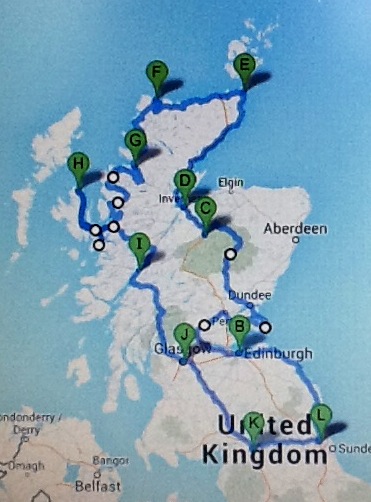
Our trip from the Lowlands (Holland) to the Highlands (John O’Groats) and back again lasted about two weeks and the rough route is shown on the map (except the ferry from IJmuiden to Newcastle). I’ll spare you the details but wanted to share with you my views on the best three

i) places we hiked

ii) castles we saw

iii) journeys we drove and

iv) walks we made.

Hiking Highlights

1. Isle of Skye

Scramble up to Coire Lagan

Scramble up to Coire Lagan

A hiker’s paradise! The Cuillin Hills are spectacular, maybe the most impressive mountain range in Britain. The steep climb to Coire Lagan ending with a scramble to a small lake in the upper corrie was most enjoyable. Also, the views of Bla Bheinn and Garbh Bheinn are truly beautiful, a feast for the eyes and the soul.

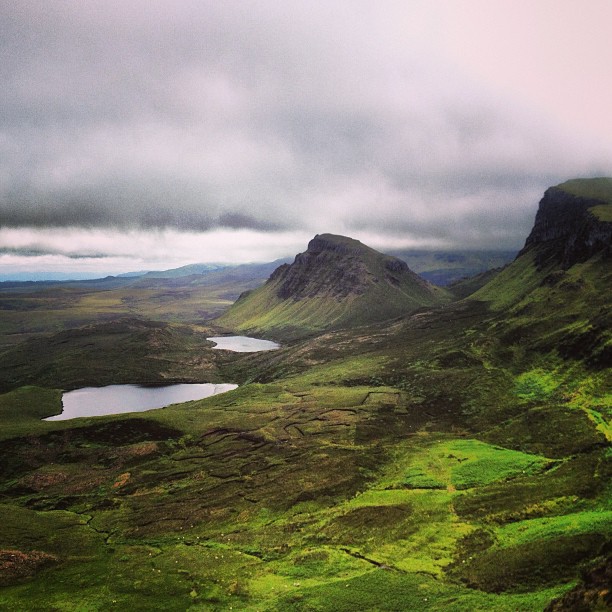
Fifty shades of green at the Quiraing

Fifty shades of green at the Quiraing

In Trotternish, there is a terrific hike at the Quiraing with excellent panoramic views. And a hike to the Old Man of Storr is a must – the upper part is an unusual and quite a spiritual place. I can highly recommend The Duisdale House Hotel as a place to stay, and The Chippy in Portree for Fish & Chips that I wouldn’t trade for any number of Michelin stars.

Spiritual sights at the Old Man of Storr

Spiritual sights at the Old Man of Storr

Beautiful Skye

Beautiful Skye

2. Ben Nevis

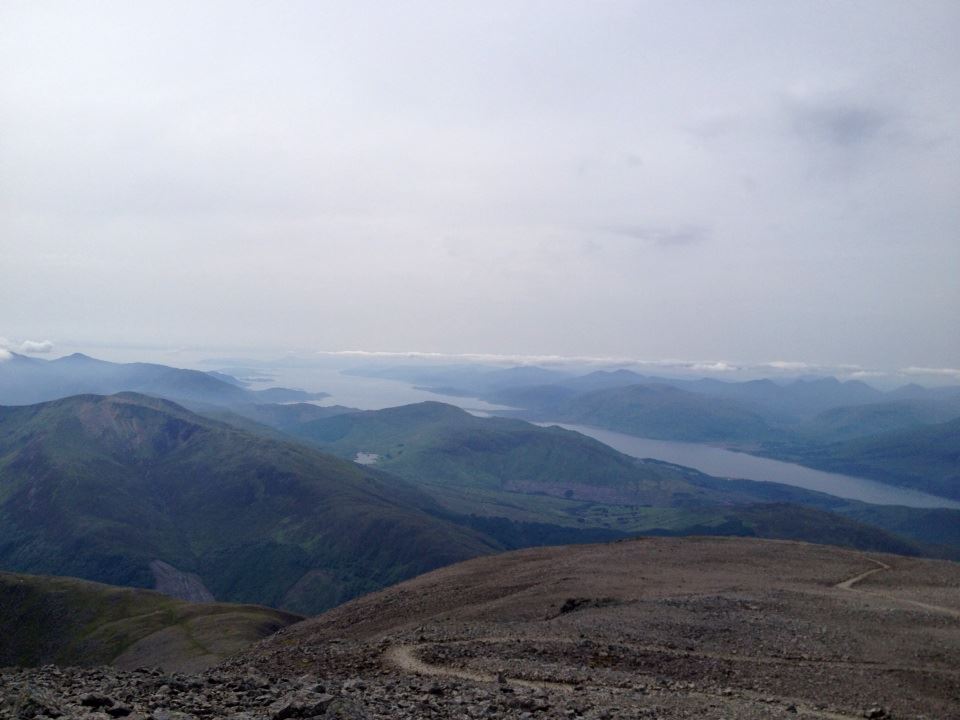
Walking back down from the summit of Ben Nevis

Walking back down from the summit of Ben Nevis

Britain’s highest peak at 1344 m. Although wrapped in cloud 9 days in every 10, we had a hot and sunny day with clear and excellent views from the summit. It was a 6.5 hour round trip and fairly taxing, especially with the heat; the beer at the Ben Nevis Inn at the base was the perfect end to the hike. We came across many people doing the Three Peaks Challenge on the way (climbing the highest peaks of Scotland, England and Wales – Ben Nevis, Scafell Pike and Snowdon – all in one day, usually for charity); respect to you all for that!

3. Cairngorms

Atop Cairngorm Mountain (pre-heatwave)

Atop Cairngorm Mountain (pre-heatwave)

Britain’s largest National Park and the biggest range of high mountains in the country, encapsulated by the valleys of the River Dee and River Spee. Cairngorm Mountain is a decent hike offering excellent views from the summit.

Caledonian Castles

1. Eilean Donan Castle

Eilean Donan Castle, Heaven on Earth

Eilean Donan Castle, Heaven on Earth

I might have been suffering from heatstroke due to the Scottish heatwave, but this place has won the top spot in my heart for the most beautiful place on Earth, topping Delicate Arch in Utah, which had held that position for quite some time. The area was originally settled in the 6th Century, with the first castle built in 1214 as a defence against the Danes. Situated in Loch Duich at the intersection between three great Loch’s, the whole area including the castle is stunningly beautiful. Truly a highlight, a place not to be missed.

View one way from the castle

View one way from the castle

View the other way from the castle

View the other way from the castle

2. Stirling Castle

Stirling Castle

Stirling Castle

“Hold Stirling and you control Scotland”. The current castle dates from the 14th-16th Century when it was a residence of the Stuarts. It’s been beautifully restored and has fantastic views of the area. Definitely worth a visit.

3. Edinburgh Castle

At Edinburgh Castle

At Edinburgh Castle

Edinburgh Castle has played a key role in Scottish history both as a military stronghold and royal residence. Well-situated atop the best-defendable hilltop in the area, the site has witnessed many armies from the Romans to the Jacobites. It’s well-maintained and impressive, with excellent views of the city, a must on any visit to the capital.

Delightful Drives

1. Duncansby Head to Durness

Melvich Beach. My Dad would have liked it here.

Melvich Beach. My Dad would have liked it here.

I had ridiculously expected to look out from the northern coast into the North Atlantic/Arctic Oceans and see icebergs being battered by treacherous storms and oilmen trying to stay aboard their rigs for dear life. But what a peaceful and unspoiled paradise it was! We even spent a morning on a sunny beach and watched the sun set in a balmy and very friendly Thurso (lovely dinner at “Le Bistro”).

Sunset at Thurso

Sunset at Thurso

Overcast at Tongue

Overcast at Tongue

2.Durness to Kyle of Lochalsh via Ullapool

On the way from Durness to Ullapool

On the way from Durness to Ullapool

Durness to Kyle of Lochalsh

Durness to Kyle of Lochalsh

Quite amazing scenery! Not the fastest road you will drive due to the multitude of single lanes, but it will be one of the most beautiful.

3. Inverness to John O’Groats

Rembrandt skies at Inverness Castle

Rembrandt skies at Inverness Castle

Having driven around Loch Ness and spent the night in a very pleasant Inverness, we then drove to John O’Groats. It was such a peaceful and quiet journey, yet my heart was beating fast all the way in excitement of visiting the north coast for the first time.

Wonderful Walks

1. Merchant City to the Necropolis in Glasgow

I spent a hard winter in Glasgow one day in the 1980’s and to be frank I was reluctant to return. How wrong I was! The city is alive and vibrant, and has been successfully transformed to a modern metropolis. Take a walk from Merchant City (originally developed by the “Tobacco Lords” in the 1750’s) to the Necropolis via the University of Strathclyde (founded in 1796) and Cathedral (the present building was consecrated in 1197) and you will get a great taste of Glasgow through the ages.

Glasgow Cathedral seen from the path to the Necropolis

Glasgow Cathedral seen from the path to the Necropolis

2. The Royal Mile in Edinburgh

You can easily spend more than a day visiting the attractions along the wonderful Royal Mile in Scotland’s capital. Starting at the Castle and ending at the Palace of Holyroodhouse there is an abundance of sights along the way, including the National Gallery of Scotland, St Giles Cathedral and the Scottish Parliament, to name but a few. We then took the walk back along Arthur’s Seat, giving spectacular views over the city. A great day!

3. Duncansby Head near John O’Groats

Duncansby Stacks

Duncansby Stacks

At the most north-easterly extreme of mainland Britain you can walk along the coastline to the monolithic Duncansby Stacks. We saw a handful of sealions and many seabirds on the way, and had good views across to the Orkney Islands. Lovely!

So those are my highlights. There are so many more wonderful places to see here too. Sub-arctic or sub-tropical, visit Scotland for the great outdoors! Batteries re-charged, ready for whatever comes next.