Category Archives: Innovation

Designing the Future of Digital Education

johnrichardmartin's avatarJohn Martin

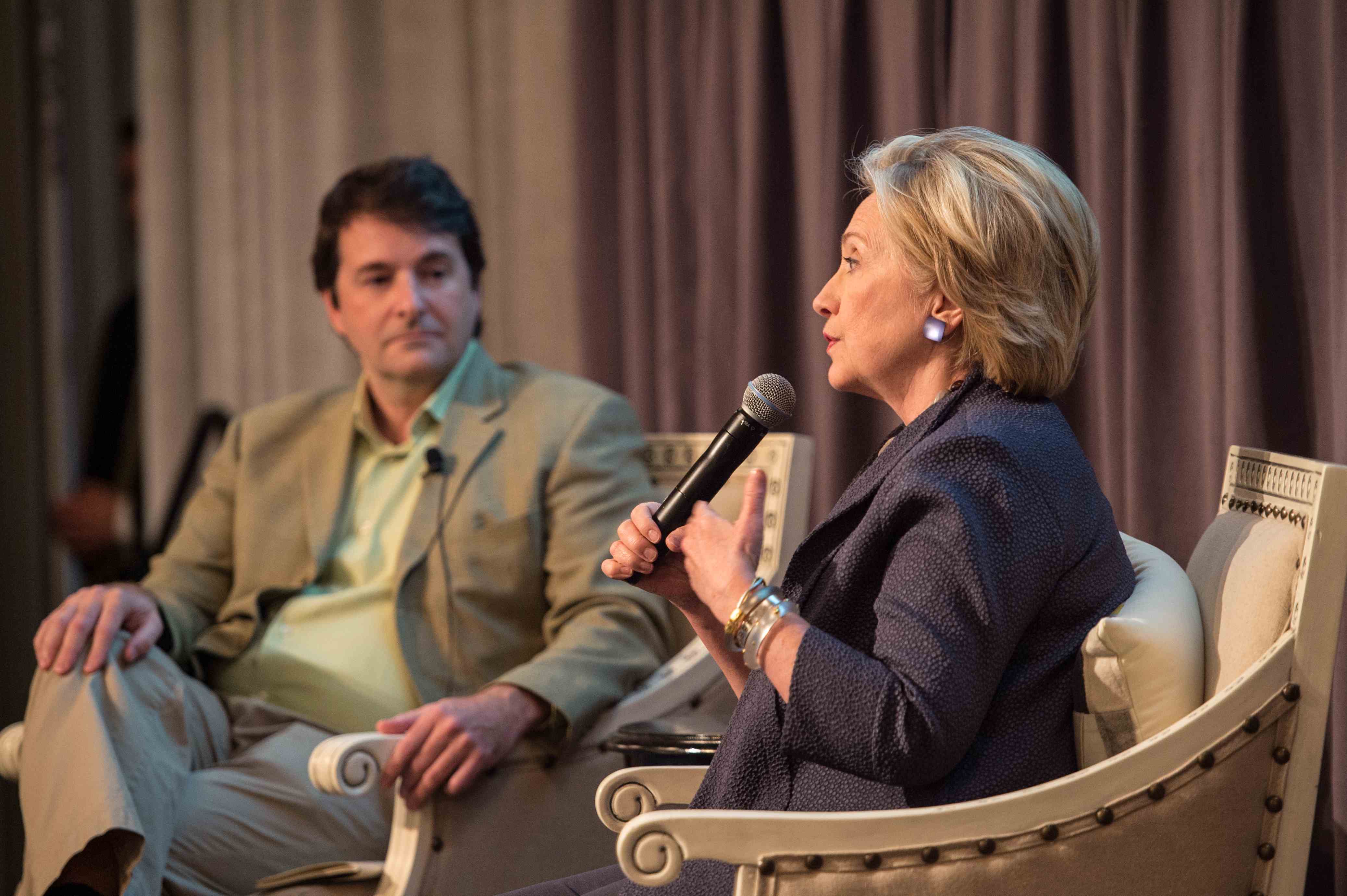
Jose Ferreira of Knewton interviewing Hillary Rodham Clinton Jose Ferreira, CEO of Knewton interviewing Hillary Rodham Clinton, former US Secretary of State

This week I joined the Knewton Symposium in San Francisco and was a panel speaker on the subject of “Digital Readiness”. We have recently started partnering with Knewton, which I am enthusiastic about since I believe adaptive learning is the next generation. I joined the meeting to make sure I’m up-to-date on the latest thinking and for the networking opportunity.

Great program

The program was a mix of speakers and panel sessions. I especially liked the interesting and provocative speakers:
Jose Ferreira, CEO of Knewton (“transparency on what drives outcomes”);
Andy Rosen, CEO of Kaplan (“why Knewton will fail” – which emphasized the open dialogue of the symposium);
Michael Crow, President of Arizona State University (I was intrigued by his words about the “rise of the super-faculty

View original post 396 more words

Sanoma’s Partnership with Knewton – the Next Generation in Empowering Teachers & Motivating Students

sanoma-logoknewton Sanoma Learning serves about 10 m pupils and one million teachers in Northern Europe. Our experience in education dates back to 1833 and these days we are known internationally for two reasons. Firstly, for quality: we’re a leading and integral partner in some of the World’s best performing education systems including Finland, The Netherlands, Belgium, and Poland, as well as Sweden. Secondly, we’re innovative and are frontrunners in the digital transformation: of our sales of about € 300 m, about € 50 m are generated from pure-play digital and a further € 100 m from multichannel solutions, making us arguably continental Europe’s biggest ed tech company today.

I believe there are three cornerstones of excellence in education: skilled teachers, motivated pupils, and high-quality learning materials. And I believe that the next generation of learning is personal: by tailoring pedagogy, curriculum, and learning support to the needs of the individual learner we can improve learning outcomes, enhance workflow efficiency, and support engaging learning.

That’s why I’m thrilled about the work we’re doing with Knewton, the global leader in adaptive learning technology with over 7 million students expected on the platform by the end of 2014. Knewton technology uses data to understand how individual students learn. Sanoma Learning products integrated with Knewton will include personalized content recommendations for students and in-depth reporting for teachers.

Knewton technology will allow us to scale personalization across our wide portfolio of course solutions, improving learning experiences for every student. Malmberg in the Netherlands is the first Sanoma company (and the first publisher in Continental Europe!) to integrate with Knewton technology.

Malmberg’s first Knewton-powered course will be a new grammar-specific English Language Teaching module. This module will provide targeted practice for any ELT student looking to focus on critical grammar concepts. Like all Knewton-powered courses, the course will feature interactive reporting dashboards to help teachers to pinpoint struggling learners in need of intervention and engage advanced students with more challenging material.

Malmberg’s instructional experts and Knewton’s adaptive course designers are making great progress in the development and building phases. Students and teachers will pilot the module early next year. Meanwhile, the teams are also in early planning phases for product builds in other subjects. I can’t wait to see these Knewton-powered products come to life. I truly believe they will contribute to better learning!

The collaboration in the Netherlands is just the beginning. We’re looking forward to rolling out Knewton-powered products across Europe, continuing to empower teachers and motivate students with high-quality, cutting-edge learning products.

Designing the Future of Digital Education

Jose Ferreira of Knewton interviewing Hillary Rodham Clinton

Jose Ferreira, CEO of Knewton interviewing Hillary Rodham Clinton, former US Secretary of State

This week I joined the Knewton Symposium in San Francisco and was a panel speaker on the subject of “Digital Readiness”. We have recently started partnering with Knewton, which I am enthusiastic about since I believe adaptive learning is the next generation. I joined the meeting to make sure I’m up-to-date on the latest thinking and for the networking opportunity.

Great program

The program was a mix of speakers and panel sessions. I especially liked the interesting and provocative speakers:
Jose Ferreira, CEO of Knewton (“transparency on what drives outcomes”);
Andy Rosen, CEO of Kaplan (“why Knewton will fail” – which emphasized the open dialogue of the symposium);
Michael Crow, President of Arizona State University (I was intrigued by his words about the “rise of the super-faculty” – it sparked my interest in the potential “rise of the super-teacher” enabled by technology in schools).

Also, some of the panel sessions gave food for thought, especially:
Investing in Edtech (I liked the quote by Michael Moe, partner at GSV “the best IRR will be produced by education companies that deliver the best ROE”)
The OER Impact (“80% of materials for university foundation years can be found Open Source”)

It was great to hear the “Big Ideas” of entrepreneur Tyler Bosmeny, CEO of Clever about solving Single-Sign-On and intrapreneur Ben Schrom from Google Classroom about simplifying digital workflows. (It was nice that he cited me and my “killer app of education is the teacher” quote too, a boost for Finnish thinking there :)).

Go Hillary!

From my perspective, the highlight of the meeting was the interview with Former US Secretary of State Hillary Rodham Clinton. She talked intelligently and engagingly about international affairs in a no-nonsense and straightforward way. Firm but fair. I liked her passion and commitment to education, for example with the “Too small to fail” program, helping to improve the health and well-being of children aged 0-5 years. Her words about making sure that schools are fit for children to attend and treating teachers as professionals appealed to me too. We had a short photo session afterwards, and even though we exchanged only a few words, she was funny and nice and I really liked her. Go for President Hillary!

Main takeaways

The three main takeaways for me from the meeting were:
1. The move to adaptive learning is the next generation. I believe we are right to be investing.
2. It will be of great importance to evidence and improve outcomes and to take a more proactive stance in positioning outcomes in our value proposition. We need to raise our game here. Our Learning Lab starting in September can help us in that regard.
3. It’s good to look and be outside, to be up-to-date with the latest developments and to be connected with talented people in the industry alongside the talent we have at Sanoma Learning.

Thank you Knewton!

It’s always great to be in the USA. I love the optimism and the way they go for it! Thanks to the Knewton team for having arranged a great meeting!

Sanoma Learning Lab: Co-create for Impact

sloa-header-1We’re going to run a Learning Lab this Autumn and I would like to invite you to join us. We’re going to develop new concepts with you, to improve and evidence the impact of education on learning.

There are 3 reasons why I would love you (teachers, academics, university students and Sanoma employees) to apply for a place at our learning lab:

1. Fantastic learning experience

You’ll get trained in start-up methods and work with experts on developing your idea. You might even win a place at bootcamp to build a prototype of it with a dedicated team of designers and developers. I’ve previously blogged about how such a program works and what happens at bootcamp. It’s really exciting to be part of it!

2. Great networking

The Lab will be a great way to build relationships with other professionals passionate about the future of learning, both locally and internationally. People from diverse backgrounds, from instructional design to user experience to learning analytics. People who want to make a difference in education.

3. Make an impact on the future of learning

We’ll co-develop new concepts with you, to improve and evidence the impact of education and to contribute to the future of learning. Concepts that will improve learning results, support the ways of working and help to better engage pupils. It’s about the future of learning.

Join us!

We’ll be accepting applications until 24th August. Please go to www.sanomalearninglab.com and apply. I really hope you’ll join us! Looking forward >>.

The killer app in education is the teacher

edtech-logoLast week the second EdTech Europe meeting was held in London. It was an inspiring day and attracted high quality participants including quite a large audience of start-ups, established operating companies and investors. Thanks to Charles McIntyre, CEO of IBIS Capital and Benjamin Vedrenne-Cloquet, Founding CEO of Edxus Group, for having arranged this excellent meeting!

I was a speaker on one of the panels and also a member of the Advisory Board, so I was happy it was a success. I loved engaging with the entrepreneurs running the edtech ventures. It’s inspiring to hear their stories and feel their energy. And it was also a great networking event for meeting peers from across Europe.

Technology, platform, content, data?

This was a meeting about educational technology, so there was rightly a lot of discussion about the transformation of education and the roles that technology, platforms, content and data will play. What will be the “killer app” of education in the future?

The killer app in education today is the teacher

Today I believe that the “killer app” of K-12 education is the teacher. Great teachers engage individuals and classes, ensuring that they are motivated to learn. They stretch and support individual pupils so that they reach the best learning outcome they can. And they guide the ways of working such that learning time is spent usefully.

Technology will both enable and disrupt teachers in the future

Effective use of technology, platforms, content and data can help to raise learning outcomes (e.g. data-driven personalised learning), bring efficiency to the ways of working (e.g. automation and performance dashboards), and support engagement and motivation (e.g. gamification and storyfication). The teacher is therefore likely to get both enabled and disrupted by technology in the future.

Yet although the role of the teacher will change, I believe they will remain the “killer app” of education in the future too. They are likely to remain the leader of the classroom. They will probably more-or-less remain as the primary guide and gatekeeper to the learning activities that are carried out. And their relationship with classes and individual pupils will remain pivotal to engagement and motivation.

Enable teachers to develop each child

Our ambition is to use edtech to enable teachers to excel at developing the talents of every child, resulting in higher outcomes, better engagement and new ways of working. That’s something I believe in and would be keen to invest in.