Tag Archives: teachers

Is the teacher still the ‘killer app’ in the age of AI?

AI in education is often framed as a battle between humans and machines. Based on conversations with teachers, founders and investors over the past year, I believe the real opportunities lie in partnership, not replacement.

The OECD’s Digital Education Outlook 2026 frames AI’s role in relation to teachers across three paradigms: replacement, complementarity and augmentation. But there’s a second often overlooked dimension: institutional embedding.  Moats in education aren’t built on technology or data alone, but on alignment with pedagogical goals, curricula, regulations & governance, procurement processes and professional practice.

1. Replacement — The Productivity Play

In replacement, AI automates tasks historically done by teachers. For example, grading, summarising texts, preparing lessons, generating worksheets and providing basic feedback loops.

This is where much of today’s AI attention is focused. Tasks that were once labour-intensive can now be executed quickly using general-purpose large language models.

However,  technology that replaces discrete tasks can be easy to replicate.  Application-layer companies that don’t control workflow, data or distribution potentially become interchangeable.

2. Complementarity — Enhancing the Teacher

Complementarity is where AI does not replace teachers but meaningfully enhances their capacity. For example:

  • turning classroom data into real-time insights
  • tracking student progress against goals
  • flagging risks and opportunities
  • designing targeted interventions

Here, teachers retain judgement while AI expands insights and  sharpens execution. The result? More impactful and stickier solutions because:

  • the solution integrates with daily workflows
  • the value is tied to teacher judgement, not automation
  • switching costs rise as the technology adapts to context
  • integration with existing systems (LMS, assessment frameworks, schedules) deepens.

In Europe especially, where education systems are fragmented by language, standards and national curriculum requirements, this tailored integration is the key to durability.

3. Augmentation — Supercharging the Teacher

Augmentation involves human–AI co‑evolution: AI learns from teacher feedback over time, adapts to their pedagogical style, and augments their professional practice in ways that produce outcomes neither could achieve alone.

In theory, this is the next frontier.

But the evidence suggests caution. Recent cross‑sector analyses have found that human–AI teams often underperform the better solo performer — not because AI is weak, but because synergy is hard to design and requires:

  • structured feedback loops
  • task‑specific modelling
  • data that is pedagogically meaningful
  • long‑term usage and refinement.

These conditions are relatively rare — and do not emerge automatically from generic chatbots. Consequently, many augmentation efforts risk failing before a few succeed spectacularly.

This layer will be hard to build, slow to monetise, but potentially transformative if it materialises. The Holy Grail, but not for the faint-hearted investor.

But even the most advanced augmentation tools will fail if they don’t address a deeper challenge: institutional embedding.

The Overlooked Dimension: Institutional Embedding

If replacement, complementarity and augmentation describe how AI interacts with the teacher, the moat is arguably how deeply a solution embeds in the system.

Edtech solutions thrive where:

  • curriculum alignment exists
  • pedagogical norms reinforce its use
  • there are many rules and regulations
  • procurement frameworks are understood and effective go-to-market capabilities are developed and in place
  • teacher support boosts adoption
  • governance structures (schools, districts, ministries) endorse and fund it

Know-how about working with institutions and alignment with standards determine durability.

This is particularly true in Europe, where:

  • education is governed nationally and regionally
  • language and curriculum diversity creates product differentiation challenges
  • procurement cycles are long and complex
  • teacher autonomy is the norm.

A solution that is embedded institutionally — even if technically less advanced — will often outlive and outperform one that is technically stronger but misses the expertise around the institutions it is designed to serve.

This is where real moats are built.

The next edtech winners won’t rely on algorithms alone.  They’ll succeed by understanding that the best AI doesn’t replace teachers or even just work for them. It works with them.

Where do you see the biggest opportunities?

Looking forward >>
It’s time to scale up European edtech

Last week, Brighteye Ventures, a leading European investor in education technology, published the fifth edition of its European Edtech Funding Report. It looks like 2023 might be the trough of the cycle that peaked with the pandemic in 2021, and there are increasingly strong signals of a resurgence in investor appetite in 2024.

Reasons to be Cheerful

  1. After a period of decline, overall new venture funding for European edtech in 2023 surpassed the levels reached in 2020 ($1.2B vs $951M) and the number of deals increased on 2022 (288 vs 256).
  2. About 1/3 of all global edtech deals took place in Europe in 2023 (a record high proportion, up from 21% in 2019), indicating a high level of investor interest in the European market.
  3. International private equity and venture capital investors are currently holding a record amount of dry power, with $2586B ready for deployment at the top 25 PE investors globally.

Resilience?

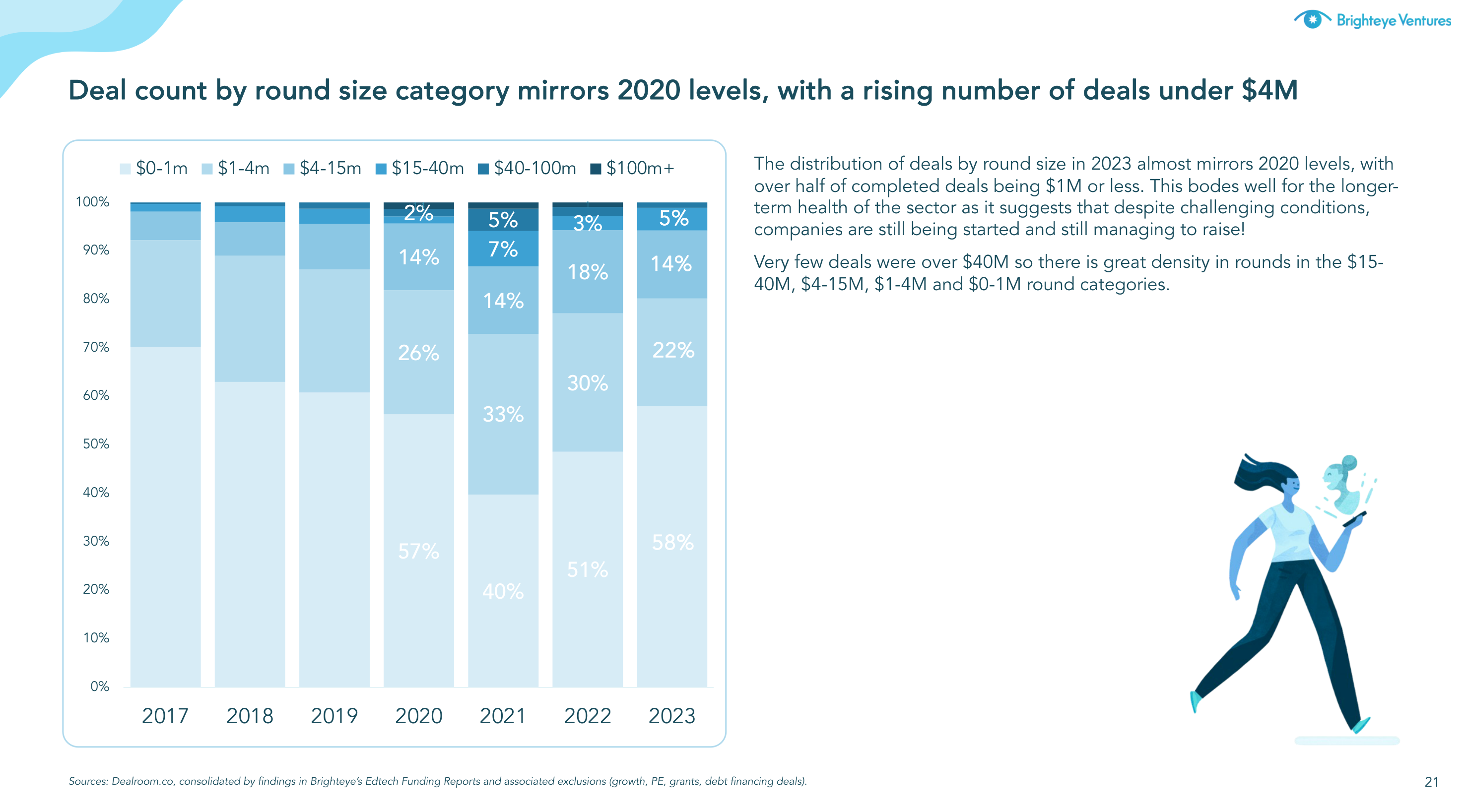
From a European perspective, “resilience in the volume of deals” was driven by a rising number of deals under $4M, with over half of the completed deals being done at $1M or less. 

On the micro level of individual businesses, this thinly spread funding might make some sense, yet on the macro level of the industry and the customer, it also highlights part of the European challenge, namely lack of scale. You have to wonder if something substantial and world-class will be built out of some of these tiny deals. Usually “recessions” (possibly a relative term in tech) are a good opportunity for industries to restructure, with strong firms building on their strengths and weaker firms going out of business in what is typically a healthy evolutionary process.

Enable and simplify the work of the teacher

According to some estimates there are currently about 27,500 edtech companies in the K-12 sector, obviously not all deployed in all schools, but it’s not uncommon for schools to use hundreds of digital products. Imagine the life of a teacher. Her first concern is leading a classroom of 25-30 children, which is no mean feat in itself. When she deploys a digital solution it needs to:

a) positively impact learner outcomes

b) be easy to use and

c) ideally save time that she can use for interacting with students.

A teacher is best served by a smaller number of well-performing and frequently-used solutions than a huge toolbox of occasionally-used options.

Build a European Champion

In my view, investors in European edtech should focus on increasing scale and building a handful of segment-specific European/International Champions. At scale, a European Champion has the resources in terms of talent, know-how and money to develop and deploy top-notch learning solutions, yielding excellent learning impact and delivering good financial returns. It’s my hope (and expectation) that a group of investors will take the opportunity at this early stage in the new economic cycle to take our industry and the services we provide to schools to the next level.

Tick Tock, the clock is ticking for a literate society.

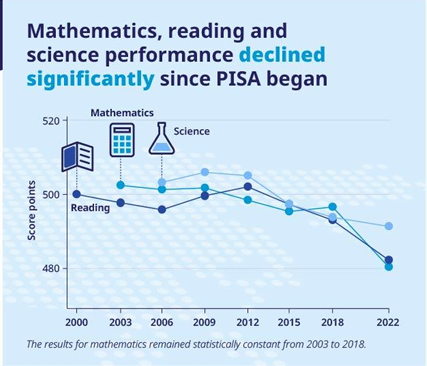
“An unprecedented drop in literacy and numeracy across the OECD”

There has been an unprecedented and disturbing drop in average performance for literacy and numeracy in the OECD, as evidenced by recently published research based on data from 2022. https://www.oecd.org/pisa/. Mean performance in mathematics fell by 15 points (equivalent to nine months of learning) and in reading by 10 points (six months of learning loss). Fortunately, average scores for science were maintained.

One in three functionally illiterate

In my home country, The Netherlands, which is one of the richest and most socially progressive places on Earth, with a high commitment to education, the data indicate that one in three students are at risk of being functionally illiterate when they leave school. One in three! That’s up from one in four in the research from 2018. What an enormous loss of potential for these children and our society.  It also makes you wonder how we can spend 12 years and €100,000 per student on education with an outcome that one in three cannot read at the level required to function at school or in society at the end of the journey.

Problem pre-dates pandemic

It would be logical to think that COVID-19 might be the primary cause of this negative development. However, the trend analysis indicates that the decline had begun before the pandemic and peak performance was 10-15 years ago. There are longer-term issues at play. 

Resilience factors could guide the way forward

Some education systems (especially in East Asia and the Baltics) showed both resilience to the disruption from the pandemic, and structurally high learning outcomes. PISA observed 10 factors that contributed to this resilience, and could be helpful in bolstering future approaches, three of which particularly relate to digital, namely:

  1. They ensured good access to skilled teachers, high-quality digital learning materials and devices and developed guidelines for their use.
  2. They limited distractions from digital devices in the classroom (particularly from smartphones and social media) by policies at school.
  3. They prepared students for autonomous and remote learning.

(Screen)-time well spent?

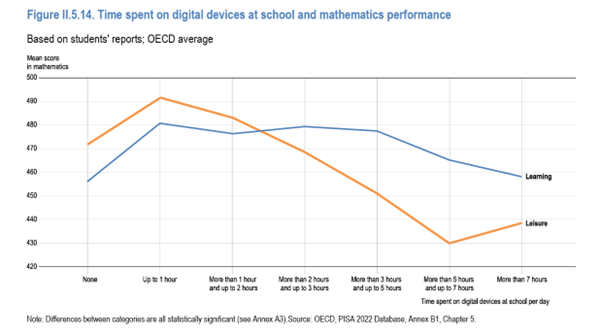
Overall, the evidence shows that using digital/devices for learning purposes in schools yields higher outcomes than not doing so, with the effect tapering off after about five hours per day.  Somewhat surprisingly, the impact of using devices for leisure purposes at school was also correlated with higher learning outcomes, although this turns more sharply negative after about two hours per day.

Most schools have articulated policies about using digital devices on site. However, the least common practices were i) not allowing the use of cell phones (34% of students attended such schools), and ii) having a specific policy about using social networks (51% of students).  In The Netherlands (2022 data), less than 10% of students attended schools where the use of cell phones was not allowed and one in three reported that every or most lessons were disturbed by digital devices.

Tick Tock, the clock is ticking to maintain a fully literate and numerate society

With good quality materials, a focus on learning outcomes and sensible rules of engagement, the use of digital in classrooms enables a positive impact on learning.  

However, smartphones and social media are disturbing the classroom and learning experience and this is likely contributing to why one in three of the kids around here could be functionally illiterate when they leave school.

No time to lose

We need to think again how we systemically approach this better for current and future students and what we can do to bolster the life-chances of this cohort of students with lower literacy and numeracy skills.  Education is a long play, with impact not only on individual lives but crossing generations. There is no time to lose.