Category Archives: Learning

Homeschooling is becoming mainstream

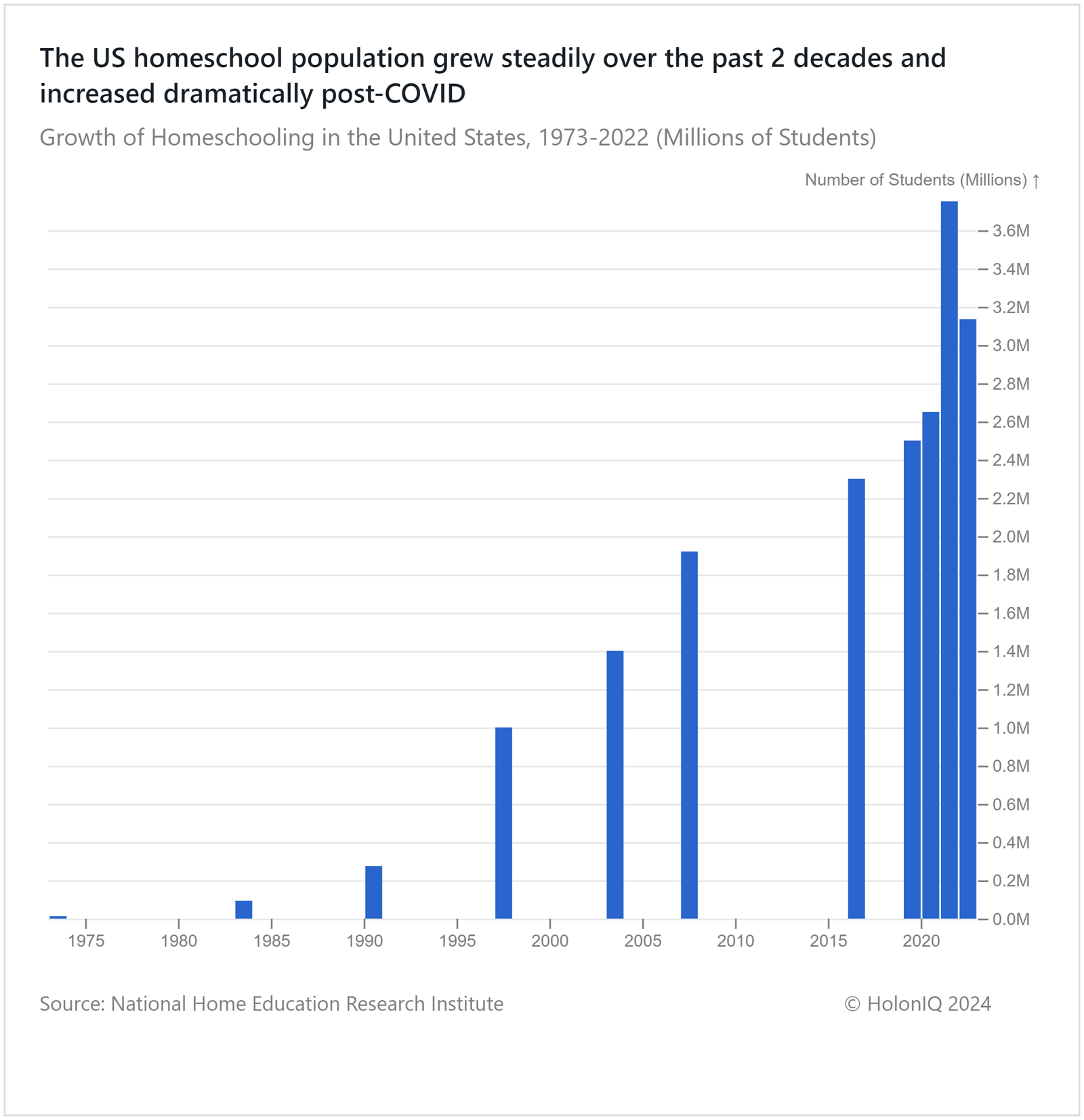
Homeschooling is becoming mainstream in many countries including the USA, Canada, UK, Australia and New Zealand, where demand is increasing and well-established legal frameworks are in place. In the USA about 3 million students (6% of total) were homeschooled in 2021-2022, an increase of 25% from 2019-2022 and a step increase from the trend growth rate of 2-8% per year since the 1990’s.

Why homeschool?

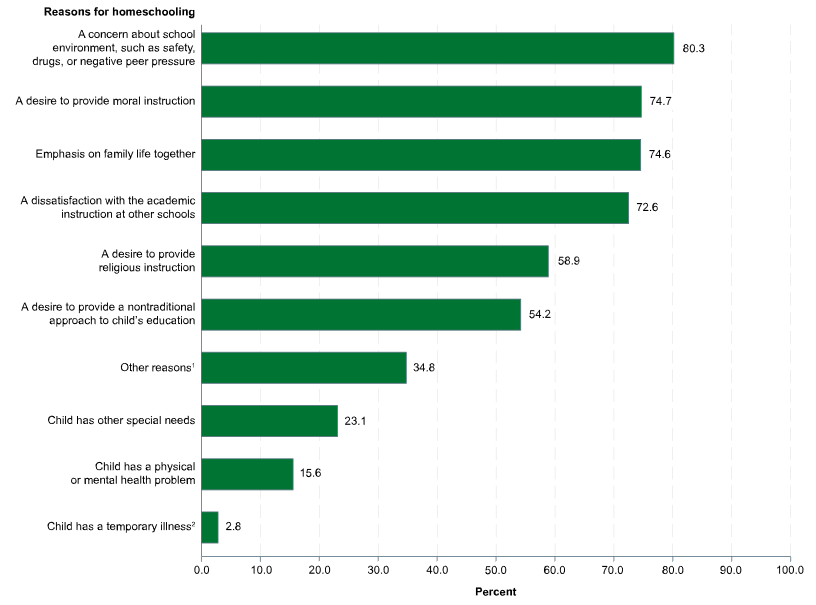
Research from the National Center for Education Statistics from 2022 shows that four of the five most popular reasons why parents decide to homeschool their children are social-cultural rather than academic:

  • concerns about the school environment (safety, drugs, peer pressure)
  • wanting to provide moral instruction
  • emphasis on a family life together
  • wanting to provide religious instruction.

In the meantime, growth in the market for education technology solutions, in part further stimulated by the pandemic, has ensured that good quality learning resources are available at scale in the home environment, thereby lowering this particular former barrier to homeschooling.

“Old school”, “new school”, “not school”?

The trend towards homeschooling reminded me of the scenario planning we had done at Sanoma about the future of education some 15 years ago, especially considering three main scenarios i) “old school” ii) “new school” and iii) “not school”. I had personally not expected the “not school” model to break through due to the high value-add of the professional teacher and the high economic and organisational implications for the family (typically requiring one parent to stay at home).  I had expected technology to underpin the further development of all three scenarios but had not foreseen the pandemic nor the increased polarisation of society at the time, which are surely factors that have made some impact on the growth of homeschooling.

I wonder what the trend to homeschooling might mean for homeschooled children and families? What impact will it have on public education systems and society as a whole?

Should we take the child out of the school, or bring the parent into the pedagogy?

School is in some ways already a limited intervention in the learning and development of a child, after all more than 80% of their time is spent outside of school. To what extent might approaches that encourage greater parental engagement in education help to support the learning of the child and help to remedy some of the social and cultural concerns that some parents have about schools?

It seems likely that more hybrid models might emerge, combining the professional and economic benefits of the school with the social and cultural engagement of the family.  Typically, an encouraging home environment, a high level of personal attention and more personalisation, tend to support learning.  Have we “outsourced” too much to schools? Especially in a world of increasing teacher shortages, might greater involvement of parents be part of the solution?

How big is the global teacher shortage?

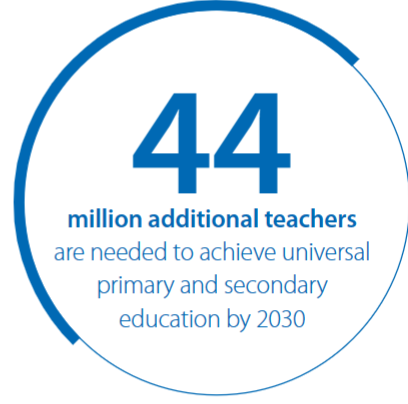
According to UNESCO in a report published this week, we need to attract no less than 44 million additional teachers into the profession to achieve universal primary and secondary education by 2030.

¡Viva la profesora!

Put in to context, that’s more than half the size of the current global workforce of teachers (about 77M) and roughly the population of Spain!

Hello, Goodbye

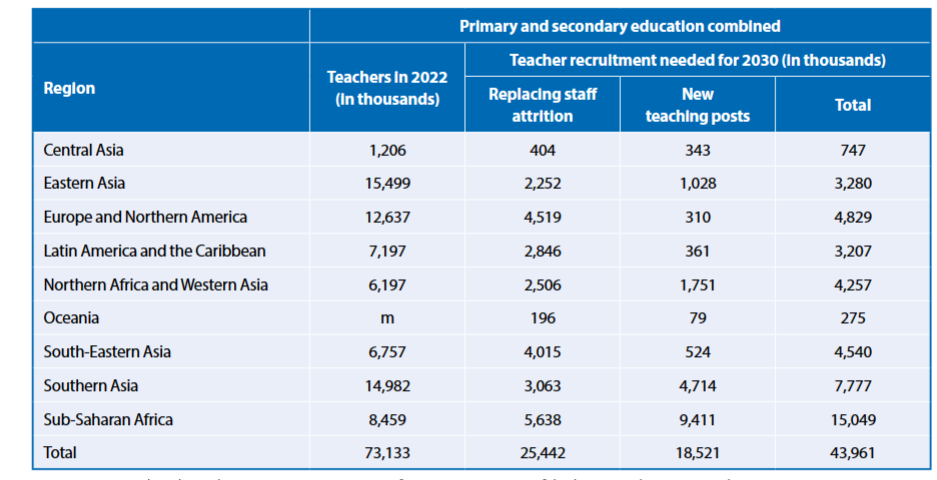
The gap is caused by two main factors (with the impact and underlying drivers differing significantly by country):

  1. Expansion as demographics push education systems to grow (42% of the 44M), and
  2. Attrition due to teachers leaving the profession (58% of the 44M).

About 1/3 of the total demand for new teachers by 2030 comes from Sub-Saharan Africa (15M additional teachers). This is driven to a significant extent by demographics and growing access to secondary education (62% of the gap is to fill new teaching posts). However 93% of the 4.8M additional teachers required in Europe and North America, are needed because of attrition.

Push, Pull, Personal

There are clearly many factors that affect teacher recruitment, retention, job satisfaction and productivity, often driven by local dynamics. Broadly, the report highlights several “push factors” (e.g. working conditions, teacher well-being), “pull factors” (e.g. remuneration and professional development) and “personal reasons” (e.g. retirement, health, family circumstances) that influence whether people join the profession and how long they stick with it.

Can AI solve the problem?

There isn’t going to be a one-size-fits-all answer to finding 44M new teachers in the coming years. AI can surely help in many areas, such as optimising the recruitment and deployment of the teaching workforce, and saving time on administrative tasks for teachers so they can focus on teaching (about half of the working time of a typical teacher is spent on non-teaching tasks outside the classroom).

However, beware of solutions that completely substitute teachers. The human teacher plays an essential role in the process of learning and coaching. Parents are unlikely to leave their (especially younger) children in the hands of a robot. Larger class sizes will likely exacerbate the negative “push factors” in the teacher workplace.

In my view, solutions that super-charge rather than disintermediate teachers are most likely to succeed.

Imagine all the Teachers

Imagine the positive impact we can make on the prosperity, well-being and sustainability of the next generation across the globe when we ensure universal access to primary and secondary education. On the other hand, imagine what declining levels of literacy and numeracy might mean, not only in a faraway land but in your own neighbourhood.

This is a high impact, solvable challenge. We should give it the priority it needs.

Tick Tock, the clock is ticking for a literate society.

“An unprecedented drop in literacy and numeracy across the OECD”

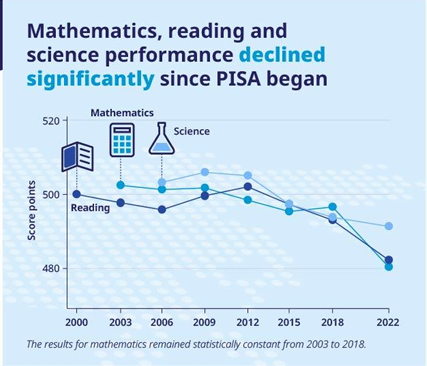
There has been an unprecedented and disturbing drop in average performance for literacy and numeracy in the OECD, as evidenced by recently published research based on data from 2022. https://www.oecd.org/pisa/. Mean performance in mathematics fell by 15 points (equivalent to nine months of learning) and in reading by 10 points (six months of learning loss). Fortunately, average scores for science were maintained.

One in three functionally illiterate

In my home country, The Netherlands, which is one of the richest and most socially progressive places on Earth, with a high commitment to education, the data indicate that one in three students are at risk of being functionally illiterate when they leave school. One in three! That’s up from one in four in the research from 2018. What an enormous loss of potential for these children and our society.  It also makes you wonder how we can spend 12 years and €100,000 per student on education with an outcome that one in three cannot read at the level required to function at school or in society at the end of the journey.

Problem pre-dates pandemic

It would be logical to think that COVID-19 might be the primary cause of this negative development. However, the trend analysis indicates that the decline had begun before the pandemic and peak performance was 10-15 years ago. There are longer-term issues at play. 

Resilience factors could guide the way forward

Some education systems (especially in East Asia and the Baltics) showed both resilience to the disruption from the pandemic, and structurally high learning outcomes. PISA observed 10 factors that contributed to this resilience, and could be helpful in bolstering future approaches, three of which particularly relate to digital, namely:

  1. They ensured good access to skilled teachers, high-quality digital learning materials and devices and developed guidelines for their use.
  2. They limited distractions from digital devices in the classroom (particularly from smartphones and social media) by policies at school.
  3. They prepared students for autonomous and remote learning.

(Screen)-time well spent?

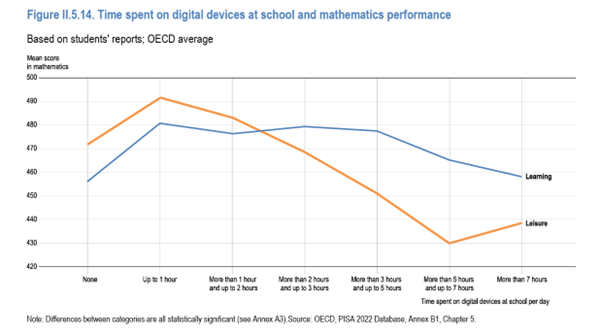
Overall, the evidence shows that using digital/devices for learning purposes in schools yields higher outcomes than not doing so, with the effect tapering off after about five hours per day.  Somewhat surprisingly, the impact of using devices for leisure purposes at school was also correlated with higher learning outcomes, although this turns more sharply negative after about two hours per day.

Most schools have articulated policies about using digital devices on site. However, the least common practices were i) not allowing the use of cell phones (34% of students attended such schools), and ii) having a specific policy about using social networks (51% of students).  In The Netherlands (2022 data), less than 10% of students attended schools where the use of cell phones was not allowed and one in three reported that every or most lessons were disturbed by digital devices.

Tick Tock, the clock is ticking to maintain a fully literate and numerate society

With good quality materials, a focus on learning outcomes and sensible rules of engagement, the use of digital in classrooms enables a positive impact on learning.  

However, smartphones and social media are disturbing the classroom and learning experience and this is likely contributing to why one in three of the kids around here could be functionally illiterate when they leave school.

No time to lose

We need to think again how we systemically approach this better for current and future students and what we can do to bolster the life-chances of this cohort of students with lower literacy and numeracy skills.  Education is a long play, with impact not only on individual lives but crossing generations. There is no time to lose.

Teachers Want to Go Digital Where it Brings Most Benefits

In the fifth annual Sanoma Learning Impact Framework (SLIF), we decided to focus on the main tasks the teacher performs in her profession. In total 7075 teachers responded to the survey, which was again carried out in all of the markets in which we operate: Belgium, Finland, The Netherlands, Poland and Sweden.

Core activities

The main tasks for teacher are: lesson planning, teaching the whole class, exercising, testing, assessment and giving guidance personally or in small groups. Of course there are other tasks too, such as administrative work and professional development, but these are the most frequently repeated activities.

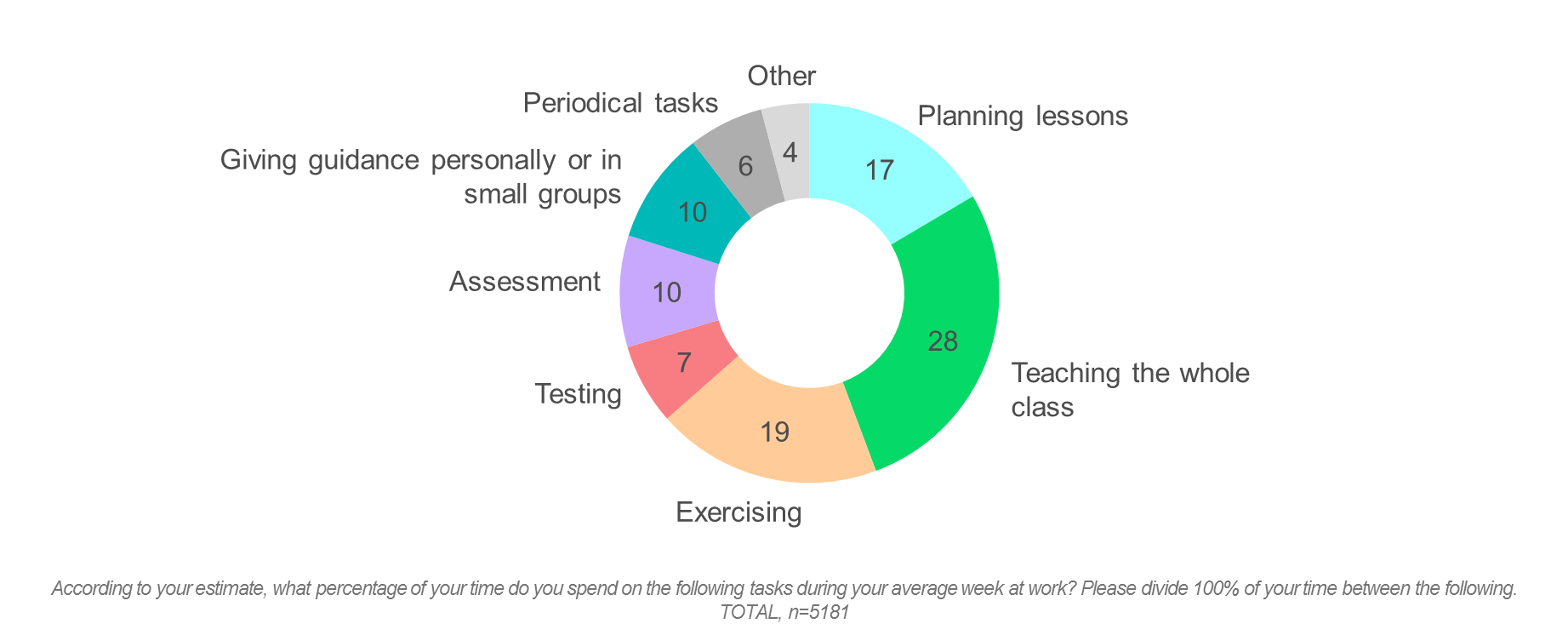
Figure 1 depicts the amount of time teachers estimate they spend on each activity. Teaching the whole study group takes most of the teachers’ time, but still only less than a third.

activities

Figure 1. Percentage of time spent on different tasks

As part of the digital transformation, we are as an educational publisher very interested in whether teachers prefer print or digital materials to support them in their work. Our experience so far is that they value both, and in last year’s SLIF we came to the conclusion that blended learning is the way to go.

As-is/to-be: medium vs activity

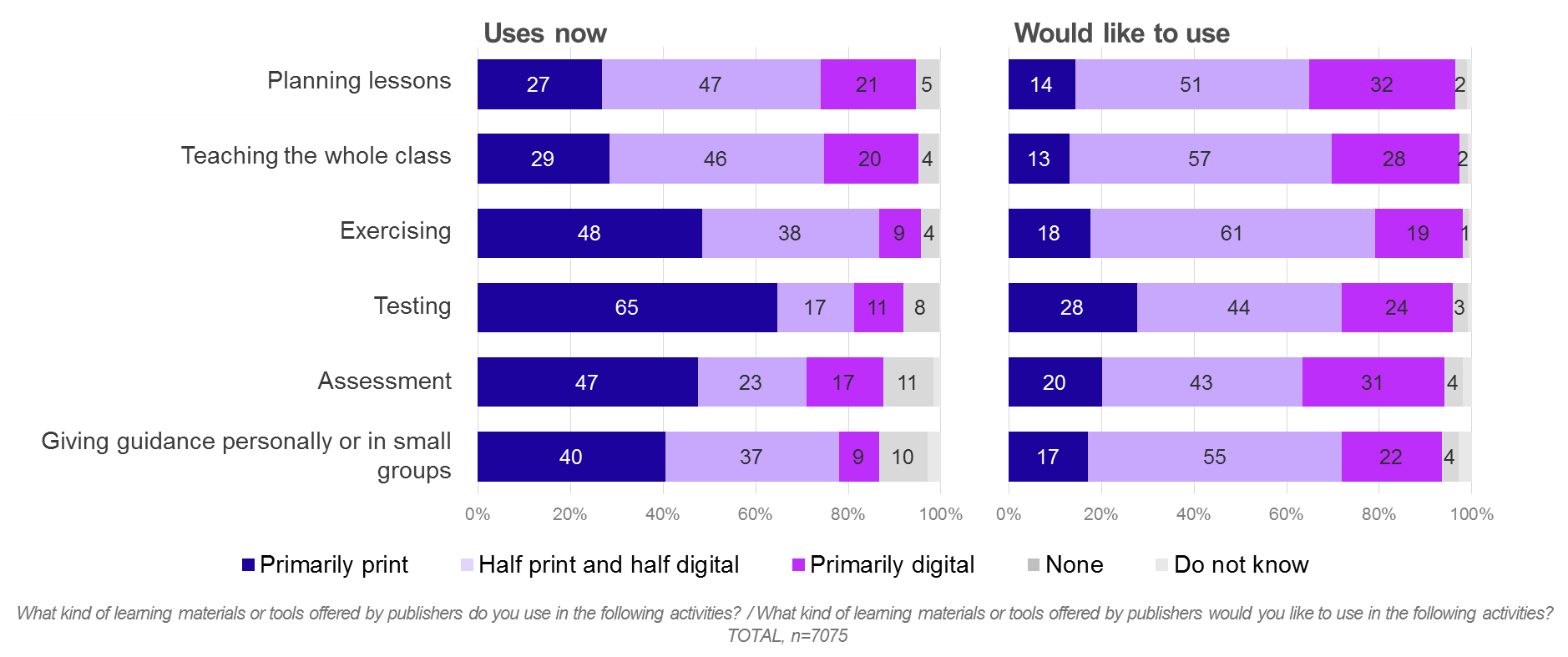
This time we decided to be more specific and map the print vs. digital axis with the activities a teacher carries out. This provided us with revealing results, as depicted in Figure 2.

present_vs_ideal

Figure 2. Materials and tools offered by publishers: Current use vs. Willingness to use

First of all, teachers would like to use more digital materials in all tasks than at present. Secondly, and perhaps more interestingly, the gap between current and desired state is the greatest in tasks where pupils/students have a relatively more active role, namely exercising, testing, and assessment.

Currently 65% of teachers are using printed tests/exams. 28% say they use half & half or primarily digital tests/exams. Contrasting this with the desired state is staggering and the percentages get flipped: only 28% would like to use primarily print and 68% half or primarily digital. A similar phenomenon can be seen in exercising and assessment.

Digital where it makes most impact

What to make of this? We think the answer is simple. Both exercising and testing generate a lot of new content and insights for the teacher to go through. This makes assessment time-consuming for the teacher. With both questions and answers in a digital form, time is saved, insights are increased and pupil/student engagement is enhanced. Teachers are selectively looking to use digital for maximum impact.

Santtu Toivonen, Lead Insight Manager, Sanoma Pro

John Martin, CEO, Sanoma Learning

Creating a European Champion in Learning

CMD cover

We’re an ambitious company and we are working on building a European Champion in Learning.

Last week we held our annual Capital Markets Day event in Helsinki – which is a good chance for us to share our plans with the investment community.  It was a positive day.  The team was in good spirits and there were lots of great questions from the participants.

I talked about our approach to building a European Champion. Check out the video of the session here.

Our starting point is strong: we serve 10m pupils and 1m teachers in some of the world’s best and most advanced education systems.  We’re a front runner on the digital transformation and have a strong financial performance and track record.  We have a solid plan and believe we can add even more value for our customers in the future.

We have a three pillar strategy to build this European Champion:

  • Win in local markets, by serving our customers well
  • Work together across borders to create one integrated company
  • Make selective acquisitions in current and new learning markets

We’re really excited about the opportunities for the business and our team is going for it!

I’m interested to hear your views and if you see opportunities that you think we should be developing too.

CMD strategy