Category Archives: Learning

Inspiring kick-off Sanoma’s Learning Lab in Leiden

Today we kicked-off of the Learning Lab at the Da Vinci College in Leiden, The Netherlands. I was super-excited about this for both professional and personal reasons. I’m passionate about our goal to improve learning as we transform to a more personalized future. I like and respect the forward-looking Da Vinci College in my home-town – the “education city” of Leiden. And this is a great collaboration between Learning and Digital at Sanoma, the teams to which I have committed my professional life in recent years.

Inspiring introductions

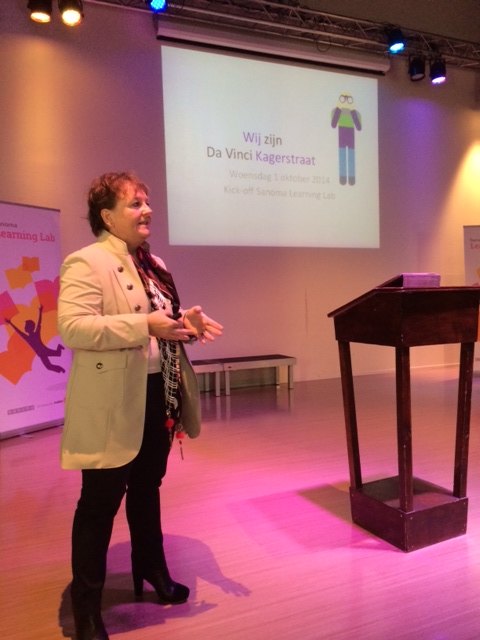
annick2We started with some inspiring introductions from the school, Sanoma and facilitator MakerLab. One of the absolute highlights of the day for me was the introduction and welcome to Da Vinci College Kagerstraat by Rector Annick Dezitter. I’d met her before on a visit to the school when we had discussed the personalization of learning. In her introduction, she talked openly and passionately about the future and had a very engaging personal style. I imagine she is an inspiring Rector! She is originally from Belgium and the two Belgians in our Learning Lab team (Johan Merlevede, Chief Transformation Officer in Sanoma Learning’s Leadership Team – the overall sponsor of the Learning Lab, and Joris van Heukelom, Partner at MakerStreet) both proudly reminded me that they are Belgian too, after her speech :-). I very much appreciated her warm welcome and inspiring words.

Lassi Kurkijarvi, innovation hero, at the kick-offAnother highlight was from my former colleague and founder of Sanoma Lab, Lassi Kurkijarvi. He was my first hire at Sanoma Digital and is a mobile native with a can-do mentality and a big heart. I love working with that guy and have learned a lot from him about engaging people. I really liked to see how the style and content of his session had deepened and progressed from our very first accelerator a couple of years ago (it was already good then). I love to see people grow like that!

Selecting the ideas and team leaders

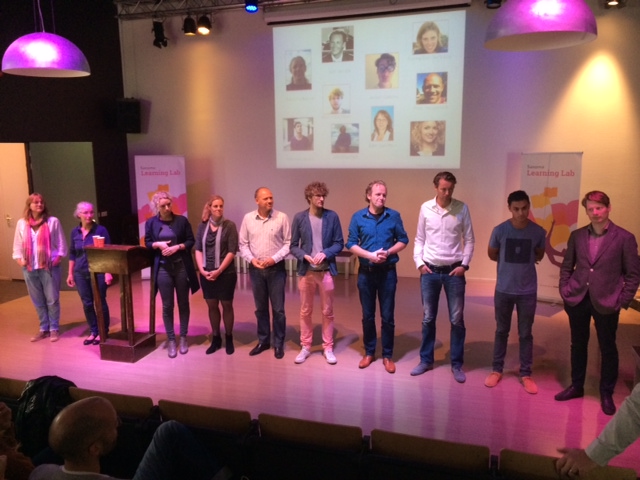
The ten idea owners who will lead the teams from HollandNext, each of the 30 participants pitched their ideas and 10 were chosen to lead teams to develop their concept in the next stage. Seven were selected by the crowd and three through wildcards. It was really fast-paced and exciting! It was great to hear the ideas and to get a sense of the person behind the idea during the pitch. I was very happy with the selection of people and ideas. The 10 team leaders include four teachers, three Sanoma employees and three external “open” applicants. A great mix of talent!

Working out

After lunch the real work began with the first workshop. The teams were formed and the first steps were taken. I’m curious where this will lead us. The spirit and energy were good.

Looking forward >>

We will be continuing with similar kick-offs in Gdansk, Antwerp, Helsinki and Stockholm in the coming days. We will then develop the concepts, five of which will eventually win a place to build a prototype of their idea at bootcamp in Amsterdam in December. I’m truly excited about this! Thanks to everyone who is joining us and respect to you! Looking forward >>

Leading the digital transformation in learning at Malmberg

lijn3Excellence and innovation

Sanoma Learning’s reputation internationally is built on two pillars. First of all, we are a leading and integral player in some of the World’s best-performing education systems including Finland, The Netherlands, Belgium, Poland and also in Sweden. Secondly, we are frontrunners in the digital transformation – with about € 50 m of new media and roughly € 100 m of multi-channel solutions sales (on a total sales base of roughly € 300 m) we are arguably Europe’s leading edtech company today.

“Now is education’s internet moment.”

We are passionate about education and are keen to play a leading role in building the next generation of learning solutions. Our purpose is to enable teachers to develop the talents of every child. And as we develop our learning solutions we keep three goals in mind: i) helping pupils and teachers to achieve great results, ii) supporting the ways of working for time and cost efficiency and iii) engaging pupils and teachers on the journey of learning. We believe digital will be a great enabler in realizing these goals.

Malmberg in The Netherlands at the front of the transformation

Of the markets in which we operate, we see that conditions in The Netherlands are the most mature for adopting digital learning solutions. Our daughter company Malmberg has taken a leading position in the digital transformation and this has been well-received by our customers.

I’ve been super-enthusiastic about the relationship that Sanoma Learning has established with Knewton with Malmberg as trailblazer. I’m really excited to see the prototypes of the next generation solutions we will develop! I am sure they will help to take a quantum leap forward in improving results, efficiency and engagement. I’ve also been happy with the trailblazing role that Malmberg has taken in developing the next generation of editorial tools that we will deploy across Sanoma Learning. Together, these initiatives will help us to serve our customers better and make our business more future proof.

High Five!

In the meantime, school year 2014/2015 has now started and we have gone live with five new big digital initiatives at Malmberg! I wanted to write a few words about them here.

1. Forward (VOoruit) in Secondary Education

VOIn August we went live with our new platform, playing five of our main courses on pc’s, laptops, tablets and smartphones. It looks really great! During the next year we will be migrating more courses onto the platform and eventually expect to power it with Knewton technology, bringing market-leading adaptive learning technology to The Netherlands. The platform covers the complete learning/teaching process from instruction to testing and also includes adaptive practice testing and learning analytics. This is going to really help pupils and teachers! Adoption has exceeded expectations an it’s really been a step up in terms of user experience.

We believe this platform takes us a step ahead of the competition and are going to use it to win a position in the market for maths, which is the biggest market in which we don’t yet have an offering. The time is ripe for renewal in that market. We are building the course now and will launch it next school year.

2. Language Blocks (Taalblokken) in Vocational Education

taalblokkenThis year we have renewed our didactic concept, concept and platform for Taalblokken. We have focused on usability and differentiation. Our first usability analysis has just been completed and both students and teachers have rated the solution with 8/10. Great! A few years ago, Taalblokken and Rekenbloken (languages and maths) were our first courses to play digital first/digital only, and they have been a big success for teachers and students and also helped us to grow our business. We have the ambition to sell 25% more student licences this year, and the signs are that we will achieve that.

3. Pluspunt Digitaal in Primary Education

pluspuntWe are market leader in primary education and our platform is now used by more than 1 m pupils in The Netherlands. We have just created a fully digital tablet version of our winning maths course Pluspunt and are testing it with 40 schools. We expect this course will help teachers and pupils to get better learning results, save time and stay motivated. We also notice that they trust the brand and like that they can deploy print and digital as they wish.

4. Final year testing (eindtoets) in Primary Education via ICE

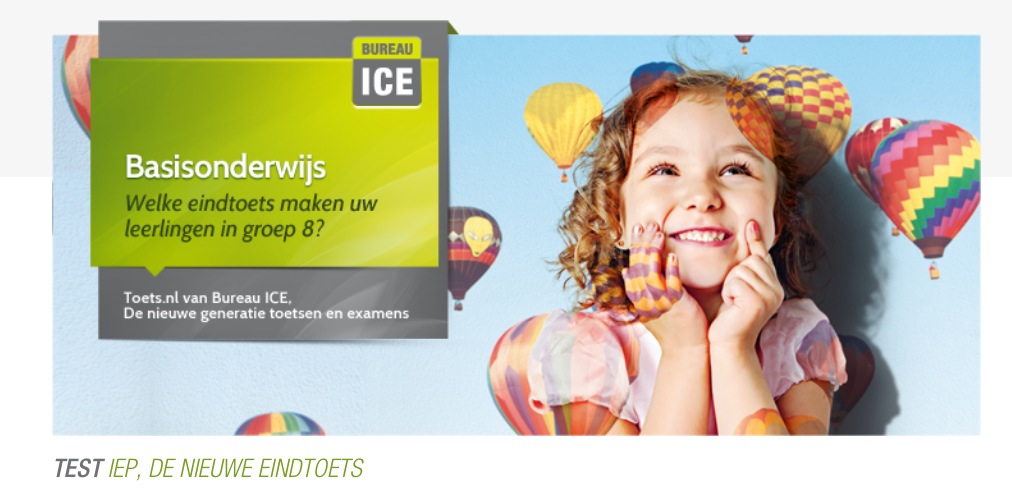
iepThe government has taken the good decision to open the market for the final year test to new entrants. ICE has an excellent reputation for quality, usability, innovation and digital and we are introducing a new solution to be deployed in 2015. This will be great for our customers and the competition will be good for the market. Cito, here we come!

5. Taking the Primary Curriculum into the home with Family Pluym

pluymWe’ve extended our language and maths courses to the home via a fully digital learning environment following the learning lines and pace of the school curriculum. We started with a soft launch last week and will be rolling it out in the next month. I really like the user experience and believe that parents are increasingly looking to support the learning of their children in the home environment. Our market research and user testing have shown that parents and children like the extension of the trusted school brand into the home too – you know that it is high quality and in time and in tune with the school. This is a potentially new market for us and I am very curious how this will develop.

Investing in the future of learning

2014 is a crucial year for us in investing for the digital future. The first signs are that our customers appreciate and have adopted the renewed offerings.

I admire the frontrunner role that Malmberg takes at Sanoma Learning and in the Dutch market. Customer focus and innovation sit deep in the genes of our people. Respect!

Looking forward >>

Sanoma’s Learning Lab hits the right note

learning-labI love the start of the new school year: it feels like a time of new beginnings and new opportunities. I’m especially excited about the coming semester because we will be running our Learning Lab in partnership with five great innovative schools!

Improving the impact of education on learning

We’re a key partner to schools and frontrunner in the digital transformation in some of the World’s best performing education systems, including Finland, The Netherlands, Belgium, Poland and also Sweden. We’re deeply committed to supporting excellence and equity in education. And we see that many stakeholders in education are looking for renewal: for improved learning outcomes, for better engagement and for new ways of working. Our goal with this Learning Lab is to co-create new concepts, together with our partners, that help to improve and evidence the impact of education on learning.

In time and in tune with teachers

Our target was to recruit 150 participants. However, the Lab has been heavily over-subscribed: we have received about 350 applications! We will increase capacity to take account of this. Interest has been especially strong from teachers. The subject and timing of this innovation lab seems to be very much in line with the needs of our customers. We really appreciate your trust in working together with us in developing new ways of teaching and learning.

Five innovative partners

Thanks to all the individuals and also to the five partner schools for showing their innovative colours and joining us on this journey of discovery. The partner schools are:

It’s great that you have taken on this challenge together with us.

Looking forward >>

I can’t wait for the kick-offs at the beginning of October. We’re going to learn new skills, broaden our networks and take a positive step to improving learning.  And we’ll have a lot of fun on the way!  I’m excited to be working with you on this initiative in the next few months!

Designing the Future of Digital Education

Jose Ferreira of Knewton interviewing Hillary Rodham Clinton

Jose Ferreira, CEO of Knewton interviewing Hillary Rodham Clinton, former US Secretary of State

This week I joined the Knewton Symposium in San Francisco and was a panel speaker on the subject of “Digital Readiness”. We have recently started partnering with Knewton, which I am enthusiastic about since I believe adaptive learning is the next generation. I joined the meeting to make sure I’m up-to-date on the latest thinking and for the networking opportunity.

Great program

The program was a mix of speakers and panel sessions. I especially liked the interesting and provocative speakers:
Jose Ferreira, CEO of Knewton (“transparency on what drives outcomes”);
Andy Rosen, CEO of Kaplan (“why Knewton will fail” – which emphasized the open dialogue of the symposium);
Michael Crow, President of Arizona State University (I was intrigued by his words about the “rise of the super-faculty” – it sparked my interest in the potential “rise of the super-teacher” enabled by technology in schools).

Also, some of the panel sessions gave food for thought, especially:
Investing in Edtech (I liked the quote by Michael Moe, partner at GSV “the best IRR will be produced by education companies that deliver the best ROE”)
The OER Impact (“80% of materials for university foundation years can be found Open Source”)

It was great to hear the “Big Ideas” of entrepreneur Tyler Bosmeny, CEO of Clever about solving Single-Sign-On and intrapreneur Ben Schrom from Google Classroom about simplifying digital workflows. (It was nice that he cited me and my “killer app of education is the teacher” quote too, a boost for Finnish thinking there :)).

Go Hillary!

From my perspective, the highlight of the meeting was the interview with Former US Secretary of State Hillary Rodham Clinton. She talked intelligently and engagingly about international affairs in a no-nonsense and straightforward way. Firm but fair. I liked her passion and commitment to education, for example with the “Too small to fail” program, helping to improve the health and well-being of children aged 0-5 years. Her words about making sure that schools are fit for children to attend and treating teachers as professionals appealed to me too. We had a short photo session afterwards, and even though we exchanged only a few words, she was funny and nice and I really liked her. Go for President Hillary!

Main takeaways

The three main takeaways for me from the meeting were:
1. The move to adaptive learning is the next generation. I believe we are right to be investing.
2. It will be of great importance to evidence and improve outcomes and to take a more proactive stance in positioning outcomes in our value proposition. We need to raise our game here. Our Learning Lab starting in September can help us in that regard.
3. It’s good to look and be outside, to be up-to-date with the latest developments and to be connected with talented people in the industry alongside the talent we have at Sanoma Learning.

Thank you Knewton!

It’s always great to be in the USA. I love the optimism and the way they go for it! Thanks to the Knewton team for having arranged a great meeting!

Inspiring leadership in education

This week I attended the Global Education Conference in Boston sponsored by Harvard and Goldman Sachs. This was one of the most inspiring conferences I’ve attended in recent years. Sessions were spread over two days and included hot topics such as “financing disruption”, “creating value in a world of content abundance”, “bridging the skills gap” and “the promise of accessible education”.

I could happily write a post about each of them. But I will write about just one. The absolute highlight of the meeting for me was the opening keynote by Geoffrey Canada, CEO of the Harlem Children’s Zone, a charter school network of 12,300 students in New York. He has been instrumental in improving the performance of his students over a period of two decades such that 95% of high school seniors these days are accepted into college. He gave the best live keynote speech I have ever seen.

GeoffreyCanadaMuch of the focus of the conference was on technology, and I certainly believe that technology can be a great enabler in improving education.

However, Geoffrey’s impact comes from excellent leadership. In particular in taking actions to re-set the normative behaviour amongst the stakeholders including the local community. In a nutshell, in changing expectations in the community from “you have to be a genius to go to college” to “if he can do it, I can do it”. And amongst teachers from “don’t blame me, this is a mission impossible” to “my job is to get these kids into college”.

I personally believe that excellent education can be delivered when skilled teachers, motivated pupils and high quality learning materials play together effectively for the benefit of the learning of the pupil. The role of the school leader has not been strong on my radar. But of course, these three cornerstones rely on selecting and leading the right teachers and ensuring that a healthy culture and practices are in place in schools and their communities! The role of the school leader is pivotal. I should re-examine my beliefs!

Canada is a brilliant and inspiring speaker. You know that he wants the best for his pupils. You know that he will do whatever it takes to make it happen. He is highly engaging and has tremendous energy. He’s firm but fair. It’s not about him, it’s about the future of the kids at his school. I liked the clarity of his message. “Your job is to get these kids into college. The military is good. Vocational training is good too. But your job is to get these kids into college. That is what I expect from you”. I liked that he saw it as a journey. Year-on-year he saw impact. But transformation is a journey and the impact 20 years later was massive.

What would the equivalent message be for my own team? The essence of it is “help teachers to excel at developing the talents of every child in their class”. I believe this is the right direction and will be the journey of learning in the coming decade. How to achieve and measure that? If you have inspiring ideas then you are welcome to join our Learning Lab this coming Autumn!

Most of Canada’s keynote was energetic and funny. He is also a poet and took a more serious tone at the end by reading one of his own poems “Don’t blame me”. Inspiring and touching. Thanks Mr Canada, a brilliant leader, for making a positive impact on thousands of lives, and for inspiring me too.

DON’T BLAME ME
February 2007

The girl’s mother said, “Don’t blame me.
Her father left when she was three.
I know she don’t know her ABCs, her 1,2,3s,
But I am poor and work hard you see.”
You know the story, it’s don’t blame me.

The teacher shook her head and said,
“Don’t blame me, I know it’s sad.
He’s ten, but if the truth be told,
He reads like he was six years old.
And math, don’t ask.
It’s sad you see.
Wish I could do more, but it’s after three.
Blame the mom, blame society, blame the system.
Just don’t blame me.”

The judge was angry, his expression cold.
He scowled and said, “Son you’ve been told.
Break the law again and you’ll do time.
You’ve robbed with a gun.
Have you lost your mind?”
The young man opened his mouth to beg.
“Save your breath,” he heard instead.
“Your daddy left when you were two.
Your momma didn’t take care of you.
Your school prepared you for this fall.
Can’t read, can’t write, can’t spell at all.
But you did the crime for all to see.
You’re going to jail, son.
Don’t blame me.”

If there is a God or a person supreme,
A final reckoning, for the kind and the mean,
And judgment is rendered on who passed the buck,
Who blamed the victim or proudly stood up,
You’ll say to the world, “While I couldn’t save all,
I did not let these children fall.
By the thousands I helped all I could see.
No excuses, I took full responsibility.
No matter if they were black or white,
Were cursed, ignored, were wrong or right,
Were shunned, pre-judged, were short or tall,
I did my best to save them all.”
And I will bear witness for eternity
That you can state proudly,
“Don’t blame me.”

Sanoma Learning Lab: Co-create for Impact

sloa-header-1We’re going to run a Learning Lab this Autumn and I would like to invite you to join us. We’re going to develop new concepts with you, to improve and evidence the impact of education on learning.

There are 3 reasons why I would love you (teachers, academics, university students and Sanoma employees) to apply for a place at our learning lab:

1. Fantastic learning experience

You’ll get trained in start-up methods and work with experts on developing your idea. You might even win a place at bootcamp to build a prototype of it with a dedicated team of designers and developers. I’ve previously blogged about how such a program works and what happens at bootcamp. It’s really exciting to be part of it!

2. Great networking

The Lab will be a great way to build relationships with other professionals passionate about the future of learning, both locally and internationally. People from diverse backgrounds, from instructional design to user experience to learning analytics. People who want to make a difference in education.

3. Make an impact on the future of learning

We’ll co-develop new concepts with you, to improve and evidence the impact of education and to contribute to the future of learning. Concepts that will improve learning results, support the ways of working and help to better engage pupils. It’s about the future of learning.

Join us!

We’ll be accepting applications until 24th August. Please go to www.sanomalearninglab.com and apply. I really hope you’ll join us! Looking forward >>.

The killer app in education is the teacher

edtech-logoLast week the second EdTech Europe meeting was held in London. It was an inspiring day and attracted high quality participants including quite a large audience of start-ups, established operating companies and investors. Thanks to Charles McIntyre, CEO of IBIS Capital and Benjamin Vedrenne-Cloquet, Founding CEO of Edxus Group, for having arranged this excellent meeting!

I was a speaker on one of the panels and also a member of the Advisory Board, so I was happy it was a success. I loved engaging with the entrepreneurs running the edtech ventures. It’s inspiring to hear their stories and feel their energy. And it was also a great networking event for meeting peers from across Europe.

Technology, platform, content, data?

This was a meeting about educational technology, so there was rightly a lot of discussion about the transformation of education and the roles that technology, platforms, content and data will play. What will be the “killer app” of education in the future?

The killer app in education today is the teacher

Today I believe that the “killer app” of K-12 education is the teacher. Great teachers engage individuals and classes, ensuring that they are motivated to learn. They stretch and support individual pupils so that they reach the best learning outcome they can. And they guide the ways of working such that learning time is spent usefully.

Technology will both enable and disrupt teachers in the future

Effective use of technology, platforms, content and data can help to raise learning outcomes (e.g. data-driven personalised learning), bring efficiency to the ways of working (e.g. automation and performance dashboards), and support engagement and motivation (e.g. gamification and storyfication). The teacher is therefore likely to get both enabled and disrupted by technology in the future.

Yet although the role of the teacher will change, I believe they will remain the “killer app” of education in the future too. They are likely to remain the leader of the classroom. They will probably more-or-less remain as the primary guide and gatekeeper to the learning activities that are carried out. And their relationship with classes and individual pupils will remain pivotal to engagement and motivation.

Enable teachers to develop each child

Our ambition is to use edtech to enable teachers to excel at developing the talents of every child, resulting in higher outcomes, better engagement and new ways of working. That’s something I believe in and would be keen to invest in.

Lifelong learning

Last week was the anniversary of the week that my father died – a long time ago in the meantime. He was a good and decent man and our family grew up in a loving home. These days I think about him when there is something happening in the family and during that last week of May that has just passed.

I got my passion for learning from my father. He was not educated, but he believed in the power of education.

  • He made me want to contribute to creating a better world
  • He encouraged my curious mind
  • He expected me to have high expectations of myself
  • He taught me to work hard and to be persistent.

I remember the happy times we had together in the past. I am thankful that our family is in good health and good spirit today. And I am grateful that you gave me a life-long love of learning.

Rest in peace Dad x.

Revitalizing Primary and Secondary Education in Russia

Last weekend I was a speaker/panelist at the St Petersburg International Economic Forum on the subject of Revitalizing Primary and Secondary Education in Russia. Learning outcomes in Russia are rather uncompetitive when seen from an international perspective. I was also surprised to hear that schools in many urban areas run two shifts a day due to a lack of capacity.

Although Sanoma Learning is not currently directly active on the Russian market, we were interested to contribute to the discussion. Firstly, because we believe that education is one of the most powerful instruments known for developing individual talent, reducing poverty and inequality and for laying the basis for sustained economic growth, sound governance and effective institutions across the globe. And secondly since we might be able to contribute to improving Russian learning outcomes in the future.

What can Russia learn from our experience?

I was asked what Russia could learn from our experience. I cannot claim to be an expert on Russian education. However, we are an integral player in a number of education systems that consistently perform very well – including Finland, The Netherlands and Belgium. In addition we are the market leader in Poland which has been one of the rising stars on outcomes in recent years. And we have recently acquired a position in Sweden and are keen to support teachers in raising learning outcomes there too.

On the basis of our experience in these successful systems, we believe there are three cornerstones of excellence in primary and secondary education.

1. Skilled and motivated teachers

The first cornerstone is to make sure the level of skills and motivation of teachers is high. A skilled teacher is like a great leader – the impact is huge. They are the heroes and heroines of education. For example, this means:
a. Getting the best people to apply to teacher training
b. Paying them adequately
c. Making sure they are treated with respect, both in school and in society
d. Not over-managing them – they are professionals. Give them space to run their classes without too many rules
e. Making sure they have access to good learning and teaching materials and are free to choose them based on their professional insights. State-prescribed and created materials tend to lead to lower standards and reduced motivation for teachers
f. Keeping their skills up-to-date.

2. Motivated pupils

The second cornerstone is to ensure that pupils are motivated. The correlation between motivation and outcomes is high. This includes:
a. As described above, recruiting and retaining good teachers who can motivate pupils and classes
b. Promoting equity. It’s important to support poorly-performing students and students in economically less advantaged areas. Furthermore, to include marginalized pupils such as those with special needs or from diverse backgrounds and minorities in the mainstream. Their education should be well resourced. It will significantly improve their life chances and lead to better overall outcomes
c. Ensuring that education is valued in society. Amongst others, this will encourage parents to support learning, and this will raise expectations which typically raises outcomes too
d. Finding ways to personalise the process of learning, for example by using technology, or ensuring the teacher has time for individual intervention, or by providing access to tutors. Personalisation improves engagement and better engagement tends to lead to improved outcomes
e. Using high quality learning materials, that both pupils and teachers appreciate.

3. High quality learning solutions

We believe that the third cornerstone to excellence in education is to provide teachers and pupils with high quality learning solutions. They can make a significant contribution to achieving excellent learning outcomes, in a time- and cost-effective manner, whilst keeping pupils and teachers engaged on the journey of learning. Such solutions could include the following elements (for some parts depending on the ICT status of the school):

a. Close “fit” with the local curriculum, language, culture and ways
b. Excellent instructional design
c. Good user experience
d. Play multichannel
e. Capture data and can give insights, and on that basis can be personalisable and adaptive
f. Deploy a coherent learning path and design – easy to use for both pupil and teacher
g. The teacher should have a high level of freedom to choose from a competitive offering – to find the solution that fits them and their class best.

Our beliefs

So those are our beliefs about the cornerstones of creating excellent education systems. There is probably not a single approach that can be copied and pasted across the globe. But the chances are good that most education systems (including Russia) would benefit by focusing on skilled teachers, motivating pupils and providing high quality learning solutions.

Where are the giants of edtech in K-12 education in Europe?

We’re committed to playing a leading role in renewing education for the next generation and believe we can add value by supporting pupils and teachers on three fronts:

– Achieving excellent learning outcomes
– Enabling efficient ways of working, and
– Supporting engagement and motivation.

Technology can be a key enabler on making progress on each of these three fronts, Today, Sanoma Learning is one of Europe’s leading edtech companies, with roughly € 40 M of pure-play digital and € 100 M of multi-channel sales.

We’re ambitious and like to partner with and acquire other edtech companies to help us to support customers on the three fronts mentioned above. Significant amounts of money are being spent on education each year, of the order of 6% of GDP. This is approximately € 800 bn per year in the EU: the market is sizeable and K-12 is a big slice of that. Yet there are relatively few edtech companies established on the continent today that generate more than € 25 M of annual sales. To be honest, I couldn’t name 10 off the top of my head.

Plenty of talent, ideas and capital

IBIS Capital estimates that there are approximately 3,000 e-learning ventures in Europe today. These companies employ a lot of entrepreneurial talent, many of them working on potentially high-impact ideas. Also, it seems to me that it’s not impossibly difficult to find funding for promising edtech ventures. In the USA in Q1/2014 about $ 500 M was committed in new funding to 99 edtech ventures – the biggest quarter for the last five years.

“The market is rich enough in talent, ideas and venture funding.”

So why hasn’t this large and transforming market in K-12 education spurred the growth of a handful of European edtech giants?

To be frank, I don’t know. Let’s start by looking at the context for K-12 education in Europe today. The great majority of the money in the market is spent (directly or indirectly) by the government through schools, many of which are not yet ready for e-learning. Also, the great majority of overall funding is spent on the salaries of teachers; this is absolutely right – teachers are the most critical factor in providing excellent education.

Within this context I think there are probably three main reasons that make it difficult for an edtech giant to emerge from the European continent on the short term:

1. A rather immature ecosystem
A well-functioning e-learning ecosystem can be built if we can make progress on four dimensions in schools: i) a clear vision on what we want to achieve and committed leadership to make it happen ii) good ICT infrastructure iii) availability of content and software and iv) teachers equipped with the skills to get ICT to work for them and their pupils. Although good progress has been made in many countries on many of those dimensions in the last ten years, most of these ecosystems are still relatively immature. In many ways progress needs to be made on each of these dimensions simultaneously in order for the ecosystem to flourish. There are a lot of data available on this. To name one important element – today there are of the order of 5 devices per household in northern Europe but five pupils per workstation at school. The home is a much more advanced digital ecosystem than the school. Surely this is just a matter of timing? Maybe BYOD tablets will provide the impulse the ecosystem needs? In any case, the early stage of the ecosystem hinders the adoption of educational technology.

2. Long sales cycles but narrow sales windows
The great majority of spending on education in Europe is channelled through institutions. Most of those institutions are organised around an annual cycle. Sales processes into them tend to be long and complex and the window of opportunity rather narrow. If your service is great, but you are not well-positioned to make the sale, the opportunity can be lost until the next year, or for many years. This can be killing for start-ups managing their monthly burn rate and can be a big disincentive to some investors and entrepreneurs.

3. Lack of scale
The final area that is probably hindering the emergence of new European edtech giants is the lack of scale in the market. Education systems tend to be organised very locally and can be prone to political influence. There are relatively few things that scale across multiple countries. Even if your business does brilliantly well in one country, it will be very hard to capture that same position across the continent. Edtech ventures from the USA or China enjoy a clear advantage, with large home markets that can attract significant funding.

How can we improve?

Europe has many natural advantages in the edtech space. For example, it’s home to some world-class education systems such as Finland and there’s a rich start-up scene in a number of leading cities. There’s also a reliable and significant commitment to spending on education.

I’m sure there are lots of smart options about taxes and skills and common standards and so on that the EU is working on in building a big single European market, and I imagine many of those things will help. In addition to that I would like to see us getting more proactive as an industry in two areas. Firstly, it would be good to get more transparency on the market. Which of these new ventures are really starting to fly? Initiatives such as Edtech Europe and Sanoma’s Start-up Challenge help, but are not enough. It’s hard (but not impossible :) ) to see the wood for the trees amongst the 3,000 of today. Who should we partner with? And secondly, are there ways for us to create a European network that can bring scale to the market so that we can more rapidly deploy new technology for the benefit of our customers?

I’m interested to hear your views on this. Feel free to drop me a line if you have inspired ideas.

Looking forward >>