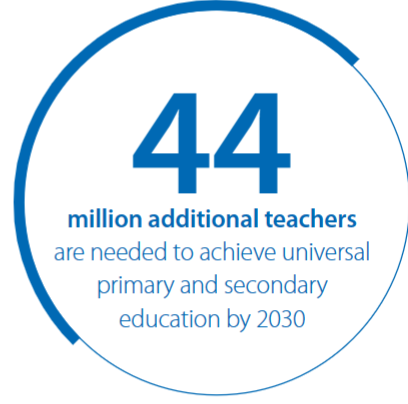
According to UNESCO in a report published this week, we need to attract no less than 44 million additional teachers into the profession to achieve universal primary and secondary education by 2030.
¡Viva la profesora!
Put in to context, that’s more than half the size of the current global workforce of teachers (about 77M) and roughly the population of Spain!
Hello, Goodbye
The gap is caused by two main factors (with the impact and underlying drivers differing significantly by country):
- Expansion as demographics push education systems to grow (42% of the 44M), and
- Attrition due to teachers leaving the profession (58% of the 44M).
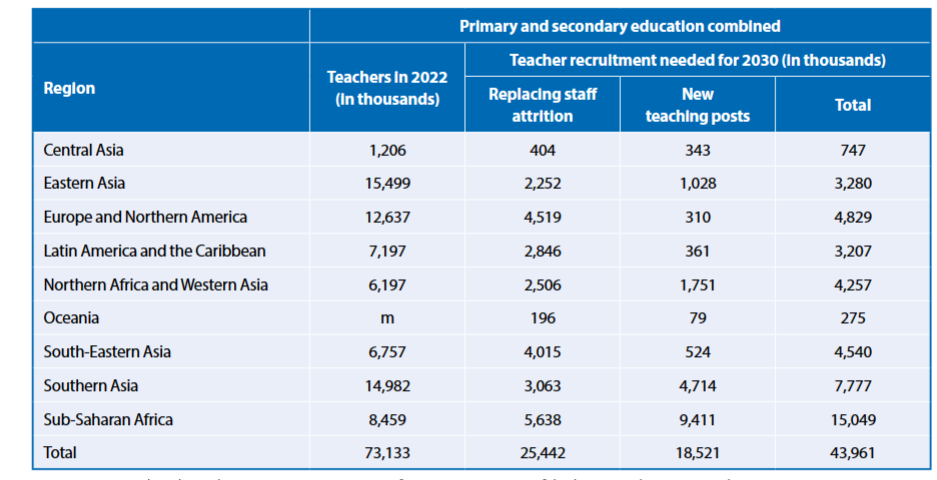
About 1/3 of the total demand for new teachers by 2030 comes from Sub-Saharan Africa (15M additional teachers). This is driven to a significant extent by demographics and growing access to secondary education (62% of the gap is to fill new teaching posts). However 93% of the 4.8M additional teachers required in Europe and North America, are needed because of attrition.
Push, Pull, Personal
There are clearly many factors that affect teacher recruitment, retention, job satisfaction and productivity, often driven by local dynamics. Broadly, the report highlights several “push factors” (e.g. working conditions, teacher well-being), “pull factors” (e.g. remuneration and professional development) and “personal reasons” (e.g. retirement, health, family circumstances) that influence whether people join the profession and how long they stick with it.
Can AI solve the problem?
There isn’t going to be a one-size-fits-all answer to finding 44M new teachers in the coming years. AI can surely help in many areas, such as optimising the recruitment and deployment of the teaching workforce, and saving time on administrative tasks for teachers so they can focus on teaching (about half of the working time of a typical teacher is spent on non-teaching tasks outside the classroom).
However, beware of solutions that completely substitute teachers. The human teacher plays an essential role in the process of learning and coaching. Parents are unlikely to leave their (especially younger) children in the hands of a robot. Larger class sizes will likely exacerbate the negative “push factors” in the teacher workplace.
In my view, solutions that super-charge rather than disintermediate teachers are most likely to succeed.
Imagine all the Teachers
Imagine the positive impact we can make on the prosperity, well-being and sustainability of the next generation across the globe when we ensure universal access to primary and secondary education. On the other hand, imagine what declining levels of literacy and numeracy might mean, not only in a faraway land but in your own neighbourhood.
This is a high impact, solvable challenge. We should give it the priority it needs.









 John Martin