Tag Archives: Edtech

Scaling European Edtech

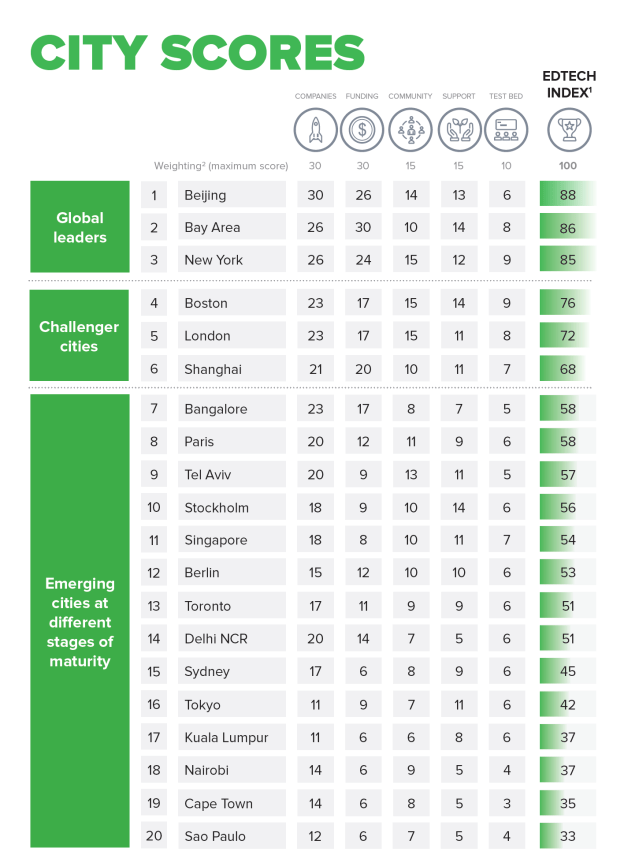
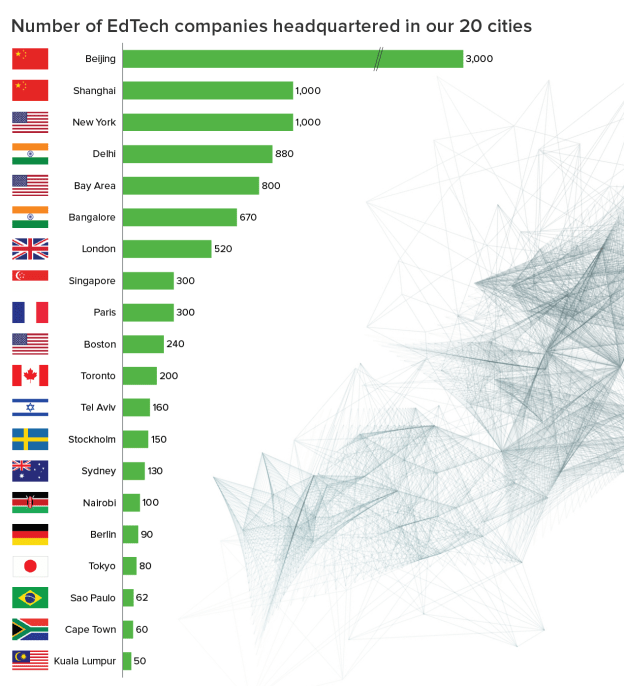
I recently came across this interesting report from Navitas Ventures – Global Edtech Ecosystems 1.0: Connecting the World of Education Technology.  Navitas analysed 20 cities with leading edtech ecosystems representing about 40% of global edtech.  Beijing, the Bay Area and New York are top of the class, with Boston, London and Shanghai challenging.  They also assessed a further 14 emerging ecosystems at different states of maturity.  It’s clear that edtech is thriving across the globe!

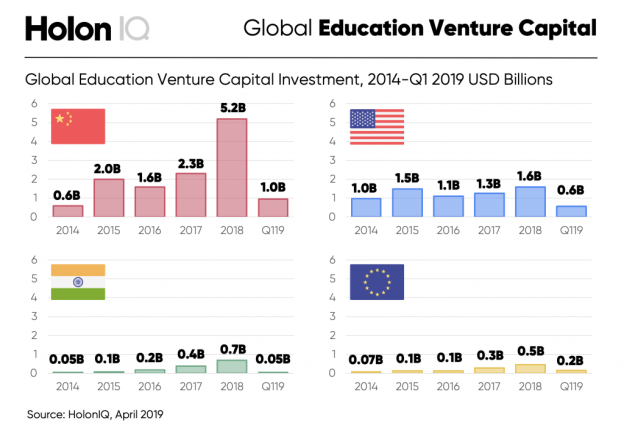
Scale is essential to success in digital and you can see that in edtech too, with the predominance of China and the USA.  In addition, given the demography and emerging status of the edtech ecosystems in India and Sub-Saharan Africa, it’s likely that together these four regions will give birth to a generation of edtech giants.  Edtech could significantly improve the life chances of hundreds of millions of people in these regions by increasing access, participation and engagement in education.  It’s a powerful promise!

HolonIQ

Source: HolonIQ

What about Europe?

Europe has some natural advantages in the edtech space.  We are home to many world-class education systems such as Finland. There’s a rich start-up scene in a number of European cities with London leading (but will Brexit make us BETT-sick?). Paris, Stockholm, Berlin, Helsinki and Amsterdam are vibrant and promising too, in fact there are more than 3000 edtech ventures across Europe today. Furthermore, there is significant and reliable spending on education through governments and ready access to venture and growth funding privately.

However, we lack scale

A lack of scale probably results in us under-serving our own customers.  It restricts our ability to expand to international markets. And it potentially exposes us to competitors grown in the big markets.  A lack of scale is restricting our potential.

European Champions

To address this, I think we need to create a European edtech network with strong go-to-market capabilities so we can effectively scale successful concepts across the continent.  I believe this network would be well served if it includes a handful of Champions to acts as magnets to talent, ideas and capital.

Learning organisation

I am interested in your ideas about how we could bring more scale to European edtech and what you think about the idea of building a European network with Champions.  How could we make that happen?  I’m also curious to learn from some of the challenger and emerging edtech ecosystems: how are they approaching this, what’s working and what’s not?  Learning is in our DNA, we need to put those skills to work if we are to bring this potential to life.

Sanoma’s Start-up Challenge Five Years On

Five years on from Sanoma’s Start-up Challenge on the Future of Learning at TNW2014, I checked out how the five finalists have fared.  I’m impressed!

Winner Labster raises growth funding

Winner of the Challenge Labster has been prospering and announced at the end of last month raising $21M in a series B round to develop more digital lab simulations and to grow in the US market.  Next stop the World.

DragonBox joins Kahoot!

Maths app developer DragonBox announced today that it has been acquired by Kahoot! for $18M.  Their claim is that together they are going to make learning maths awesome!

ClassCharts wins BETT

Edukey’s ClassCharts, a seating planner and behavioural management tool, has gone from strength to strength based on the close understanding of teaching and the classroom underpinned by a strong data and analytics capability. Edukey won Company of the Year at BETT2019.

Jumpido combines movement with software to boost maths learning and looks like quite a fun thing to do in primary schools.  Although the website is still active and the company was a finalist at the Forbes e-volution Award in 2016, they have been rather quiet since.

The website for the final contender Eduvee, an intuitive learning and tutoring platform, now re-directs to the education page of custom software and consulting company Elinext, likely indicating that some form of major pivot has taken place for this company.

Impressive

Overall it’s really impressive to see how much success these companies are achieving.  We were lucky to have selected such a strong cohort for our Start-up Challenge.

Inspiring

What I found inspiring in all of the contestants at the time was their deep understanding of their customers and their passion and drive to make a difference.  Five years on you can see the positive impact of the energy they have put into their ventures.

Looking forward >>

I’m curious on how far these companies will go in the next five years, and wish them every success in turning their ambitions into reality.

Edtech: hotter than the Acropolis in August

At the beginning of the week I was in Athens celebrating my birthday. Let’s just say I was born in the 1970s :). I’ve always had an interest in Greek mythology (it was a good choice to read Mythos on the way) and as a man of learning, I wanted to see more of the homeland of Socrates, Plato and Aristotle.  An inspiring and thoroughly enjoyable visit!

News broke of the sale for $1.75B of plagiarism-checker Turnitin, more than the total amount that all edtech startups raised in 2018 ($1.45B) and also one of the biggest edtech deals this decade, beating LinkedIn’s purchase of Lynda, but smaller than the Ellucian deal.  This underlines the growing importance of technology in learning markets. In the meantime, Sanoma Learning is, with the intended acquisition of Iddink Group, emerging as Europe’s leading edtech company, with a couple of hundred million euros of digital/multichannel revenues and more than 300 tech employees.  It’s a hot place to be.  Hotter than the Acropolis in August!

The immediate focus back at the office was the steering of our High Five program.  At the beginning of March we went live with our Next Gen EdTech Team, where we have created one technology team for the whole of Sanoma Learning. It was good to see we are well on track to launch Kampus in Finland & Sweden, and Bingel in The Netherlands.  Overall I feel we are making great leaps forward with High Five!

Then we spent time with the Iddink team in preparing ourselves for finalizing the intended transaction.  There’s a good click between us, which is a great starting point.

At the end of the week we did the monthly business reviews with each of the units. We’re deploying a new stage-gated investment process into new courses and had a couple of very interesting cases from Poland. I was highly enthusiastic about how the team is approaching this and really appreciated to be able to spend time with them to learn more.  Well done!

Looking forward >>

The Chinese are coming to a school near you


Last week we visited China with a small team to learn more about their education system. The timing was good with today’s announcement of the results of the latest PISA survey,  with the Chinese regions once again performing very well.

china

Amongst others we visited a variety of successful private and state-owned enterprises as well as a government department of education and – best of all – a primary school. It was an inspiring experience and we were greeted warmly and had open discussions everywhere we went.

The primary school felt very similar to those in our home countries, although the class sizes were twice as big at 50 rather than 25 students.  We sometimes have the impression of Chinese children doing heavy duty rote learning, but I was struck by the emphasis on meaning, aspiration and happiness in the school we visited.  Teachers were experimenting with project-based learning and digital, not dissimilar to recent innovations in Finland.

The companies we visited were all proud to present what they were working on, very open to answer questions and to curious to learn about us too.  Finnish education was well respected.  The tech companies looked and felt very similar to those in Silicon Valley but somehow seemed even more keenly commercial.

The government clearly has a big voice in education, with central government setting overall policy through the five year plan and the local authority we visited was actively working to understand and improve school performance across the region, driven by quite a rich set of data.

It made me wonder:

“is China going to lead the next wave of breakthrough innovations in education and learning?”

The scale of the market, commitment of the key players and innovative potential of the ecosystem  create a compelling case.

Scale

With a population of over 1.3 bn inhabitants and about 200 m students in K-12 education this is a huge market.  Each year about 17 m new students join the system, with this number likely to get boosted by up to 6 m each year due to the recent move to a “two-child” policy.

Commitment

The government is highly committed to education and the 13th 5-year plan (2016-2020) focuses on improving quality and access, with a key role for digital. Significant new resourcing is being dedicated to the transformation. At the same time, private spending on education is huge, estimated to be of the order of 1/3 of average household disposable income, driven by the “six adults – one child” phenomenon resulting from the earlier “one child” policy. The commitment to education in China seems unrivalled on the global stage.

Innovative potential

The companies and organisations we met had high quality management and development capabilities at least comparable with what we have seen in the West. There seems to be a “learning culture”, with people keen to try new things and work hard at it. There is everything to win. The transformation need is clearly articulated and well-funded.  Authorities and companies are building large networks of users and rich databases.  Surely the insights that will come from this ecosystem about learning on all levels (individual, class, school, region, nation) will power innovation in education and learning?

China: coming to a school near you

All-in-all I think it’s highly likely that China will become a powerhouse of innovation in education in the coming years – and that our education systems will also benefit from Chinese innovations in education.  Also, given the growing global importance of China, how long will it be before Mandarin is a common second language in our curricula?  One way or another, the Chinese are coming to a school near you pretty soon.

Working together to develop scalable technology at Sanoma Learning

One of the key trajectories in our strategy is using technology to help pupils and teachers. We believe technology is an enabler of what we call learning impact: engaging pupils, improving learning outcomes and supporting the workflow of the teacher. Developing and deploying the right technology in the right way is therefore critical to our mission.

Key parts of our technology are developed together and scaled across our units. This is not easy but brings benefits in terms of speed, quality, cost, skills and shared learning.

This week I caught up with new recruit Heikki Rusama, in the team of our Chief Business Technology Officer Arnoud Klerkx, who recently moved from Rovio in Finland to Sanoma Learning’s co-development team in The Netherlands, to learn more about this work.

Tell us about your background and why you joined Sanoma Learning

I’ve been interested in learning since my teenage years and studied educational science to originally prepare for a role in academia. I’m keen to work in a role that will allow me to combine my passion for education with technology.

I found such a role when previously working at Rovio Learning, the entertainment company behind the Angry Birds. However I joined Sanoma for two reasons: to me it is important that learning is the company’s core business and secondly I see potential for further international growth in learning. Therefore, Sanoma Learning feels like a perfect fit for me.

What’s your role at Sanoma Learning?

My role as one of the Business Technology Consultants is to help business units to grow in digital learning by providing building blocks for the current and the future applications. This I do by leading some co-development initiatives like Edubase (learning engine), Identity & Access Management, and later this year Learning Analytics.

How does this bring value to our ways of working?

One of the many strengths of this company is the deep understanding of education including the local differences. Through our co-development program we identify and build common, scalable technology.  This helps us to develop higher quality solutions, faster and at lower cost and also to share learnings across our footprint which includes some of the World’s best education systems. If we are able to take co-development to the next level, we are going to create more Bingels in the future.

What are your first impressions of working with us?

I really enjoy my work. Like today, when I had meetings with Business Technology teams from Van In (Belgium) and Sanoma Utbildning (Sweden). Not only are they inspiring people to work with, I really admire the drive and passion they have for learning and technology. With teams like these, the co-development agenda will succeed.

Where do you think we stand on the digital transformation?

The future of our business seems bright yet increasingly complex. I am confident that we are tackling the right questions. We’re clearly a frontrunner on the digital transformation, which is going to be a long journey. Our deep understanding of learning combined with our technology capabilities make us strong. Further building on our co-development abilities will prepare us better for the future, by enabling us to make better products faster.

Thanks for the feedback Heikki. I believe enabling our learning methods with technology to help our customers is the way forward.  The co-development agenda is a great way for us to scale investments, skills and learnings as we progress.

P.S. Leicester City has a five point lead at the top of the Premier League.  Go Foxes!