Author Archives: johnrichardmartin

Unknown's avatar

About johnrichardmartin

Former CEO at Sanoma Learning.

It’s time to scale up European edtech

Last week, Brighteye Ventures, a leading European investor in education technology, published the fifth edition of its European Edtech Funding Report. It looks like 2023 might be the trough of the cycle that peaked with the pandemic in 2021, and there are increasingly strong signals of a resurgence in investor appetite in 2024.

Reasons to be Cheerful

  1. After a period of decline, overall new venture funding for European edtech in 2023 surpassed the levels reached in 2020 ($1.2B vs $951M) and the number of deals increased on 2022 (288 vs 256).
  2. About 1/3 of all global edtech deals took place in Europe in 2023 (a record high proportion, up from 21% in 2019), indicating a high level of investor interest in the European market.
  3. International private equity and venture capital investors are currently holding a record amount of dry power, with $2586B ready for deployment at the top 25 PE investors globally.

Resilience?

From a European perspective, “resilience in the volume of deals” was driven by a rising number of deals under $4M, with over half of the completed deals being done at $1M or less. 
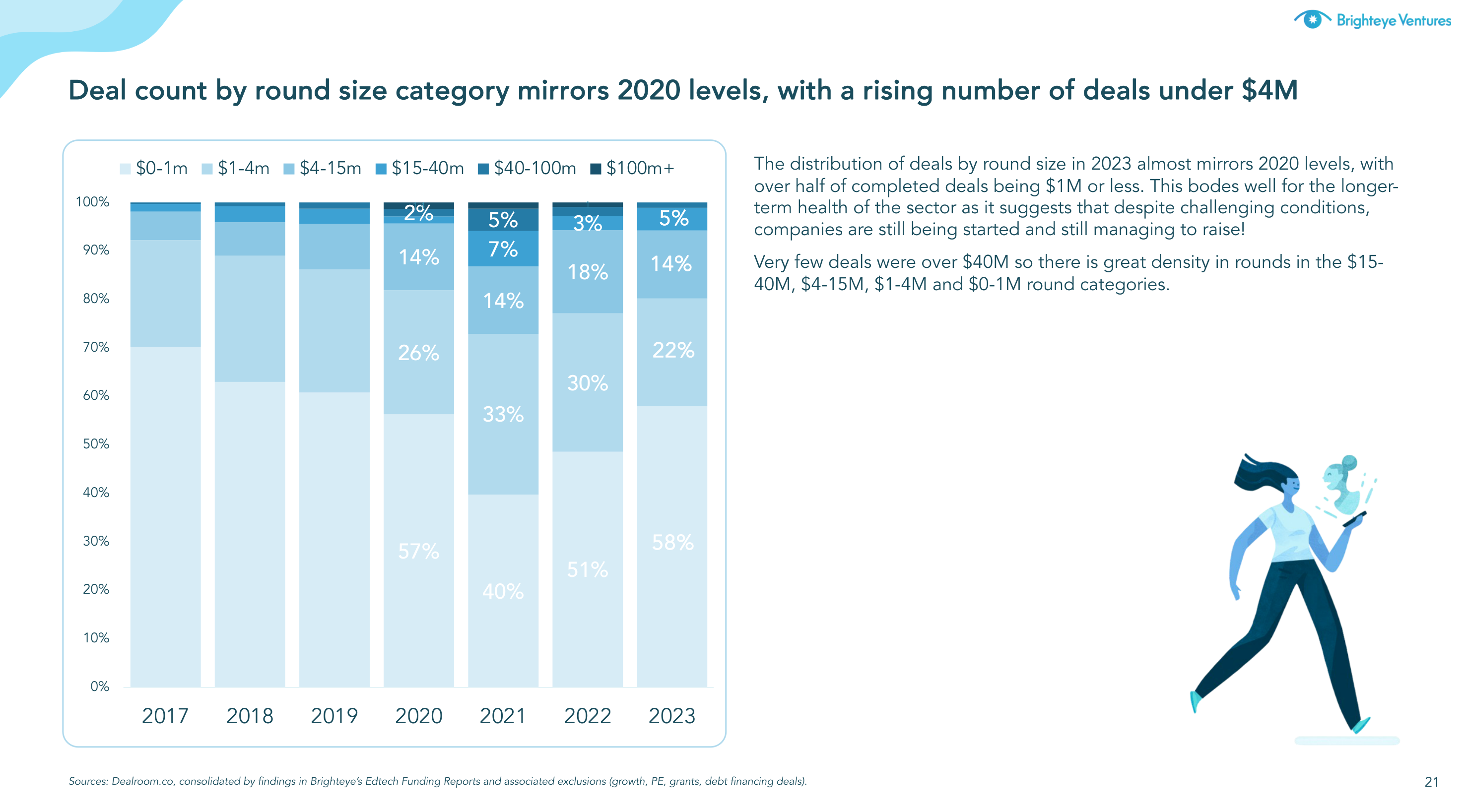
On the micro level of individual businesses, this thinly spread funding might make some sense, yet on the macro level of the industry and the customer, it also highlights part of the European challenge, namely lack of scale. You have to wonder if something substantial and world-class will be built out of some of these tiny deals. Usually “recessions” (possibly a relative term in tech) are a good opportunity for industries to restructure, with strong firms building on their strengths and weaker firms going out of business in what is typically a healthy evolutionary process.

Enable and simplify the work of the teacher

According to some estimates there are currently about 27,500 edtech companies in the K-12 sector, obviously not all deployed in all schools, but it’s not uncommon for schools to use hundreds of digital products. Imagine the life of a teacher. Her first concern is leading a classroom of 25-30 children, which is no mean feat in itself. When she deploys a digital solution it needs to:

a) positively impact learner outcomes

b) be easy to use and

c) ideally save time that she can use for interacting with students.

A teacher is best served by a smaller number of well-performing and frequently-used solutions than a huge toolbox of occasionally-used options.

Build a European Champion

In my view, investors in European edtech should focus on increasing scale and building a handful of segment-specific European/International Champions. At scale, a European Champion has the resources in terms of talent, know-how and money to develop and deploy top-notch learning solutions, yielding excellent learning impact and delivering good financial returns. It’s my hope (and expectation) that a group of investors will take the opportunity at this early stage in the new economic cycle to take our industry and the services we provide to schools to the next level.
Tick Tock, the clock is ticking for a literate society.

“An unprecedented drop in literacy and numeracy across the OECD”

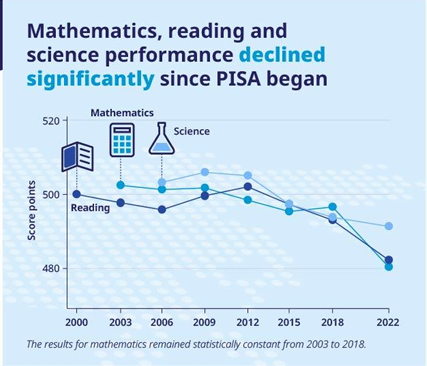
There has been an unprecedented and disturbing drop in average performance for literacy and numeracy in the OECD, as evidenced by recently published research based on data from 2022. https://www.oecd.org/pisa/. Mean performance in mathematics fell by 15 points (equivalent to nine months of learning) and in reading by 10 points (six months of learning loss). Fortunately, average scores for science were maintained.

One in three functionally illiterate

In my home country, The Netherlands, which is one of the richest and most socially progressive places on Earth, with a high commitment to education, the data indicate that one in three students are at risk of being functionally illiterate when they leave school. One in three! That’s up from one in four in the research from 2018. What an enormous loss of potential for these children and our society.  It also makes you wonder how we can spend 12 years and €100,000 per student on education with an outcome that one in three cannot read at the level required to function at school or in society at the end of the journey.

Problem pre-dates pandemic

It would be logical to think that COVID-19 might be the primary cause of this negative development. However, the trend analysis indicates that the decline had begun before the pandemic and peak performance was 10-15 years ago. There are longer-term issues at play. 

Resilience factors could guide the way forward

Some education systems (especially in East Asia and the Baltics) showed both resilience to the disruption from the pandemic, and structurally high learning outcomes. PISA observed 10 factors that contributed to this resilience, and could be helpful in bolstering future approaches, three of which particularly relate to digital, namely:

  1. They ensured good access to skilled teachers, high-quality digital learning materials and devices and developed guidelines for their use.
  2. They limited distractions from digital devices in the classroom (particularly from smartphones and social media) by policies at school.
  3. They prepared students for autonomous and remote learning.

(Screen)-time well spent?

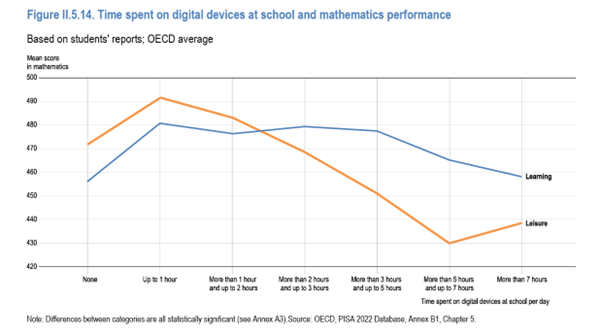
Overall, the evidence shows that using digital/devices for learning purposes in schools yields higher outcomes than not doing so, with the effect tapering off after about five hours per day.  Somewhat surprisingly, the impact of using devices for leisure purposes at school was also correlated with higher learning outcomes, although this turns more sharply negative after about two hours per day.

Most schools have articulated policies about using digital devices on site. However, the least common practices were i) not allowing the use of cell phones (34% of students attended such schools), and ii) having a specific policy about using social networks (51% of students).  In The Netherlands (2022 data), less than 10% of students attended schools where the use of cell phones was not allowed and one in three reported that every or most lessons were disturbed by digital devices.

Tick Tock, the clock is ticking to maintain a fully literate and numerate society

With good quality materials, a focus on learning outcomes and sensible rules of engagement, the use of digital in classrooms enables a positive impact on learning.  

However, smartphones and social media are disturbing the classroom and learning experience and this is likely contributing to why one in three of the kids around here could be functionally illiterate when they leave school.

No time to lose

We need to think again how we systemically approach this better for current and future students and what we can do to bolster the life-chances of this cohort of students with lower literacy and numeracy skills.  Education is a long play, with impact not only on individual lives but crossing generations. There is no time to lose.

How will AI impact teachers?

Super-charger

ChatGPT has recently triggered tremendous excitement about AI and its potential impact on education. Much interest has focused on the learner experience, including the ability to personalise learning. There have of course also been concerns around cheating and plagiarism.

However, AI also has the potential to super-charge teachers.

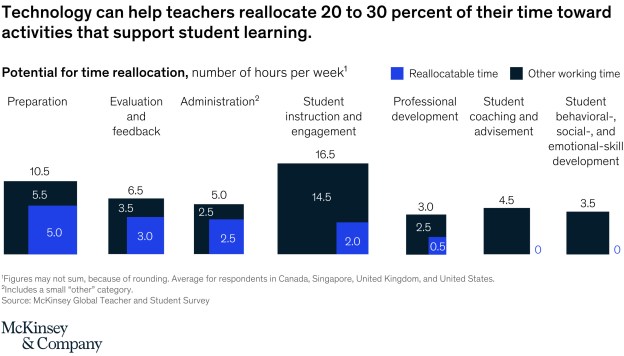
According to McKinsey, 20-40% of current teacher time comprises tasks that could be automated. They estimate that teachers could re-direct approximately 13 hours per week towards activities that raise student outcomes and increase teacher satisfaction.  The tasks of preparing lessons, administration, evaluation and feedback are flagged as high potential for AI.

Love’s Labour’s Lost

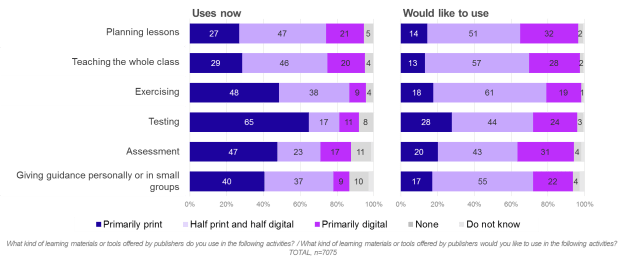
These results echo those of Sanoma’s Learning Impact Survey, in which teachers indicate a desire to go digital in those areas which were most labour intensive, flagging essentially the same areas.  This suggests both that the opportunity is in these tasks and that the profession is looking for solutions.

present_vs_ideal

Teaching profession under pressure

The teacher is arguably the most positive intervention in education.  However the teaching profession faces significant challenges.  UNESCO estimates an additional 69m teachers need to enter the profession by 2030 to fulfil global demand.  In some parts of the world, teacher turnover is high, for example in parts of the USA annual teacher turnover exceeds 15%.  In the UK more than 80% of teachers are considering leaving the profession due to dis-satisfaction.

Higher impact & happier teachers needed!

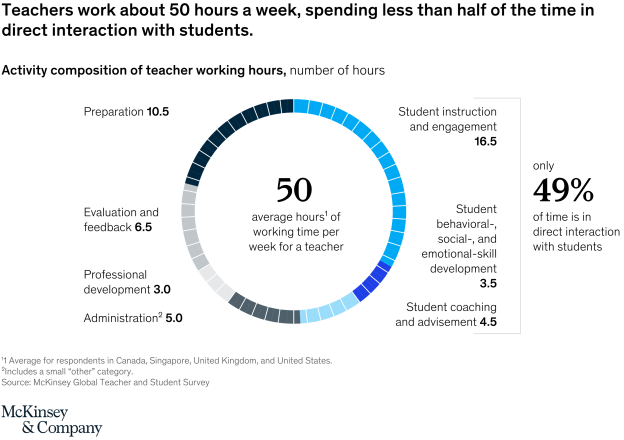
Furthermore, on average teachers spend only half of their time actually teaching.  This represents not only lost productivity from the core task but is also demotivating for many teachers whose passion is to teach rather than the ancillary tasks around it.  Enabling teacher workflow could therefore not only increase productivity but also make the profession more attractive.

SVGZ-AI-boon-Ex1.svgz

$400bn impact & opportunity

The opportunity to solve this productivity gap is huge.  Measured in terms of financials, assuming global spending on education to be some $6trn, of which 45% is on K-12 education,  and of which 75% is spent on staff salaries, this implies a global spend on teaching/staff salaries of some $2trn per year.  A 20-40% uplift in productivity through AI could arguably be worth some $400-800bn per year in terms of paid and unpaid output!  Which is not to say that this is a saving governments could make or a revenue that education companies could earn, because a significant slice of that value should rightfully return to teachers through higher salaries and quality of life, and another part would rightfully get re-directed to teacher-student interaction to increase outcomes and professional satisfaction.

20%

Help the teacher to focus on teaching!

It’s my belief that the teacher will continue to be the killer app in education, and that the biggest opportunity to make not only a positive impact on learning and teaching in K-12 but also to build a successful business, is to enable the workflow of the teacher.  Probably by combining it with the other side of the same coin: the learn-flow (learning experience) of the student.  

Looking forward >>

It will be exciting to see how we deploy AI in the coming years for a positive impact on learning. Looking forward >>.

Attention edtech champions! 

EdTechX Awards 2022

EdTechX is currently running the 10th edition of the All Stars Awards. They’re a fantastic opportunity to see who’s shaping the future of edtech, with previous winners including the heroes at Kahoot!, Kognity, Busuu, OpenClassrooms and FutureLearn.

Learning, Earning and Yearning

They say there are three ingredients to the good life, learning, earning and yearning, which seems to have inspired the three categories this year:

  • Startup, for ventures with annual revenues of less than €5M, who have demonstrated stellar innovation and growth over the last year Apply here >>
  • Scale-Up for ventures with annual revenues over €5M who have delivered outstanding revenue growth momentum over the last 3 years Apply here >>
  • ESG & Impact for companies who can demonstrate positive ESG (Environmental, Social, and Governance) policies and impact strategiesApply here >>

Summit Up

EdTechX is accepting applications right now – don’t miss the deadline of 30th April.  

Winners and finalists will be announced at the EdTechX Awards Ceremony during the EdTechX Summit on 23 June in London.

Looking forward >>

I’ve joined all of the EdtechX meetings to date and they’re a great place to network with the movers and shakers in the industry.  It’s also a perfect opportunity to visit London again 😊.

A Life on Our Planet

Since Life on Earth was first broadcasted, I’ve loved David Attenborough’s work – a fascinating and beautifully produced narrative of natural history. No doubt Attenborough in part also inspired me to study the life sciences.

I enjoyed his latest book too: A Life on Our Planet.  He puts forward his witness statement and a vision for the future: how to rewild the world. It’s a compelling account of the impact of humans on our planet and what we need to do to create a sustainable future.

Biodiversity?

As a biologist I was shocked to learn this:

  • There are currently about 9,000,000 different species inhabiting our planet, one of which is of course Homo sapiens.
  • Today our farmland covers 5 billion hectares: more than half of the habitable land on the planet.
  • Nearly 80% of that land, 4 billion hectares, equivalent to the whole of North and South America is used for meat and dairy production.
  • Beef represents only 2% of the calories we consume but we dedicate 60% of our farmland to raising it!
  • Our population continues to grow and is forecasted to peak at between 9-11 billion people, up from almost 8 billion today
  • As we get richer, we continue to eat more meat.  The average meat consumption in the USA today is 120kg per person annually.  In Europe it’s 60-80kg. In Kenya, 16kg and in India it’s 4kg (with cultural factors encouraging vegetarianism there too).

Wise human?

Billions of additional people eating more meat each year is unlikely to be a sustainable path towards a biodiverse future.

Are we eating the right things in the right proportions?

Homo sapiens means ‘wise man’.  What would a wise human do in this situation?