Author Archives: johnrichardmartin

Unknown's avatar

About johnrichardmartin

Former CEO at Sanoma Learning.

Paper – where efficacy meets equity

I was excited to read about this $270M Series D round for Canadian-based ubiquitous tutoring solution Paper – where efficacy meets equity.

A thousand blossoms blooming

Bloom’s seminal work on the 2 Sigma Problem, carried out in the early 1980’s is a classic must-read for edtech ventures today. The outcomes of the research are startling, showing that an average student under tutoring performs about two standard deviations above the average performance of a conventional class. 

Or put another way, an average student following a tutoring program outperforms 98% of students in a conventional classroom!

Since then, the private tutoring market has grown significantly, although new regulations in China last year driven by concerns around equity and student well-being did have a significant negative impact on that market. 

Efficacy AND equity

The good thing about the private tutoring market is its efficacy – it raises learner outcomes.  The disadvantage however is that the rich tend to benefit disproportionately, because they can afford it. The resulting inequity can’t be a good design principle for the provision of education.

Since Bloom, the search has been on to provide solutions that yield similar efficacy at scale.  Paper is potentially such a solution.  For a fixed price, Paper sells licenses to schools and districts to make its online tutoring support available to every student, around the clock, with no cap on usage. Students can connect with a trained tutor for homework help, writing feedback and study support across all K-12 subject areas. Teachers at schools can access these sessions, see which students need support, and adjust their instruction accordingly.

I’m enthusiastic about this approach because it enables both efficacy and equity in education. The risk of inequity isn’t completed removed of course because richer schools might be more likely to adopt the solution than poorer.  Yet with most K-12 education systems funded publicly, that risk could be mitigated by policy. A second risk could be increased competition between schools and tutoring companies for teachers.  Yet the deployment of university students and new/re-entrants into the profession could also work to increase the overall talent pool of teachers available.

Looking forward >>

I’m very interested to see how Paper will grow in the coming years and believe there could be international potential for this type of solution.

BETTer Future

I’ll be visiting London and BETT at the end of March (probably 22nd -24th).  As for so many of us this will be my first trade fair since the pandemic and I’m really looking forward to joining in real life again (never expected to be this enthusiastic about a trade fair, not even BETT 😊). It does feel like we are now emerging from the restrictions of the last couple of years and I’m excited to get out there again.

I’m especially interested to meet people from companies with strong market positions, from scale-ups and from investors in the education, edtech, science and healthtech spaces during my trip to London.

As of March I have some availability for advisory and interim work and have extensive skills and experience in leadership/leading change, digital/transformation and commercial/strategy work.  I have deep knowledge and networks across the European education sector.

I’m also open to become a Non-Executive Director of such an organisation, as long as this doesn’t conflict with existing work. Very flexible in terms of location.

Feel free to send me a message at johnmartin@contentconnected.com or DM me on social media if you would like to meet up in London!

Looking forward >>

#OpenForWork #Leadership #Education #Edtech #Science #Digital #Transformation

European edtech & the emergence of supplementary education

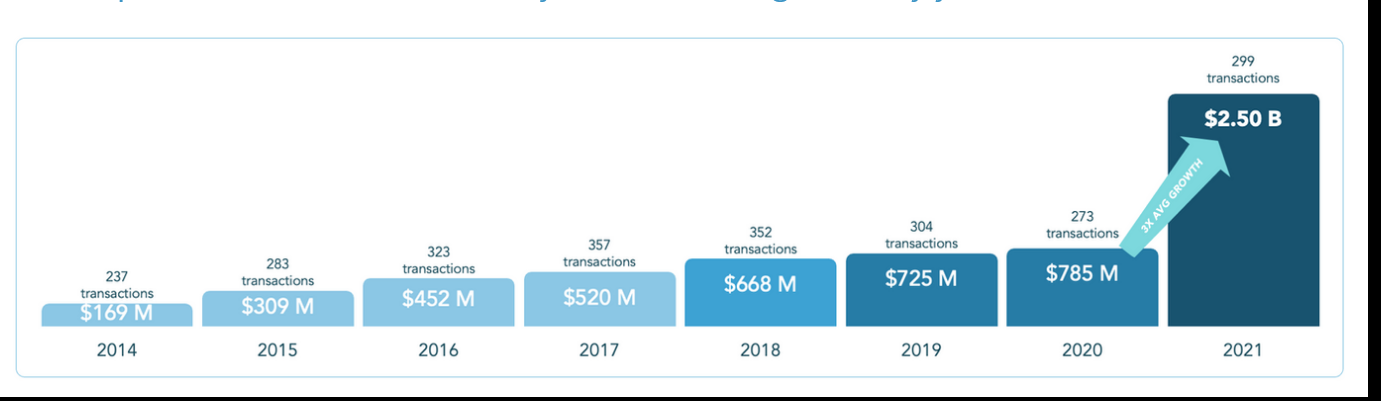
The Brighteye Ventures Edtech Funding Report released last week evidenced a positive and increasingly broad-based development of the European edtech sector:

Venture capital funding tripled over the previous year, reaching some $2.5B.

Average deal size also tripled to $8.4M, indicating increasing maturity of the sector.

Corporate Learning attracted the most funding ($926M), followed by K-12 ($659M) and Life-long/Consumer Learning ($652M), with Higher Education ($289M) and Pre-K ($136M) trailing. One possible reason being that B2C and B2B segments are sometimes seen as easier to sell into than B2G.

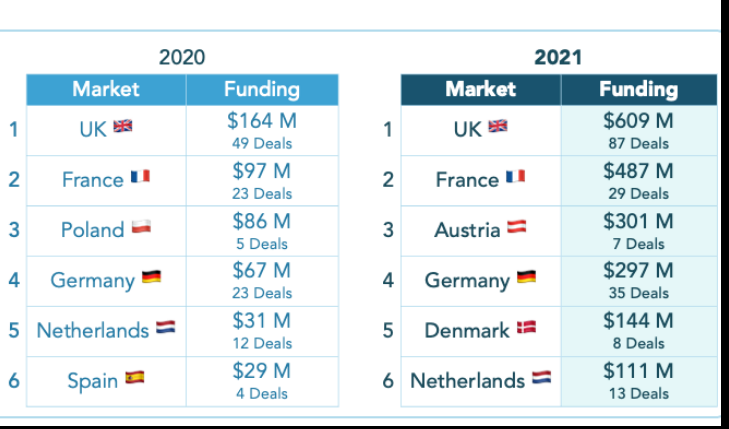
Six European markets raised more than $100M, up from just one market previous year.

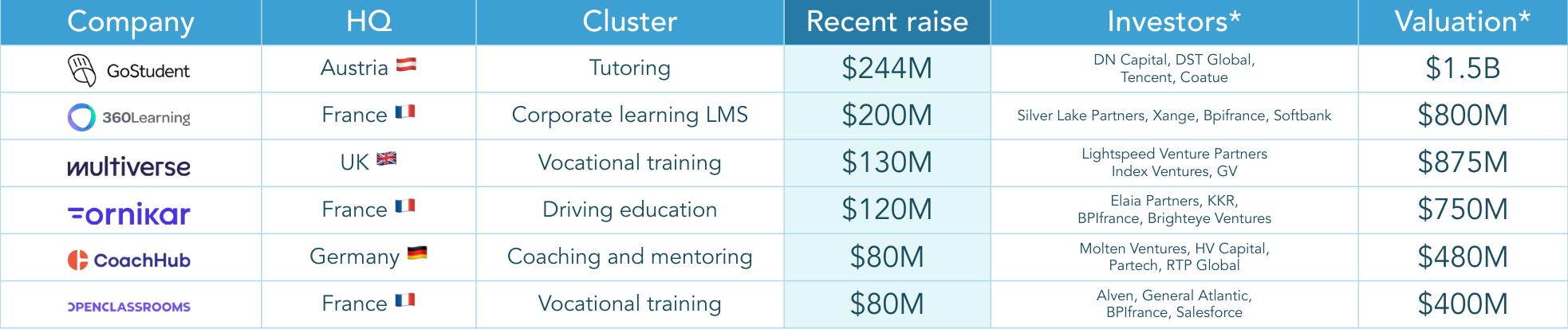
There were six deals in excess of $80M in 2021, up from one in the previous year

Go GoStudent!

The biggest round in Europe last year was in K-12 at Vienna-based tutoring company GoStudent which is currently driving a very rapid international expansion.

(Online) tutoring has long been well represented amongst global edtech unicorns, with the heavy Chinese contingent prospering until the local market crash last year due to regulatory reforms. However, until recently online tutoring had not really taken off at scale in Europe, arguably because the European landscape is fragmented and both the quality of state-provided education and the cultural preference for equity, high.

Market for supplementary education likely to grow

I believe it’s likely that the global market for supplementary education (leaving China aside for now) will continue to grow strongly in the coming years, because:

a) It works

+ Positive impact on learner outcomes*
+ Potential to support teacher retention by reducing after-hours work for existing teachers hence making the profession more attractive
+ Potential to enable recruitment as teachers of university students, former teachers and other professionals, by first (re)-igniting their interest as a tutor,

and

b) There is growing demand for it:


+ More children attend schools than ever before, expanding the addressable market
+ There is increasing competition for top universities and jobs
+ Lower fertility rates boost spending per child
+ Growth in the number of families where both parents work, reducing the time available to help children with homework.

Beware pernicious effects


However, there are some potential pernicious effects should be mitigated:
Rising inequality, since the rich can better afford it than the poor
– Unreasonable pressure on students
Competition with schools for teachers, potentially undermining public education systems.

Public-private-partnerships?

In some European countries including the UK and The Netherlands, additional public funding was made available for supplementary education during the pandemic. I am interested to learn what impact these interventions have made and whether the combination of core and supplementary educational provision in the future might be a path to raising average learner outcomes and supporting disadvantaged students?

I’m interested to learn any insights you might have on this subject. Feel free to drop me a line.

*The outcomes of the research are startling: an average student under tutoring performs about two standard deviations above the average performance of a conventional class. Or put another way, an average student following a tutoring program outperforms 98% of students in a conventional classroom! 
https://lnkd.in/gDYHazw

DeepMind uses AI to understand life.

Life at the molecular level that is.

Last week saw the breakthrough news that Google has essentially solved the protein folding problem with AlphaFold from DeepMind. I was especially interested in this since this was the area of my PhD.

Function follows structure

Proteins carry out a variety of functions from DNA replication to catalysis to structuring the cytoskeleton.  Each protein is built up from a unique sequence formed from 20 different amino acids. Some 200M sequences are currently known, growing by about 30M per year. The chain of amino acids folds into a unique 3D structure.  This structure determines its functionality.

Prediction: the shape of things to come

Some 170,000 protein structures have been determined to date, and DeepMind has used this dataset to create an algorithm which can predict the 3D structure of a protein based only on its sequence of amino acids, to the same level of accuracy as if actually measured using a technique such as X-ray crystallography.  A reasonably sized protein might take as many as 10300 different shapes, so that’s quite a prediction!

This is relevant because understanding the 3D structure of a protein can inform its function and arguably mis-function, thereby potentially accelerating the rational design of interventions such as drugs against disease states for example.  With 200M proteins in scope, the potential for scientific discovery is massive.

Now we can look to Google not only in search of pizza, but also for the elixir of life.

Determined structures

25 years ago I calculated the 3D structure of a protein essentially by hand (serine proteinase human stefin A, see below) – with a simulated annealing protocol using distance and angle constraints obtained from high-resolution Nuclear Magnetic Resonance spectroscopy.  This took 2.5 years! Multiplied by 200M proteins, it would take quite some effort to map the universe of proteins. The task has now been reduced from years to hours!

Family of 17 solution structures showing the backbone atoms of serine proteinase human stefin A. The protein has a well-defined global fold consisting of five anti-parallel β-strands wrapped around a central five-turn α-helix. There are two flexible regions in this structure which are two of the components of the “tripartite wedge” that docks into the active site of the target proteinase. These regions, which are shown to be mobile in solution, are the five N-terminal residues and the second binding loop. In the bound conformation they form a turn and a short helix, respectively.

The Future of Work in Europe: Back to School

Double dose of disruption

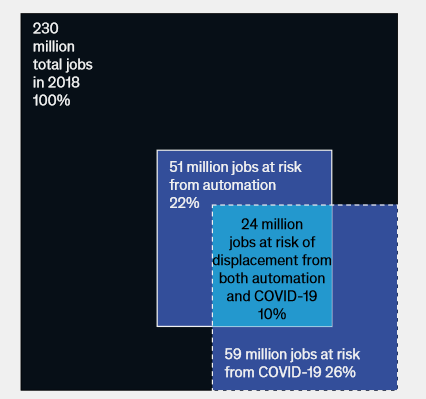
New research from McKinsey suggests that automation and the coronavirus crisis are likely to disrupt many occupations in Europe. They estimate some 51m jobs are at risk due to automation and 59m from COVID-19 to 2030, with a sizeable overlap of 24m jobs exposed to both developments.

Large overlap between jobs at risk from coronavirus crisis short term, and automation long term. @ McKinsey Global Institute

Jobs at risk of being done for

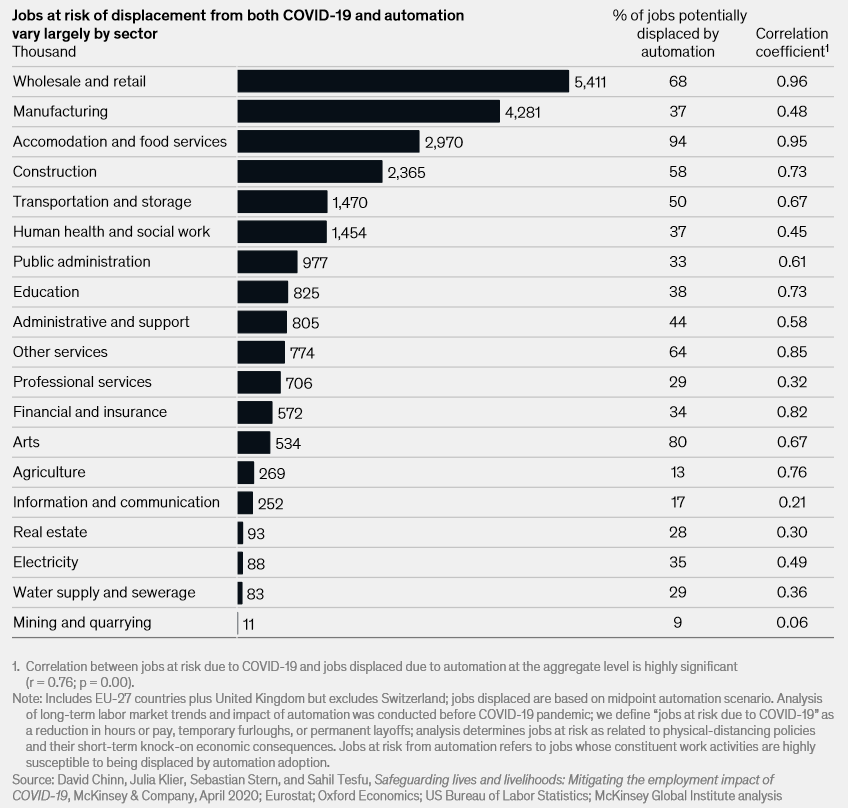
The wholesale & retail, manufacturing, accommodation & food services and construction sectors appear to be particularly exposed, with some 15m jobs at risk.

Jobs at risk by sector @ McKinsey Global Institute

Learn to earn: growth expected in high skills jobs

Some occupations are expected to show significant net job growth in the coming years, with STEM professionals (+4.0m net job growth to 2030), business and legal professionals (+3.9m), health professionals (+2.9m), managers (+2.3m) and education (+2.2m) showing significant potential. These occupations employ a relatively large share of highly educated workers.

Much of the pain is expected to sit in office support, production work and customer service & sales. The great majority of employees in these occupations have not completed tertiary education. 80% of the jobs flagged to be at risk (46m) are carried out by people not holding a tertiary degree.

Europe needs to create more training and career pathways

Education and training have a pivotal role to play in addressing the economic and social impact of this changing job market. Skills are likely to be a key factor in determining recovery from the coronovirus crisis and future prosperity.

Good quality schools, good access to tertiary (particularly STEM) and further education, and the commitment of governments, companies and individuals to ongoing skills development can all contribute to positive employment outcomes.

Re-design for the future

We have rightly seen emergency measures implemented across the World to keep our societies and economies afloat in the midst of the coronavirus crisis. This has come at a huge financial cost. With good reason, the emphasis so far has been to maintain the status quo, to minimise the economic and social chaos.

In the coming period we need to look critically at what the next generation of work will look like and to design interventions that prepare us for that future. This will likely be a job market demanding higher levels of education and skills, and where large numbers of people will need to transition from offices and shops to hospitals and schools for example. How do we organise ourselves for this change?

Best practices

I’m especially interested to learn about initiatives and best practices from institutions preparing for this transformation:

  • organisations that are re-skilling their workforce
  • schools and post-secondary institutions that are adjusting their offerings
  • successful companies that are offering services to close the skills gap
  • new education policies from governments that are intended to enable the transition to new work post-corona.

Feel free to reach out if you know of any great examples!

Looking forward >>