Category Archives: Sanoma

Inspiring leadership in education

This week I attended the Global Education Conference in Boston sponsored by Harvard and Goldman Sachs. This was one of the most inspiring conferences I’ve attended in recent years. Sessions were spread over two days and included hot topics such as “financing disruption”, “creating value in a world of content abundance”, “bridging the skills gap” and “the promise of accessible education”.

I could happily write a post about each of them. But I will write about just one. The absolute highlight of the meeting for me was the opening keynote by Geoffrey Canada, CEO of the Harlem Children’s Zone, a charter school network of 12,300 students in New York. He has been instrumental in improving the performance of his students over a period of two decades such that 95% of high school seniors these days are accepted into college. He gave the best live keynote speech I have ever seen.

GeoffreyCanadaMuch of the focus of the conference was on technology, and I certainly believe that technology can be a great enabler in improving education.

However, Geoffrey’s impact comes from excellent leadership. In particular in taking actions to re-set the normative behaviour amongst the stakeholders including the local community. In a nutshell, in changing expectations in the community from “you have to be a genius to go to college” to “if he can do it, I can do it”. And amongst teachers from “don’t blame me, this is a mission impossible” to “my job is to get these kids into college”.

I personally believe that excellent education can be delivered when skilled teachers, motivated pupils and high quality learning materials play together effectively for the benefit of the learning of the pupil. The role of the school leader has not been strong on my radar. But of course, these three cornerstones rely on selecting and leading the right teachers and ensuring that a healthy culture and practices are in place in schools and their communities! The role of the school leader is pivotal. I should re-examine my beliefs!

Canada is a brilliant and inspiring speaker. You know that he wants the best for his pupils. You know that he will do whatever it takes to make it happen. He is highly engaging and has tremendous energy. He’s firm but fair. It’s not about him, it’s about the future of the kids at his school. I liked the clarity of his message. “Your job is to get these kids into college. The military is good. Vocational training is good too. But your job is to get these kids into college. That is what I expect from you”. I liked that he saw it as a journey. Year-on-year he saw impact. But transformation is a journey and the impact 20 years later was massive.

What would the equivalent message be for my own team? The essence of it is “help teachers to excel at developing the talents of every child in their class”. I believe this is the right direction and will be the journey of learning in the coming decade. How to achieve and measure that? If you have inspiring ideas then you are welcome to join our Learning Lab this coming Autumn!

Most of Canada’s keynote was energetic and funny. He is also a poet and took a more serious tone at the end by reading one of his own poems “Don’t blame me”. Inspiring and touching. Thanks Mr Canada, a brilliant leader, for making a positive impact on thousands of lives, and for inspiring me too.

DON’T BLAME ME
February 2007

The girl’s mother said, “Don’t blame me.
Her father left when she was three.
I know she don’t know her ABCs, her 1,2,3s,
But I am poor and work hard you see.”
You know the story, it’s don’t blame me.

The teacher shook her head and said,
“Don’t blame me, I know it’s sad.
He’s ten, but if the truth be told,
He reads like he was six years old.
And math, don’t ask.
It’s sad you see.
Wish I could do more, but it’s after three.
Blame the mom, blame society, blame the system.
Just don’t blame me.”

The judge was angry, his expression cold.
He scowled and said, “Son you’ve been told.
Break the law again and you’ll do time.
You’ve robbed with a gun.
Have you lost your mind?”
The young man opened his mouth to beg.
“Save your breath,” he heard instead.
“Your daddy left when you were two.
Your momma didn’t take care of you.
Your school prepared you for this fall.
Can’t read, can’t write, can’t spell at all.
But you did the crime for all to see.
You’re going to jail, son.
Don’t blame me.”

If there is a God or a person supreme,
A final reckoning, for the kind and the mean,
And judgment is rendered on who passed the buck,
Who blamed the victim or proudly stood up,
You’ll say to the world, “While I couldn’t save all,
I did not let these children fall.
By the thousands I helped all I could see.
No excuses, I took full responsibility.
No matter if they were black or white,
Were cursed, ignored, were wrong or right,
Were shunned, pre-judged, were short or tall,
I did my best to save them all.”
And I will bear witness for eternity
That you can state proudly,
“Don’t blame me.”
Where are the giants of edtech in K-12 education in Europe?

We’re committed to playing a leading role in renewing education for the next generation and believe we can add value by supporting pupils and teachers on three fronts:

– Achieving excellent learning outcomes
– Enabling efficient ways of working, and
– Supporting engagement and motivation.

Technology can be a key enabler on making progress on each of these three fronts, Today, Sanoma Learning is one of Europe’s leading edtech companies, with roughly € 40 M of pure-play digital and € 100 M of multi-channel sales.

We’re ambitious and like to partner with and acquire other edtech companies to help us to support customers on the three fronts mentioned above. Significant amounts of money are being spent on education each year, of the order of 6% of GDP. This is approximately € 800 bn per year in the EU: the market is sizeable and K-12 is a big slice of that. Yet there are relatively few edtech companies established on the continent today that generate more than € 25 M of annual sales. To be honest, I couldn’t name 10 off the top of my head.

Plenty of talent, ideas and capital

IBIS Capital estimates that there are approximately 3,000 e-learning ventures in Europe today. These companies employ a lot of entrepreneurial talent, many of them working on potentially high-impact ideas. Also, it seems to me that it’s not impossibly difficult to find funding for promising edtech ventures. In the USA in Q1/2014 about $ 500 M was committed in new funding to 99 edtech ventures – the biggest quarter for the last five years.

“The market is rich enough in talent, ideas and venture funding.”

So why hasn’t this large and transforming market in K-12 education spurred the growth of a handful of European edtech giants?

To be frank, I don’t know. Let’s start by looking at the context for K-12 education in Europe today. The great majority of the money in the market is spent (directly or indirectly) by the government through schools, many of which are not yet ready for e-learning. Also, the great majority of overall funding is spent on the salaries of teachers; this is absolutely right – teachers are the most critical factor in providing excellent education.

Within this context I think there are probably three main reasons that make it difficult for an edtech giant to emerge from the European continent on the short term:

1. A rather immature ecosystem
A well-functioning e-learning ecosystem can be built if we can make progress on four dimensions in schools: i) a clear vision on what we want to achieve and committed leadership to make it happen ii) good ICT infrastructure iii) availability of content and software and iv) teachers equipped with the skills to get ICT to work for them and their pupils. Although good progress has been made in many countries on many of those dimensions in the last ten years, most of these ecosystems are still relatively immature. In many ways progress needs to be made on each of these dimensions simultaneously in order for the ecosystem to flourish. There are a lot of data available on this. To name one important element – today there are of the order of 5 devices per household in northern Europe but five pupils per workstation at school. The home is a much more advanced digital ecosystem than the school. Surely this is just a matter of timing? Maybe BYOD tablets will provide the impulse the ecosystem needs? In any case, the early stage of the ecosystem hinders the adoption of educational technology.

2. Long sales cycles but narrow sales windows
The great majority of spending on education in Europe is channelled through institutions. Most of those institutions are organised around an annual cycle. Sales processes into them tend to be long and complex and the window of opportunity rather narrow. If your service is great, but you are not well-positioned to make the sale, the opportunity can be lost until the next year, or for many years. This can be killing for start-ups managing their monthly burn rate and can be a big disincentive to some investors and entrepreneurs.

3. Lack of scale
The final area that is probably hindering the emergence of new European edtech giants is the lack of scale in the market. Education systems tend to be organised very locally and can be prone to political influence. There are relatively few things that scale across multiple countries. Even if your business does brilliantly well in one country, it will be very hard to capture that same position across the continent. Edtech ventures from the USA or China enjoy a clear advantage, with large home markets that can attract significant funding.

How can we improve?

Europe has many natural advantages in the edtech space. For example, it’s home to some world-class education systems such as Finland and there’s a rich start-up scene in a number of leading cities. There’s also a reliable and significant commitment to spending on education.

I’m sure there are lots of smart options about taxes and skills and common standards and so on that the EU is working on in building a big single European market, and I imagine many of those things will help. In addition to that I would like to see us getting more proactive as an industry in two areas. Firstly, it would be good to get more transparency on the market. Which of these new ventures are really starting to fly? Initiatives such as Edtech Europe and Sanoma’s Start-up Challenge help, but are not enough. It’s hard (but not impossible :) ) to see the wood for the trees amongst the 3,000 of today. Who should we partner with? And secondly, are there ways for us to create a European network that can bring scale to the market so that we can more rapidly deploy new technology for the benefit of our customers?

I’m interested to hear your views on this. Feel free to drop me a line if you have inspired ideas.

Looking forward >>

Seven trends shaping the future of learning

Last week we concluded the start-up challenge on the future of learning with five inspiring pitches at TNW Europe. Many congratulations to Labster on winning and thanks to all five finalists would did themselves proud in their pitches! Check out my post on it here.

I was also one of the keynote speakers on the EduTrack at TNW. I received quite a few requests for a copy of the presentation – here it is TNW-keynote.blog and here is a drawing taken during the session.

These days I try to use images more than words in storytelling (except in my blog :-) ), so the slides benefit from further explanation. In this post, I would like to share my views on a number of trends that are shaping the future of learning, as seen from the perspective of a provider of learning solutions. Obviously this is in the style of a 15 minute presentation at a tech conference and not a white paper :-).

I would like to introduce myself

I was born in the Heart of England in the early 1970’s. Already at primary school I developed a passion for learning. I wanted to become a doctor and find a cure for cancer. So I studied hard, I really loved to learn, and went on to complete a PhD in molecular biology. Now of course my dream was unrealistic, I didn’t find a cure. But the dream did bring me something else. It brought me an education. And this gave me a passport to the world. So I moved to The Netherlands as a research scientist and university teacher. I then became a science publisher and now lead Sanoma Learning one of Europe’s leading education companies, with headquarters in Helsinki.

About Sanoma Learning

What I like the most about Sanoma Learning is working together with 1500 professionals who share my passion for learning.

We serve about 10 M pupils and 1 M teachers every day in Northern Europe. And we’re an integral player to the educational systems of 5 countries including Finland, The Netherlands, Belgium, Poland and Sweden – a sort of all-star cast for PISA. We acquired our position in Sweden a couple of years ago and are going to help them to improve their learning outcomes and rise in the PISA rankings, as we have been doing in Poland. We have a reputation for quality and export solutions to more than 40 other countries.

We make annual sales of about € 300 M, including € 40 M of pure-play digital and € 100 M of multichannel, arguably making us Europe’s biggest EdTech company today.

Three cornerstones to excellent education

three-cornerstonesWe believe that an effective interplay between teachers, pupils and learning resources is the primary factor in achieving great learning outcomes. From the perspective of being a leading provider of learning solutions, we see seven trends that are shaping the next generation of learning.

Trend #1 From input to outcomes

input-to-outcomesinputThere has traditionally been a lot of emphasis on the inputs into education. How much do we spend? How many pupils per classroom? How many hours of class time? How many devices in the school? And so on. These things are all inputs. The good thing about inputs is that they’re fairly easy to measure. But the value is in the outcome not the input.

Ultimately on the system level, the main outcome we are trying to achieve is to help people to make progress in their lives: to help them in their learning career, to help prepare them for work and to help to develop them to become good citizens.

These are really big goals for education systems, and by the time we know how we are doing, it’s too late to make positive interventions for a better outcome. So in my view we need to guide outcomes in learning on a more local level, maybe on the level of each lesson or each course:

– does this activity contribute to a good learning result for all of the pupils involved?
– in a way that is time and cost effective?
– and in a way that is engaging and motivating for pupils and teachers?

I believe we should re-shape education by bringing these outcomes into focus.

Trend #2 From mass to personal

massmass-personalAs we move from the industrial age to the knowledge age, our ways of working in education will change too.


Technology will support us in tailoring pedagogy, curriculum and learning support to the needs and aspirations of the individual learner.

If we can get that right, we will be much more successful in helping individuals to reach their potential. This is a huge opportunity for us to unleash the potential of our children.

Trend #3 From workload to workflow

workload-workflowworkloadWe did some ethnographic research with teachers in Finland, a world-class education system. We were surprised to see that about 15 hours per week were being lost on bottlenecks in the workflow. For example, keeping track of administration, manual checking, inefficient communication streams and disruption in the classroom. Imagine the effect that these bottlenecks have on learning outcomes and motivation, and think about the impact that could be achieved if those hours were spent on teaching instead. Also, for a primary school with say 350 pupils and 35 teachers, the financial cost of these bottlenecks is about € 500 k per year.

We expect that technology will address some of the problem. For our part, we are digitalising our courses. Other elements of the workflow will get automated and personalised too. Teachers should spend their time and energy on teaching. This is their skill and passion and this is where they bring excellence to education.

Trend #4 From analogue to digital

analog-digitalanalogueSchools are slowly but surely becoming more digital. However, today in northern Europe, there is a big gap in access to technology between the school and the home. And we are arguably the most digital part of the world! There might typically be 5 devices per household. At the same time, there are typically about 5 pupils for every workstation in schools. So we have to design solutions that can play to that dynamic. Currently most of our methods play multichannel. We expect to continue to play multichannel for 5 or 10 more years and that by 2020 digital will be leading in the usage of most courses.

Trend #5 From data to insight

datadata-insightIn the coming years a wealth of data will come on stream about the learning of our children. Clearly, we have to treat privacy with the utmost respect. And also to look to the opportunity. We’re going to get rich data-sets and insights into how individual pupils, teachers, classes, pieces of content, courses and entire systems perform. We can use these insights to guide intervention: to raise learning outcomes, to focus resources, to enhance engagement. We should embrace these insights to improve learning, and to stop doing the things do not bring value.

Trend #6 From classroom to borderless

classroom-borderlessclassroomDigital is fundamentally changing the way we live. In the analogue world, the classroom was the centre of learning, whereas the individual stands central in the digital world. Digital has opened up the border between school and home and we see growing demand for services related to curriculum, tutoring and communication that bring a holistic approach to learning for the pupil.

Trend # 7 From scarcity to abundance

scarcity-abundancescarcityLooking at it from the global perspective, good quality education has been the preserve of the happy few. It’s been a scarce resource. However, that’s about to change for the better. Extreme poverty has halved over the last 20 years and some reckon that extreme poverty will be eliminated within 20 years. Going hand-in-hand with rising prosperity has been increased access to mobile technology for the world’s poorest people.

Education is one of the most powerful instruments known for reducing poverty and inequality and for laying the basis for sustained economic growth, sound governance, and effective institutions.

“Imagine the profound impact on our people and planet if we can bring mobile learning to the four billion people rising out of poverty. Imagine that.”

Time to embrace change and invest in renewing education

So these are seven trends that we believe are shaping the next generation of learning. I am sure there are more, and they are obviously impacted by the perspective you have.

“We believe it’s time for governments, companies, schools and individuals to embrace these changes and invest in renewing education for the next generation.”

What can Sanoma do?

So we ask ourselves what we can do to contribute to the renewal of education. The answer is in our mission already – in supporting pupils and teachers on three fronts:

– Achieving excellent learning outcomes
– Enhancing workflow efficiency
– And supporting engaging learning

By creating courses that play multichannel that address those three goals, we can contribute to building the future of learning.

Learning outcomes accelerator

We see that the most challenging of these tasks for everyone in the educational ecosystem is how we can take a step forward on learning outcomes.

We like a challenge at Sanoma Learning. So we want to run an innovation accelerator focusing on learning outcomes.

“How can we improve and evidence the impact of education in the new era?”.

Together with schools, teachers, pupils and academics, plus about 75 learning and start-up professionals from Sanoma, we want to run a 10 week program to develop ideas and build prototypes of solutions that can improve and evidence the impact of education.

We’re going to start recruiting the teams and participants now, ready for a kick-off in September. If you’re interested to join us or to learn more, please visit sanomalearningoutcomes.com

We’ve run 5 accelerators at Sanoma in the last couple of years and I can promise you they are inspiring and energising and you learn new ways of co-developing your ideas with your customers.

Any questions?

Thanks for listening. Feel free to contact me @johnrichmartin. And please let me know if you want to join us in renewing education for the next generation.

Labster wins Sanoma’s start-up challenge on future of learning at TNW Europe

Mads Bonde, CEO of Labster, pitching at TNW

Mads Bonde, CEO of Labster, pitching at TNW

Last Friday at TNW Europe, Labster (www.labster.com) won Sanoma’s start-up challenge on the future of learning. Congratulations to Mads Bonde and the Labster team on winning not only € 25,000 but also eternal fame!

Labster runs 3D virtual labs in the life sciences and allows students to run their own experiments in a concept inspired by flight simulation. They claim their labs are effective in teaching theory, cost 1/10 of a physical lab, help to motivate pupils and yield rich learning analytics for teachers. They have been working together with leading institutions including UC Berkeley, Stanford University Online High School, University of Copenhagen, University of Hong Kong and Novo Nordisk and are currently used by more than 10,000 students worldwide.

Alongside Labster from Denmark, four other promising edtech start-ups pitched for the crown in Amsterdam, including:

i) Eduvee (www.eduvee.com) from England – an intuitive learning and tutoring platform that integrates and delivers personalised curriculum-mapped content to learners on any device
ii) DragonBox by We Want to Know (www.wewanttoknow.com) from Norway – a fun, game-based solution for learning maths
iii) Jumpido (www.jumpido.com) from Bulgaria – a game re-imagining education through games combining physical exercise with engaging maths problems, and
iv) EduKey’s Class Charts (www.classcharts.com) from Wales – a behavioural data solution supporting teachers in identifying how students interact with eachother and how this impacts their learning.

We chose Labster as winner of the challenge for two reasons:
i) excellent potential impact on the future of education, showing good proof-points on learning results, cost efficiency and engagement, and
ii) a strong “make it happen” team

We were really impressed by the quality of all five of these start-ups – they all did themselves proud in the pitching and we had a heated discussion about which of them would be the ultimate winner. Thanks to you all for having joined the challenge – you are all winners!

Sanoma sponsored this initiative since we are determined to take an innovative position in creating the future of education. We were delighted to have attracted more than 100 edtech startups from 24 countries across Europe. I also appreciated the good collaboration between Sanoma Learning, SanomaVentures and VentureScout in running a successful and spirited challenge: thanks to the teams for making this happen!

Learning outcomes accelerator: co-creating new solutions with schools

The future of learning is personal

personalAs we move from the industrial age to the knowledge age, our ways of working in education will change too. Amongst others, technology will enable us to tailor pedagogy, curriculum and learning support to the needs and aspirations of each individual learner. Developing the talents and potential of individuals and helping them to make progress in their lives will be key.

Our thinking needs to shift. From inputs …

Governments have traditionally put a lot of emphasis on the inputs into education. How much do we spend? How many pupils per classroom? How many hours of class time? How much do we spend on learning materials? How many devices in the school? These things are all important.

… to outcomes

input-to-outcomesHowever, the value is in the outcome not the input. Are we helping individuals to make progress in their learning career? Are we preparing them for effectively for work? Are we enabling them to become good and fulfilled citizens? These are the big outcomes questions.

Maybe these questions are so big that we only know the answers when it’s too late. Therefore, on a more practical level, we should break it down into something more manageable. For example, for each activity (“course” or “lesson”):

– does this contribute to a good learning result for all of the individual pupils?
– in a way that is engaging and motivating for pupils and teachers?
– and in a way that is effective in terms of time, cost and energy?

By bringing these outcomes into focus, we can reshape education for the next generation.

Enter the Learning Outcomes Accelerator

At the OPPI Learning Festival in Helsinki last week (great initiative!), we announced the launch of an open Learning Outcomes Accelerator:

“how can we improve and evidence the impact of education in the new era?”

In each of the countries in which Sanoma Learning operates (Finland, The Netherlands, Belgium, Poland and Sweden) – pretty much an all-star cast for PISA :) – we would like to work with one school where at least one teacher/class would participate.

Also, we would like to ask academics (with expertise in outcomes, learning analytics, pedagogy and so on) to join us to bring an extra richness to our thinking and approach. And 75 professionals from Sanoma, with expertise about course and curriculum development, design and user experience, and lean startup methodologies will join us in creating new prototypes.

How does the accelerator work?

Participants at bootcamp

Participants at bootcamp

We will launch (in September, dates to be finalized) with five “live” kick-offs, one in each of the main schools participating. This will be followed by a seven week program of ideation and training, during which hundreds of ideas will be created, tested and improved. Towards the end of the process the best five ideas will be selected by public voting and the winners will be invited (expenses paid) for a four-day bootcamp in Amsterdam to build their prototype. I’ve previously blogged about how an accelerator works and what happens at bootcamp. It’s really exciting and inspiring to be part of it!

What is it, what isn’t it?

The accelerator will be above all about learning by doing! It will be fast-paced, highly practical and we will go from idea to functional prototype in less than 10 weeks. It will be structured in terms of the goals, process and support. And open in terms of ideas. It will be a journey of discovery and experimentation and this is what makes an open accelerator so exciting.

It’s not a big academic exercise. We won’t write a book about it. (Even if books are good too.)

Register and help us co-create new solutions for outcomes

If you would like to join the accelerator and you’re either a teacher at a school in one of the five countries mentioned earlier, or an academic from there or elsewhere, please let us know at sanomalearningoutcomes.com. We will strive to have decided which five schools to work with on this particular accelerator by the end of June. Participation is free of charge. We will be accepting applications until 1 September.

I was positively surprised by the interest from other groups at OPPI too. For example, some Foundations, Universities, other companies, schools in other countries and educational journalists also wanted to get involved. If you are from one of these groups and have something exciting to bring to the accelerator, then please take contact with me and let’s see if there are possibilities for us to adapt the program so you can join us.

Looking forward >>

I believe that by bringing outcomes into focus, we can reshape education for the next generation. I hope you will join us on this exciting journey!

Back to the Future of Learning

future of learningThis week I have returned to Sanoma Learning as CEO, succeeding Jacques Eijkens who established and has led the development of the company during the last eight years. Great job Jacques! It’s an honour to be given this opportunity. I have a big respect for the teams and what they have achieved so far and believe I can bring digital and innovation experience that can help us on the journey to the next era.

Education is at the dawn of a new age

Stakeholders rightly want to renew education: they have new and higher demands on outcomes, personalisation and ways of working in particular.  We’re at the dawn of a new age for education – and technology will be a key enabler of the transformation. Today, Sanoma Learning is a successful provider of educational resources and has excellent customer focus, skilled people, strong brands and good financial health. Yet today’s strength does not guarantee tomorrow’s success. I believe that by supporting pupils and teachers with digital personalised-learning solutions, Sanoma Learning can have a major positive impact on the transformation of education. We are well-positioned as we continue on the journey to the digital future, but our success will be determined by how markets for learning solutions evolve and how effectively we manage the digital transformation.

Further renewing our offering will be key

Our main priority in the coming years will be to further renew our offering. In our core markets, we will focus on the digital transformation: digitalising courses, adding workflow functionalities and using data to support workflow, guide personalisation and improve learning outcomes. We also have the ambition to build a position in online tutoring, thereby further personalising the learning experience and creating new possibilities for growth. And we intend to build a position in emerging markets, leveraging and increasing the impact of our learning solutions and opening up new revenue streams. At this moment in time, we are making good progress in our core markets and are at the early stage of developing new home-grown ventures in online tutoring and emerging markets.

Learning about Learning

Today is my first day in the new role and I will start by visiting the units to engage with the teams – I’m enthusiastic about getting to know the people and to understand the opportunities and plans for the future. I will be keen to support and accelerate the development agenda and for Sanoma Learning to play a pivotal role in the transformation of education. I’m really looking forward to working with the teams on this great opportunity!

Sanoma’s digital transformation gains momentum

Sanoma House in Helsinki

Sanoma House in Helsinki

Last week Sanoma announced the FY2013 results. To be frank they were mixed, with online and mobile sales growing but print media in decline. The vocabulary turned classical: annus horribilis, Utopia, and per angusta ad augusta, could be heard in English, Finnish and Dutch conversations during the week. As is often the case with mixed signals, the good news has been somewhat drowned out by the more negative headlines throughout the year.  Yet Learning had a good 2013. And after a slow start to the year the overall digital platform has gained momentum and performed particularly strongly in the final quarter.

I always find it tricky blogging about financial results given that Sanoma is a listed company. But now that we have announced the results, I’d like to call out a handful of highlights on digital in Finland, The Netherlands, Learning and early stage innovation at Sanoma in 2013, drawing on the published materials.

As a reminder, the core strategy of Sanoma rests on three pillars: i) connecting consumers with content and brands, anywhere, anytime; ii) delivering powerful marketing opportunities to advertisers through our reach and consumer insight; and iii) providing personalized digital learning solutions to pupils and teachers.  Digital is clearly an integral part of that strategy.

Finland

Our share of the online media market grew by 5%-points to almost 40%.  Our online advertising revenues grew by 18% over the previous year and digital consumer sales grew by almost 30%. Digital subscriptions at Sanoma’s single biggest brand, the newspaper Helsingin Sanomat, grew by almost 40% to 160,000 (on a total of about 355,000). Furthermore, digital sales at our second biggest brand Ilta-Sanomat grew by about 40%, whereby digital revenue gains now appear to be exceeding print losses; this terrific performance also secured a lead for Ilta-Sanomat over Iltalehti in terms of visitors. We also saw early success at magazines with the Donald Duck library reaching 12,000 subscribers.

Our market-leading position in recruitment got even stronger and we regained leadership in terms of visitors in real estate.  Finally, we made a great start with e-commerce service MSO.fi with more than 120 retailers already on board.

We have seen strong growth in usage via mobile devices and of online video and this is where we have registered our fastest growth.  By the end of 2013, over 50% of all pageviews on our Finnish network came from mobile devices, with mobile visitors growing by over 100% and pageviews by close to 150%.  Correspondingly, mobile advertising sales grew by around 180%Online video advertising sales grew by over 30% and the weekly reach of video platform ruutu.fi by 25%.

The Netherlands

comScore ranks Sanoma #4 of the big 5 in The Netherlands with 8.1 M unique visitors (MUV) in December 2013  – behind Google, Microsoft and Facebook (12.7, 10.7 and 9.9 MUV, respectively), but ahead of eBay (6.6 MUV). Other Dutch media groups are also represented in the top 20, but lack the reach of Sanoma. The state-subsidised NPO, and privately run TMG, De Persgroep and RTL Groep, registered a reach of 6.2, 5.3, 4.7 and 4.4 MUV respectively in December.

NU.nl, the leading news site by visitors and strongest media brand in The Netherlands and a cornerstone of Sanoma’s digital network, further strengthened this position in 2013 delighting readers with more than 10.000.000.000 pageviews, almost exactly 50 per inhabitant per month! Pageviews have more than doubled in the last three years and in the meantime more than 75% of views are made from mobile devices.  NU-apps have been downloaded more than 5 M times so far.

In common with Finland, video also grew strongly (about 40%) totalling 152 M at video platform zie.nl.

Lindanieuws.nl – an extension of the highly successful magazine brand Linda. – came with a new version that resulted in a tripling of the number of visitors to 1.2 M and a doubling of advertising sales.

Digital sales via automated trading increased by almost 25% – a serious money-maker for our digital network.  Our performance-based business had a solid year. In particular, sales at the recently acquired FashionChick doubled, partly driven by international expansion. The introduction of curated search at directory Startpagina.nl has been a runaway success and one of the most rapidly growing digital product innovations we have made in recent years. Net sales of e-commerce service SBC grew by 25%, with sales of home deco performing particularly well with a growth of nearly 50%, And soft launches of new brands leef.nl (health) and yixx.nl (jewellery) and of the international launch of price comparison site kieskeurig.nl in France and Poland have helped to ensure a healthy pipeline of new business lines that we expect will support the growth of the performance-based assets in the coming years.

Learning

At Learning, there are also good data to evidence our progress to a more digital future. Much of this relates to bringing content to life by making it more functional through digital. For example, in The Netherlands, more than 1,000,000 pupils in primary education work with Malmberg’s software, reaching 60% of all schools.  In a single week in November, more than 1,000,000 exercises were made on homework platform Bingel.be in Belgium. And in Finland, teachers and pupils logged into Sanoma Pro’s new learning environment 1,900,000 times, with 768,000 hours of active use. In the meantime 800 e-books have been published in Sanoma’s five Learning countries on the BookShelf platform provided by Young Digital Planet.

In addition to transforming its core business, Sanoma Learning is working on providing learning services to the home market with a new online tutoring proposition for mathematics: StudySteps. This has been soft launched in Belgium and The Netherlands, tested in Poland and Russia, and the first results are promising, with 110,000 exercises made in the test period.

Furthermore, Sanoma Learning is exploring the possibilities to build a position in emerging markets and has amongst others made an agreement with the People’s Education Press to provide digital services to support the provision of e-learning in China. It’s early days, but there is clear demand for Sanoma’s high quality Learning capabilities abroad.

Innovation

SanomaVentures had an exciting year, receiving over 400 requests from external startups, which ultimately resulted in 9 investments, bringing the total to 15 to date.  In aggregate the business/financial performance of this portfolio has been promising and these ventures currently employ over 161 people. We expect to make a similar number of new investments this year.

Building on the success of the series of in-house innovation accelerators, we have now launched an Innovation Lab to foster the ventures that are borne out of the accelerators and as a test ground for new ideas from the core business.  We currently have a full pipeline of concepts, prototypes and early stage ventures and have set ourselves the goal to have established five ventures in the next 3-5 years that have an annual revenue potential of € 10 M+. In 2013 we ran four accelerators (Content, Commerce, Talent and NU-lab), two of which were open to external participation. Through these accelerators we trained about 500 Sanoma employees on the lean development methodology and created 15 functional prototypes, about half of which have been given seed funding for further customer validation.

Finally, we have significantly increased our investments and human resourcing on data science including hiring a team of 20 data scientists last year to boost our analytics and insights capabilities across Sanoma. We are currently working on developing the common “big data” enablers, as well as specific cases on consumer sales, online advertising and new business models. We expect to make a quantum leap in our insights capabilities in the coming years.

Good progress on the journey

Overall, reflecting on the three pillars of Sanoma’s strategy i) connecting consumers with content and brands, anywhere, anytime, and ii) delivering powerful marketing opportunities to advertisers through our reach and consumer insight and iii) providing personalized digital learning solutions to pupils and teachers, I believe the highlights above show that digital has made a big contribution in 2013 to progressing this strategy. Respect to the teams who have made this happen and thanks for your hard work!

Sanoma Startup Challenge: the Future of Learning

20140105-230333.jpg

We recently announced the launch of a startup challenge, focusing on the future of learning. The goal of the challenge is to identify Europe’s most promising startups in K-12 education and to work with them in finding ways to help them to grow.

We’re encouraging applications from European startups that have a live product and growing customer base, but are still smaller than € 2 M in annual revenues and have been established within the last five years.

The application round is now open and will close on 1 March. Five finalists will be invited (expenses paid) to Amsterdam on 23-25 April to work with executives and experts from Sanoma Learning and SanomaVentures and to pitch their startup to The Next Web Conference audience and jury. The final winner will be announced immediately after the pitches and will receive a cash prize of € 25.000. We will also explore the options with the finalists for closer collaboration with Sanoma in supporting their growth ambitions.

Education is at the dawn of a new era, partly enabled by technology. As interim CEO of Sanoma Digital and CEO Designate of Sanoma Learning I am excited about working together with high potential startups in the edtech space and hope that we can build some successful and long-lasting relationships through this initiative!

For more information on the learning startup challenge, including the application procedure, click here.

Good luck to all applicants and I hope to see you in Amsterdam in April!

Making it happen at the CommerceAccelerator bootcamp!

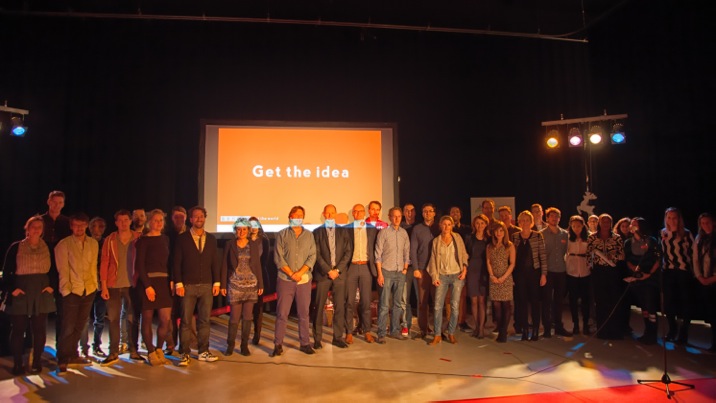
Participants at the closing session. Blinded by the light ...

Participants at the closing session. Blinded by the light …

We’re working hard on transforming Sanoma for a more digital future. Boosting innovation is key and includes developing new digital business lines and learning new skills that we can use across the company. For this purpose we have created the Innovation Accelerators and the CommerceAccelerator is the third in the series so far.

We see three domains of opportunity for the future Sanoma. Firstly, we want to provide information and entertainment to consumers across multiple channels. Secondly we want to help advertisers with powerful marketing solutions based on our reach to consumers and insights into them.  And thirdly, we want to help to help pupils and teachers to achieve great learning outcomes using new learning solutions.

Winners go to bootcamp

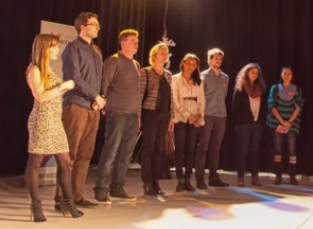
Team leaders at the closing session

Team leaders at closing session

In Amsterdam last week we ran the bootcamp for the CommerceAccelerator – focusing on the advertising domain mentioned above. The top 5 ideas and their owners were selected in a live webinar to build prototypes of their concepts. This followed an inspiring program of ideation and training, of building and testing ideas, which started out with about 220 participants from across Sanoma and included about 70 university students.

Rich talent

Student team Weggle from Tampere

Student team Weggle from Tampere

We had an interesting and varied mix of talent amongst the team leaders, including people from business development, sales, product management, television and a student team from Tampere.  I like it a lot when we have such a diversity of experience and skills at the bootcamp: it makes for a rich and exciting experience!

Fast pace, strong delivery

I love the bootcamps. They are practical and fast paced. They’re very demanding but also a lot of fun. It’s great to have teams of talented and driven people working on building prototypes and testing them with real customers.  Making it happen!  I believe in learning by doing and this is a very concrete proof of that!

Leadership

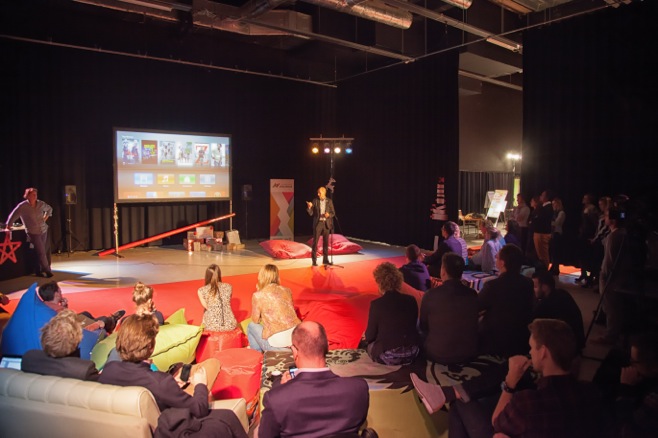
Listening to CEO Harri-Pekka Kaukonen kicking off the pitch session (for the sake of good order, I am tweeting that picture in this photo, I am not checking my mail during the speech :))

Listening to CEO Harri-Pekka Kaukonen kicking off the pitch session. (For the sake of good order, I am tweeting that picture in this photo, I am not checking my mail during the speech!)

We were joined by Sanoma’s CEO Harri-Pekka Kaukonen, CHRO Jackie Cuthbert and the CEO of Sanoma Learning Jacques Eijkens. They are all strong supporters of the accelerators. We appreciated that they joined us; they are all super-busy driving the transformation of Sanoma, but it is brilliant that they make the time to support the accelerators.  A great show of leadership!

Five prototypes

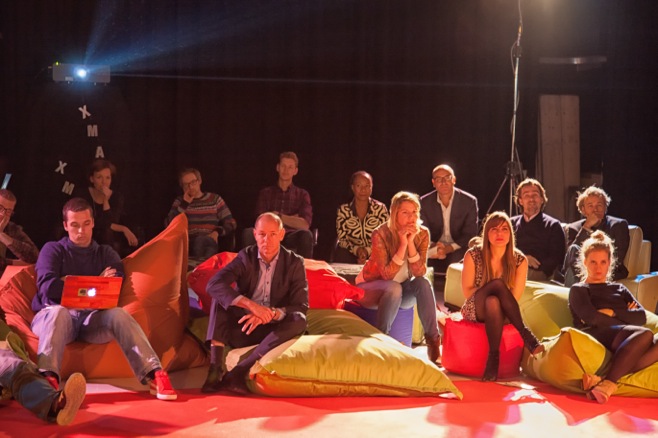
Listening with intent to the pitches. Amongst others, Harri-Pekka Kaukonen on the front row, and Jackie Cuthbert on the back row.

Listening with intent to the pitches. Amongst others, Harri-Pekka Kaukonen on the front row, and Jackie Cuthbert on the back row.

At the end of the day on Thursday each of the teams demonstrated their prototypes. They included i) a contextual and sentimental targeting service; ii) a pre-targeting service; iii) a mobile advertising service iv) a gamified service to engage viewers during TV commercial breaks and v) a shopping service bridging the real and virtual worlds. Some of the testing with customers has been quite brilliant and helped to underpin the commercial promise of the ideas. Great validation!  (I would like to show the promo video’s here, but feel it’s a bit premature at this stage).

Top teams

I really like and respect the passion and enthusiasm of the teams and am proud of how they have performed and behaved! This counts for the idea owners and the talented professionals from MakerLab.  And also for Lassi Kurkijärvi (@lassi, Director at Sanoma) and Joris van Heukelom (@jorisheuk, Partner at Makerstreet) who once again showed inspiring leadership throughout the program.  Great job everyone!

Next steps

We have promised the teams that we will inform them how we would like to proceed by the end of next week. There are three alternatives: i) create a new venture ii) develop within the business or iii) not pursue the opportunity. I am confident we will pursue some of these concepts and will engage with the key stakeholders to ensure that we will be able to bring them to market quickly!

The world turns of course, and we are working on developing the next accelerator which will focus on 4G and video and we aim to start in Q1 next year.  With the launch of our Innovation Lab in January (as part of the new unit Sanoma Digital), which will be led by our mobile superhero Lassi Kurkijärvi, the Innovation Accelerators have become a core element of our transformation program. I see the establishment of the Innovation Lab as a great validation of the success of the accelerators we have run so far.

I’ve been happy about the high level of support that we have won from top management and young talent. What I would like to develop further in upcoming accelerators is to secure more engagement from middle managers. I believe this would help us in transforming the core business.  If anyone has good ideas about how to achieve this, please drop me a line!

CommerceAccelerator goes to bootcamp

commerce-accelerator-bootcamp-selectionLast week in a live broadcast, we selected the five winning concepts and idea owners who will join us this week at the bootcamp of the CommerceAccelerator in Amsterdam. We will build prototypes of these ideas and test them with customers, as a pre-cursor to deciding which concepts to sponsor as new ventures at Sanoma.

Two big goals

We have two main objectives for the accelerator programs.

Firstly, we want to develop new digital business lines – to plant the seeds of the next generation of Sanoma products and services. We have set ourselves the target of establishing five new ventures (the “fabulous five”) within the next five years that have clearly demonstrated the potential to become as successful as NU.nl is today. From the first two accelerators we have created six new ventures and we will soon reach the critical moment when we decide which of them to boost further and which to discontinue.

Secondly, we want to develop lean development skills across Sanoma to support the overall digital transformation. We want 20% of all employees to join an accelerator program in the next five years. By the end of 2014, we expect that more than 1.000 Sanoma employees will have participated in an accelerator and learned the lean development methodology.

So far, so good :-).

Why the CommerceAccelerator?

This is the third accelerator in the series so far and focuses on enabling commerce. We see three domains of opportunity where Sanoma has the ability and ambition to succeed: i) creating, curating and distributing content for consumers ii) providing powerful marketing solutions to advertisers and iii) supporting learning and education. This accelerator clearly supports our ambitions in the second domain.

Positive and optimistic

I’m enthusiastic about how this accelerator has been going so far. I love the positive energy and can-do attitude of the people. This time we have made the accelerator “open” to university students and that’s brought it an extra edge, a new freshness. I like it when we innovate the innovation programs :-). It’s also been great to see such a good mix of people: Sanoma and Students; Finland and The Netherlands; Print, Digital and TV. Lassi and Joris have done a wonderful job again: every time we do it, it grows and gets better.

Voting criteria

The ten concepts and their owners were all strong and had put forward excellent pitches. Prior to the selection I advised the voters to consider five criteria when making their decision: i) does it fit our strategy? ii) are we capable of doing it? iii) can we earn money from it? iv) can this person make it happen and v) is the lean development method being well used? I don’t know if anyone listened to the advice, but I am happy with the results of the voting :-).

High Five

Voting was tense and the public rounds went to the wire a couple of times. The three concepts selected from the public voting included propositions for mobile advertising, engaging tv ads and marrying offline and online commerce. Two additional concepts won “wildcards” from the expert jury based on the expectation that they would be well position to “make it happen”: a reverse retargeting proposition and a relevant and engaging online advertising service.

Excited about bootcamp

I’m truly excited to see what the idea owners will create at bootcamp this week! What can we make of these concepts? Might one of them eventually become one of the fabulous five? I’m sure that most of the participants will experience this as one of the best weeks in their professional lives so far: hard work, fast pace, rapid learning, focus on delivery and a lot of fun too! Tomorrow morning is the kick-off and by the end of Thursday afternoon we will see what the teams are capable of.

So, good luck to the teams and do your best! Looking forward >>