Tag Archives: Digital

Tick Tock, the clock is ticking for a literate society.

“An unprecedented drop in literacy and numeracy across the OECD”
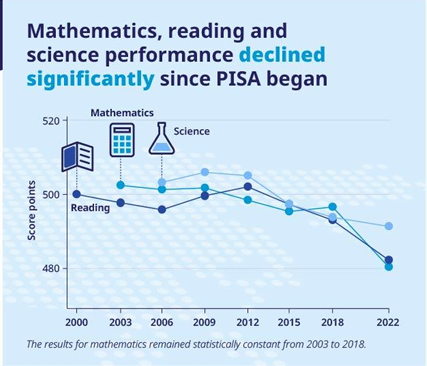
There has been an unprecedented and disturbing drop in average performance for literacy and numeracy in the OECD, as evidenced by recently published research based on data from 2022. https://www.oecd.org/pisa/. Mean performance in mathematics fell by 15 points (equivalent to nine months of learning) and in reading by 10 points (six months of learning loss). Fortunately, average scores for science were maintained.

One in three functionally illiterate

In my home country, The Netherlands, which is one of the richest and most socially progressive places on Earth, with a high commitment to education, the data indicate that one in three students are at risk of being functionally illiterate when they leave school. One in three! That’s up from one in four in the research from 2018. What an enormous loss of potential for these children and our society.  It also makes you wonder how we can spend 12 years and €100,000 per student on education with an outcome that one in three cannot read at the level required to function at school or in society at the end of the journey.

Problem pre-dates pandemic

It would be logical to think that COVID-19 might be the primary cause of this negative development. However, the trend analysis indicates that the decline had begun before the pandemic and peak performance was 10-15 years ago. There are longer-term issues at play. 

Resilience factors could guide the way forward

Some education systems (especially in East Asia and the Baltics) showed both resilience to the disruption from the pandemic, and structurally high learning outcomes. PISA observed 10 factors that contributed to this resilience, and could be helpful in bolstering future approaches, three of which particularly relate to digital, namely:

  1. They ensured good access to skilled teachers, high-quality digital learning materials and devices and developed guidelines for their use.
  2. They limited distractions from digital devices in the classroom (particularly from smartphones and social media) by policies at school.
  3. They prepared students for autonomous and remote learning.

(Screen)-time well spent?

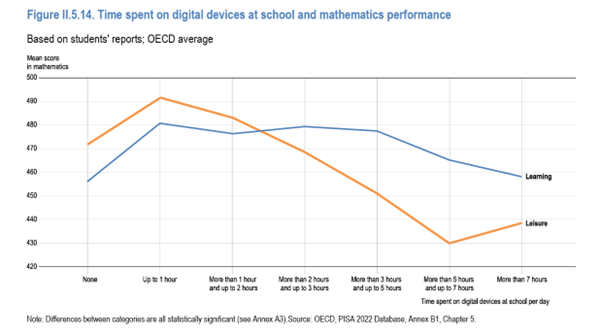
Overall, the evidence shows that using digital/devices for learning purposes in schools yields higher outcomes than not doing so, with the effect tapering off after about five hours per day.  Somewhat surprisingly, the impact of using devices for leisure purposes at school was also correlated with higher learning outcomes, although this turns more sharply negative after about two hours per day.
Most schools have articulated policies about using digital devices on site. However, the least common practices were i) not allowing the use of cell phones (34% of students attended such schools), and ii) having a specific policy about using social networks (51% of students).  In The Netherlands (2022 data), less than 10% of students attended schools where the use of cell phones was not allowed and one in three reported that every or most lessons were disturbed by digital devices.

Tick Tock, the clock is ticking to maintain a fully literate and numerate society

With good quality materials, a focus on learning outcomes and sensible rules of engagement, the use of digital in classrooms enables a positive impact on learning.  

However, smartphones and social media are disturbing the classroom and learning experience and this is likely contributing to why one in three of the kids around here could be functionally illiterate when they leave school.

No time to lose

We need to think again how we systemically approach this better for current and future students and what we can do to bolster the life-chances of this cohort of students with lower literacy and numeracy skills.  Education is a long play, with impact not only on individual lives but crossing generations. There is no time to lose.

BETTer Future

I’ll be visiting London and BETT at the end of March (probably 22nd -24th).  As for so many of us this will be my first trade fair since the pandemic and I’m really looking forward to joining in real life again (never expected to be this enthusiastic about a trade fair, not even BETT 😊). It does feel like we are now emerging from the restrictions of the last couple of years and I’m excited to get out there again.

I’m especially interested to meet people from companies with strong market positions, from scale-ups and from investors in the education, edtech, science and healthtech spaces during my trip to London.

As of March I have some availability for advisory and interim work and have extensive skills and experience in leadership/leading change, digital/transformation and commercial/strategy work.  I have deep knowledge and networks across the European education sector.

I’m also open to become a Non-Executive Director of such an organisation, as long as this doesn’t conflict with existing work. Very flexible in terms of location.

Feel free to send me a message at johnmartin@contentconnected.com or DM me on social media if you would like to meet up in London!

Looking forward >>

#OpenForWork #Leadership #Education #Edtech #Science #Digital #Transformation

Open for consulting and advisory work in education and/or digital transformation

As announced earlier, my handover period at Sanoma is soon coming to an end.  At present I have some attractive leads for edtech ventures that I’m keen to help on their way. And a good plan for the next step in my career, which will take a bit of time to come to fruition.

In the meantime, I’m open for consulting and advisory assignments, mainly in two areas:

  1. Education sector (entire range)
  2. Digital and digital transformation assignments in a variety of sectors (not exclusively education).

These are the areas where my expertise is most developed and that I am passionate about. I’m flexible in terms of location.

If you have a challenging assignment and if you think I could help your organisation to prosper, please feel free to reach out at johnrichmartin@gmail.com

Looking forward >>

Teachers Want to Go Digital Where it Brings Most Benefits

In the fifth annual Sanoma Learning Impact Framework (SLIF), we decided to focus on the main tasks the teacher performs in her profession. In total 7075 teachers responded to the survey, which was again carried out in all of the markets in which we operate: Belgium, Finland, The Netherlands, Poland and Sweden.

Core activities

The main tasks for teacher are: lesson planning, teaching the whole class, exercising, testing, assessment and giving guidance personally or in small groups. Of course there are other tasks too, such as administrative work and professional development, but these are the most frequently repeated activities.

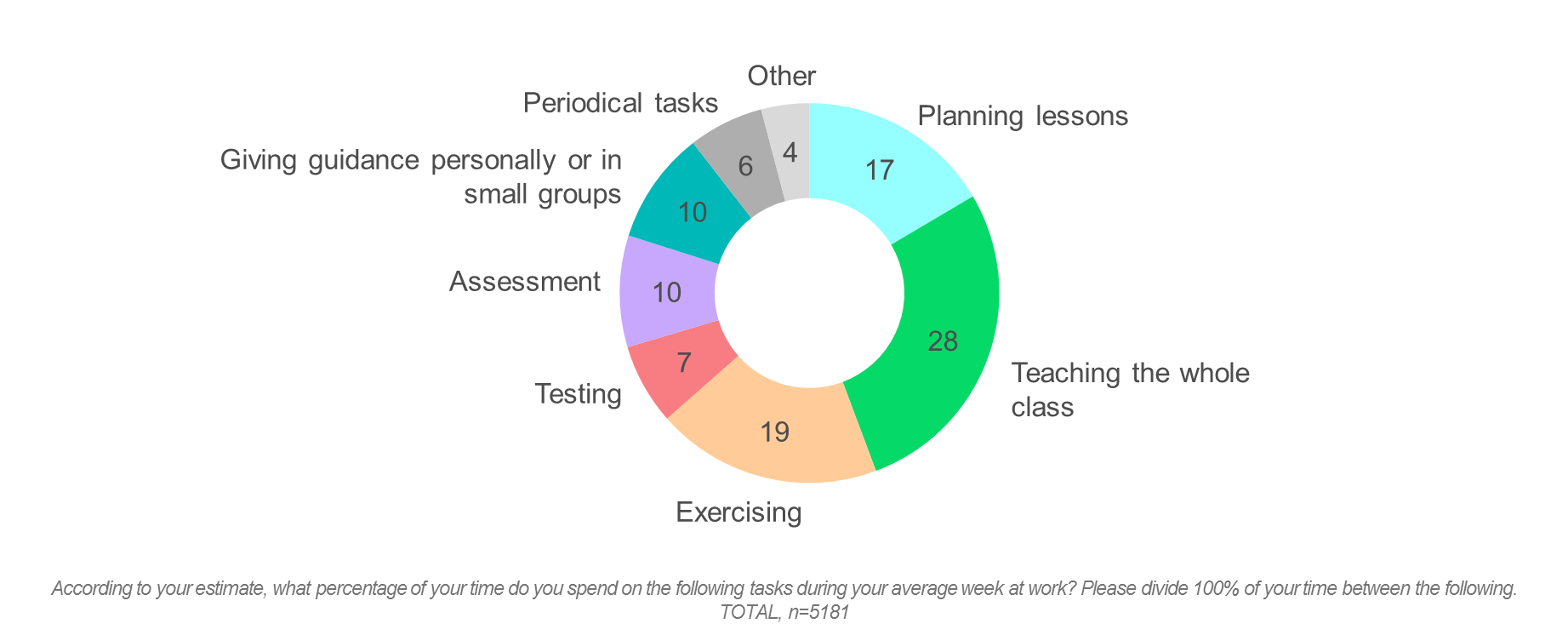
Figure 1 depicts the amount of time teachers estimate they spend on each activity. Teaching the whole study group takes most of the teachers’ time, but still only less than a third.

activities

Figure 1. Percentage of time spent on different tasks

As part of the digital transformation, we are as an educational publisher very interested in whether teachers prefer print or digital materials to support them in their work. Our experience so far is that they value both, and in last year’s SLIF we came to the conclusion that blended learning is the way to go.

As-is/to-be: medium vs activity

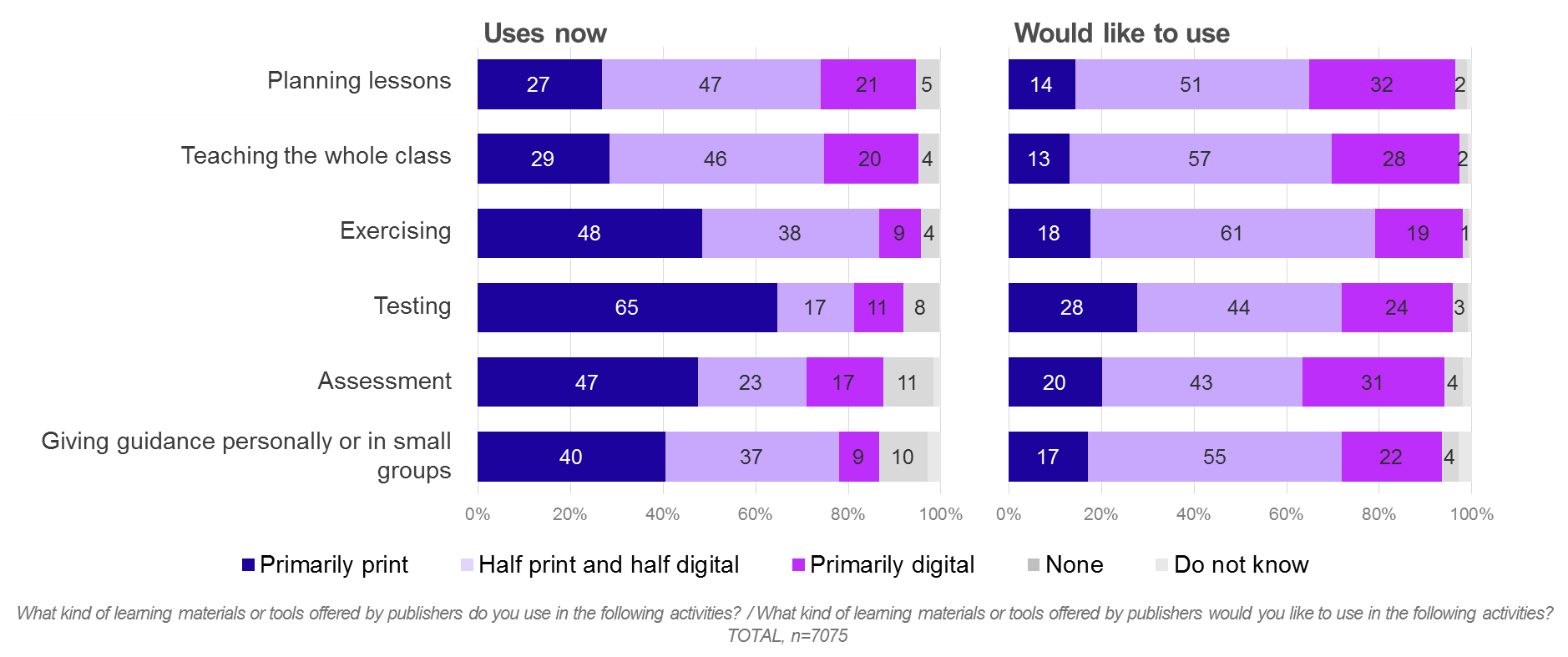
This time we decided to be more specific and map the print vs. digital axis with the activities a teacher carries out. This provided us with revealing results, as depicted in Figure 2.

present_vs_ideal

Figure 2. Materials and tools offered by publishers: Current use vs. Willingness to use

First of all, teachers would like to use more digital materials in all tasks than at present. Secondly, and perhaps more interestingly, the gap between current and desired state is the greatest in tasks where pupils/students have a relatively more active role, namely exercising, testing, and assessment.

Currently 65% of teachers are using printed tests/exams. 28% say they use half & half or primarily digital tests/exams. Contrasting this with the desired state is staggering and the percentages get flipped: only 28% would like to use primarily print and 68% half or primarily digital. A similar phenomenon can be seen in exercising and assessment.

Digital where it makes most impact

What to make of this? We think the answer is simple. Both exercising and testing generate a lot of new content and insights for the teacher to go through. This makes assessment time-consuming for the teacher. With both questions and answers in a digital form, time is saved, insights are increased and pupil/student engagement is enhanced. Teachers are selectively looking to use digital for maximum impact.

Santtu Toivonen, Lead Insight Manager, Sanoma Pro

John Martin, CEO, Sanoma Learning

Strongest result in our history so far at Sanoma Learning

We always win

Last week Sanoma announced the financial results for 2018, which were very good with improved operational profits across all three divisions.

“Best result ever at Sanoma Learning”

For Sanoma Learning this was the best result in our history so far, with profitability increasing by 10% from € 55.6M in 2017 to € 61.2M in 2018.  This very much helps to underpin the major investments we are making in the digital transformation.

“Win locally”

I’m especially proud that a large part of this very good performance came from gains in market share in many of our countries, demonstrating that our learning materials are appreciated by teachers and pupils and that we are competitive in the market. Our Learning Impact survey showed that teachers believe our solutions support them in reaching their learning objectives (92%), enable them in their workflow (87%) and help in student engagement (83%). This really highlights the important work we are doing in enabling teachers in developing the talents of our children.

“Working together across borders”

A second driver of the good results in 2018 was the High Five program where we are working together on investing in the next generation of Sanoma Learning, and funding that journey by creating leaner processes on a number of back-office activities. This gave a solid underpinning to the results in 2018, and we will see further benefits in 2019.

“New growth through acquisitions”

In addition we announced at the end of 2018 our intention to acquire Iddink Group which  will increase the size of Sanoma Learning by about half going forward.  Iddink will help us to accelerate the digital transformation of secondary education in The Netherlands, will extend our role in Belgium and will bring us a new position and new opportunities in Spain. During the course of 2019 we expect to become the owner of Iddink.

Thank you!

I very much want to thank the teachers and pupils who work with our courses for your trust in us. I would also like to thank our teams for the good work in 2018. I know we asked a lot of you and I appreciate the important work we did together.   This has truly been a team effort!

Looking forward >>

We have a big year ahead of us not least with the launch of new platform Kampus in Finland and Sweden, Bingel in The Netherlands, new reforms in Upper Secondary Education in Poland and other reforms in Belgium.  We will be working hard to progress the High Five Program. And we expect to finalize the transaction with Iddink and further develop the business.

We have a strong plan for the coming years and are highly committed to making a positive impact on learning and teaching.  Looking forward >>