Category Archives: Education

Paper – where efficacy meets equity

I was excited to read about this $270M Series D round for Canadian-based ubiquitous tutoring solution Paper – where efficacy meets equity.

A thousand blossoms blooming

Bloom’s seminal work on the 2 Sigma Problem, carried out in the early 1980’s is a classic must-read for edtech ventures today. The outcomes of the research are startling, showing that an average student under tutoring performs about two standard deviations above the average performance of a conventional class. 

Or put another way, an average student following a tutoring program outperforms 98% of students in a conventional classroom!

Since then, the private tutoring market has grown significantly, although new regulations in China last year driven by concerns around equity and student well-being did have a significant negative impact on that market. 

Efficacy AND equity

The good thing about the private tutoring market is its efficacy – it raises learner outcomes.  The disadvantage however is that the rich tend to benefit disproportionately, because they can afford it. The resulting inequity can’t be a good design principle for the provision of education.

Since Bloom, the search has been on to provide solutions that yield similar efficacy at scale.  Paper is potentially such a solution.  For a fixed price, Paper sells licenses to schools and districts to make its online tutoring support available to every student, around the clock, with no cap on usage. Students can connect with a trained tutor for homework help, writing feedback and study support across all K-12 subject areas. Teachers at schools can access these sessions, see which students need support, and adjust their instruction accordingly.

I’m enthusiastic about this approach because it enables both efficacy and equity in education. The risk of inequity isn’t completed removed of course because richer schools might be more likely to adopt the solution than poorer.  Yet with most K-12 education systems funded publicly, that risk could be mitigated by policy. A second risk could be increased competition between schools and tutoring companies for teachers.  Yet the deployment of university students and new/re-entrants into the profession could also work to increase the overall talent pool of teachers available.

Looking forward >>

I’m very interested to see how Paper will grow in the coming years and believe there could be international potential for this type of solution.
Open for consulting and advisory work in education and/or digital transformation

As announced earlier, my handover period at Sanoma is soon coming to an end.  At present I have some attractive leads for edtech ventures that I’m keen to help on their way. And a good plan for the next step in my career, which will take a bit of time to come to fruition.

In the meantime, I’m open for consulting and advisory assignments, mainly in two areas:

  1. Education sector (entire range)
  2. Digital and digital transformation assignments in a variety of sectors (not exclusively education).

These are the areas where my expertise is most developed and that I am passionate about. I’m flexible in terms of location.

If you have a challenging assignment and if you think I could help your organisation to prosper, please feel free to reach out at johnrichmartin@gmail.com

Looking forward >>

Looking for new opportunities in education (technology)

Europe’s biggest edtech company

After 10 years at Sanoma, mostly leading Sanoma Learning, I’ve informed the company of my intention to move on as of spring next year, giving plenty of time to arrange a smooth handover to a successor.  Check out the press release of 13 November about it here.

Great place to work

It’s been an honour to lead Learning during this period, and I’m really proud about what the teams have achieved.  I love the dedication to learning that can be felt across the company and very much respect the commitment of our people to do a great job for pupils and teachers.

Growth and successful transformation

Our teams have achieved a lot of success in local markets and made great leaps forward on the digital transformation.  We have worked together intensively across the company on the High Five program in building one Sanoma Learning.  And we’ve completed a number of acquisitions including Sanoma Utbildning in Sweden, Tammi Learning in Finland, De Boeck in Belgium and and Iddink in The Netherlands, Belgium and Spain.  We are now about twice the size we were five years ago.

Amongst the best performers in the industry

Today we stand as a very successful company.  We are positively impacting about 11m learners and 1m teachers in some of the World’s best education systems through a professional organization of some 1700 talented people. We are a frontrunner on the digital transformation, arguably Europe’s biggest edtech company today in terms of revenues and employment.

We’re growing and amongst the best performing companies in the industry financially: 2018 brought us the strongest result in our history so far, and we are well on track to extend that success further in 2019.  It has really been a privilege to be part of this great company!

My priority right now is to continue leading Learning effectively and then to handover to a successor before leaving Sanoma.

Investing in education/technology

After that, I’m intending to make some investments in the education (technology) sector and to see where that  brings me.  For early stage investments I will be investing in and working together with eduimpact.fi.  For later stage investments I will work together with other investors.  Feel free to reach out to me at johnrichmartin@gmail.com if you think I could in some way help your company to prosper.

Thank you!

Thank you to my colleagues at Sanoma Learning for their excellent work and cooperation through the years. Wishing them and Sanoma Learning all the best for a bright future ahead!

Looking forward >>

John Martin

Teachers Want to Go Digital Where it Brings Most Benefits

In the fifth annual Sanoma Learning Impact Framework (SLIF), we decided to focus on the main tasks the teacher performs in her profession. In total 7075 teachers responded to the survey, which was again carried out in all of the markets in which we operate: Belgium, Finland, The Netherlands, Poland and Sweden.

Core activities

The main tasks for teacher are: lesson planning, teaching the whole class, exercising, testing, assessment and giving guidance personally or in small groups. Of course there are other tasks too, such as administrative work and professional development, but these are the most frequently repeated activities.

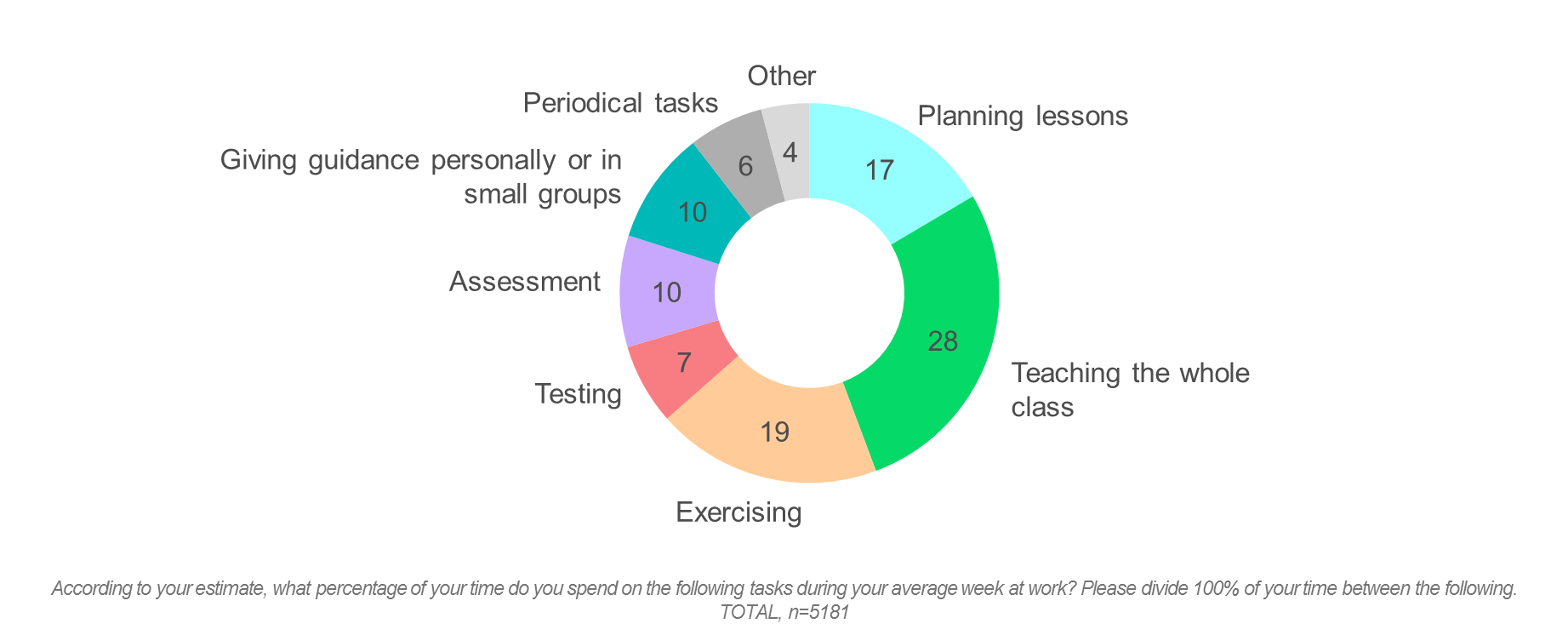
Figure 1 depicts the amount of time teachers estimate they spend on each activity. Teaching the whole study group takes most of the teachers’ time, but still only less than a third.

activities

Figure 1. Percentage of time spent on different tasks

As part of the digital transformation, we are as an educational publisher very interested in whether teachers prefer print or digital materials to support them in their work. Our experience so far is that they value both, and in last year’s SLIF we came to the conclusion that blended learning is the way to go.

As-is/to-be: medium vs activity

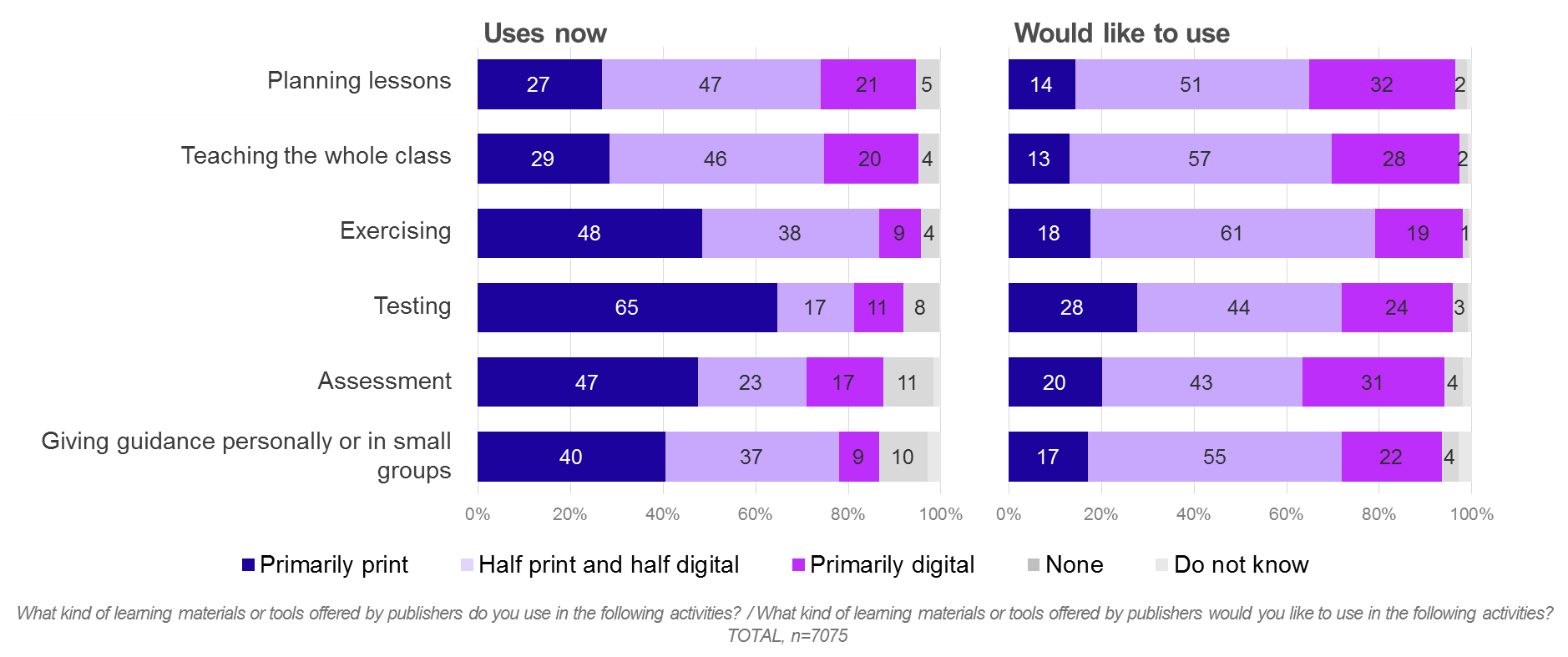
This time we decided to be more specific and map the print vs. digital axis with the activities a teacher carries out. This provided us with revealing results, as depicted in Figure 2.

present_vs_ideal

Figure 2. Materials and tools offered by publishers: Current use vs. Willingness to use

First of all, teachers would like to use more digital materials in all tasks than at present. Secondly, and perhaps more interestingly, the gap between current and desired state is the greatest in tasks where pupils/students have a relatively more active role, namely exercising, testing, and assessment.

Currently 65% of teachers are using printed tests/exams. 28% say they use half & half or primarily digital tests/exams. Contrasting this with the desired state is staggering and the percentages get flipped: only 28% would like to use primarily print and 68% half or primarily digital. A similar phenomenon can be seen in exercising and assessment.

Digital where it makes most impact

What to make of this? We think the answer is simple. Both exercising and testing generate a lot of new content and insights for the teacher to go through. This makes assessment time-consuming for the teacher. With both questions and answers in a digital form, time is saved, insights are increased and pupil/student engagement is enhanced. Teachers are selectively looking to use digital for maximum impact.

Santtu Toivonen, Lead Insight Manager, Sanoma Pro

John Martin, CEO, Sanoma Learning

Creating a European Champion in Learning

CMD cover

We’re an ambitious company and we are working on building a European Champion in Learning.

Last week we held our annual Capital Markets Day event in Helsinki – which is a good chance for us to share our plans with the investment community.  It was a positive day.  The team was in good spirits and there were lots of great questions from the participants.

I talked about our approach to building a European Champion. Check out the video of the session here.

Our starting point is strong: we serve 10m pupils and 1m teachers in some of the world’s best and most advanced education systems.  We’re a front runner on the digital transformation and have a strong financial performance and track record.  We have a solid plan and believe we can add even more value for our customers in the future.

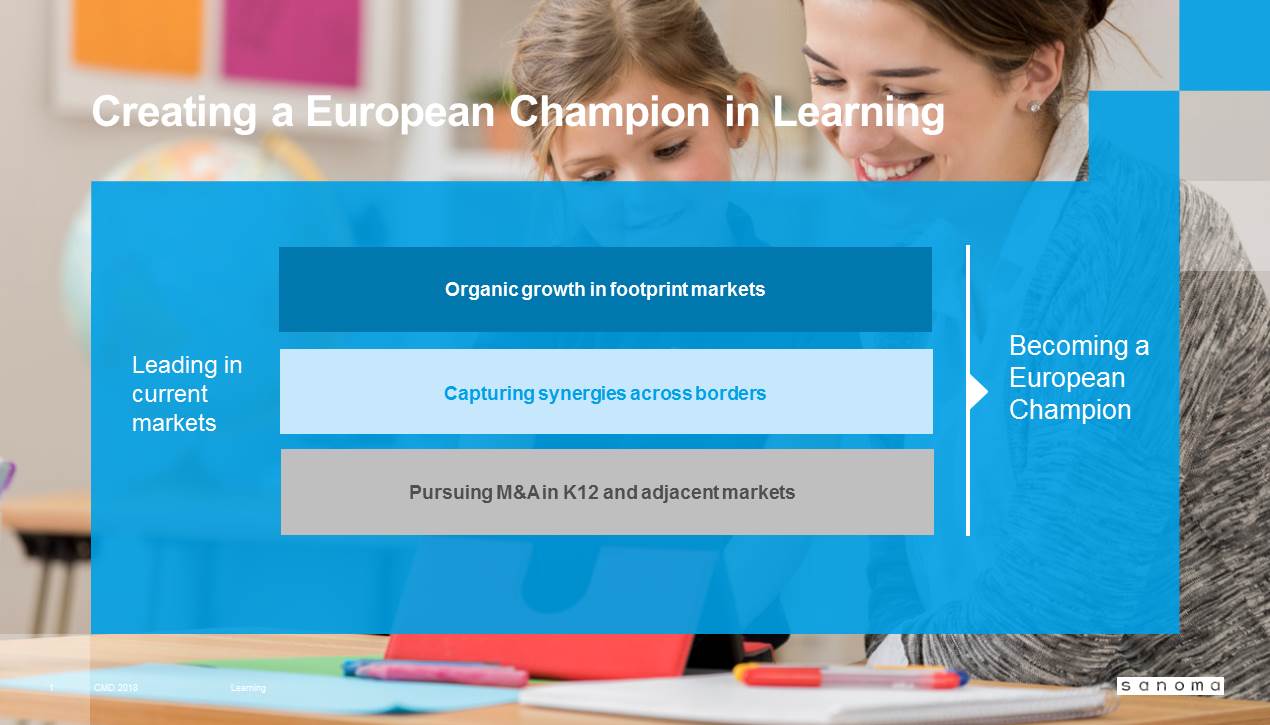
We have a three pillar strategy to build this European Champion:

  • Win in local markets, by serving our customers well
  • Work together across borders to create one integrated company
  • Make selective acquisitions in current and new learning markets

We’re really excited about the opportunities for the business and our team is going for it!

I’m interested to hear your views and if you see opportunities that you think we should be developing too.

CMD strategy