Teachers value blended learning

In 2018, we carried out our SLIF survey (Sanoma Learning Impact Framework) for the fourth time. In total 7594 teachers answered the online survey, which was carried out in all our markets: Belgium, Finland, The Netherlands, Poland, and Sweden. The main purpose of SLIF is to investigate the impact of published materials on learning. This time we focused on blended learning materials.

We are happy to observe that digital materials are gaining ground in learning. The most important benefit of digital according to teachers is engagement. 68% of the survey respondents felt that digital materials are more engaging for their pupils/students than printed materials. This is easy to believe: for example Bingel with its visually appealing avatar characters which the pupils can adapt with pingping they earn from doing exercises has proved to be very engaging and motivating.

Ultimately we want to offer learning materials that lead to improved learning outcomes. When we asked which factors have the highest influence on learning outcomes, engagement was mentioned as the most important factor, followed by variation in learning activities, individual coaching, and timely feedback to pupils.

It is worth noting that the second most important factor, variation in learning activities, was also considered as something which is better achieved in the blended model. 64% of respondents thought that digital learning materials are better for providing variation than print materials. Again, this is easy to understand. Digital learning materials include video, audio, animations, interactive exercises, instant feedback, and other features obviously missing from printed materials.

Figure 1 summarizes nicely the teachers’ attitude towards digital learning materials. We can see that only 27% of teachers use only printed materials. Whilst it is significantly more than the amount of teachers using only digital materials (3%), we can see that the majority of teachers are somewhere in between, adopting the blended learning approach: 17% apply half digital / half print approach, and 44% primarily print with some digital components.

Figure 1

Figure 1. Teachers would like to use more digital learning materials

It’s interesting to compare the current state of teachers’ materials with their ideal situation. At the moment 17% of the teachers use half digital / half print materials. However, 38% would prefer to have this combination. The difference in print-only teaching is even more pronounced with 27% of teachers currently teaching with print only, but a mere 1% would like to do so also in the future.  This is firm evidence that demand for digital should grow in the coming years.

“Demand for digital in the blended mix to grow”

Whilst teachers want more digital, as our survey clearly shows, it is worth emphasizing that virtually no-one of our respondents would like to teach with digital-only materials. Currently 3% are doing so, but it is not seen as the optimal state by anybody. What to make of this? Our answer: blended learning models work best.

Santtu Toivonen, Lead Insight Manager, Sanoma Pro

John Martin, CEO, Sanoma Learning

Strongest result in our history so far at Sanoma Learning

We always win

Last week Sanoma announced the financial results for 2018, which were very good with improved operational profits across all three divisions.

“Best result ever at Sanoma Learning”

For Sanoma Learning this was the best result in our history so far, with profitability increasing by 10% from € 55.6M in 2017 to € 61.2M in 2018.  This very much helps to underpin the major investments we are making in the digital transformation.

“Win locally”

I’m especially proud that a large part of this very good performance came from gains in market share in many of our countries, demonstrating that our learning materials are appreciated by teachers and pupils and that we are competitive in the market. Our Learning Impact survey showed that teachers believe our solutions support them in reaching their learning objectives (92%), enable them in their workflow (87%) and help in student engagement (83%). This really highlights the important work we are doing in enabling teachers in developing the talents of our children.

“Working together across borders”

A second driver of the good results in 2018 was the High Five program where we are working together on investing in the next generation of Sanoma Learning, and funding that journey by creating leaner processes on a number of back-office activities. This gave a solid underpinning to the results in 2018, and we will see further benefits in 2019.

“New growth through acquisitions”

In addition we announced at the end of 2018 our intention to acquire Iddink Group which  will increase the size of Sanoma Learning by about half going forward.  Iddink will help us to accelerate the digital transformation of secondary education in The Netherlands, will extend our role in Belgium and will bring us a new position and new opportunities in Spain. During the course of 2019 we expect to become the owner of Iddink.

Thank you!

I very much want to thank the teachers and pupils who work with our courses for your trust in us. I would also like to thank our teams for the good work in 2018. I know we asked a lot of you and I appreciate the important work we did together.   This has truly been a team effort!

Looking forward >>

We have a big year ahead of us not least with the launch of new platform Kampus in Finland and Sweden, Bingel in The Netherlands, new reforms in Upper Secondary Education in Poland and other reforms in Belgium.  We will be working hard to progress the High Five Program. And we expect to finalize the transaction with Iddink and further develop the business.

We have a strong plan for the coming years and are highly committed to making a positive impact on learning and teaching.  Looking forward >>

High Five!

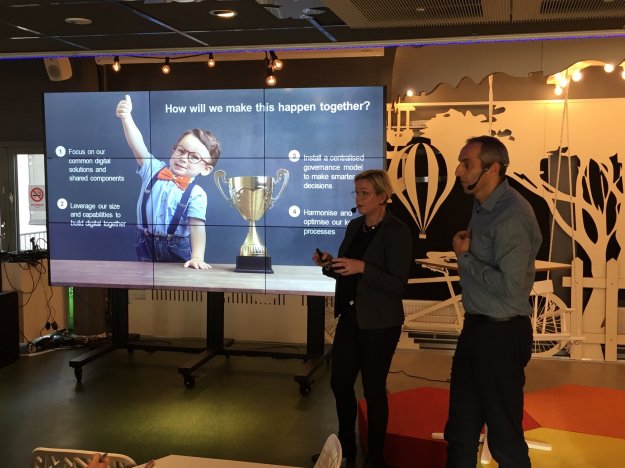
We’re currently executing the “High Five” program at Sanoma Learning: working together across the borders of the five national units to build one integrated European company.

We serve about 10m pupils and 1m teachers in some of the World’s best performing education systems (Finland, The Netherlands, Belgium, Poland and Sweden). Our customers especially appreciate “blended learning solutions”: mashing up physical and digital approaches to inspire learning.  High Five is really about organizing ourselves to be able to create and provide impactful blended learning solutions to schools in the most effective way.

We’ve divided the program into three areas:

  • Investing in the future (our approach to digital applications, courses, data and technology)
  • Funding the journey (improving our procurement processes)
  • Enabling the transformation (making sure our support processes are fit for the digital transformation).
kirsi and winfried

Kirsi Harra-Vauhkonen (MD of Sanoma Pro in Finland & CPO Secondary Education) and Winfried Mortelmans (MD of Van In in Belgium & CPO Primary Education) discussing High Five with the team in Helsinki.

The last weeks we’ve been travelling with the team to all of the countries to engage further with our people as we move forward with High Five.  I have experienced this as an inspiring period, bringing a lot of new energy, and I feel we really have a good momentum with High Five!

I’d like to thank the teams for all the excellent work in co-creating and executing High Five so far and to all our people who joined us in the roadshow.  Very much appreciated and well done!

Looking forward >>

high five logo

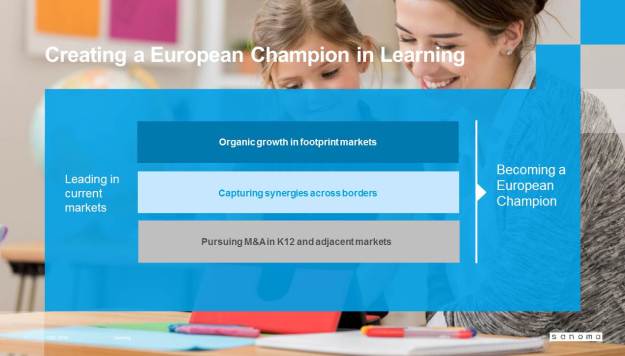
Creating a European Champion in Learning

CMD cover

We’re an ambitious company and we are working on building a European Champion in Learning.

Last week we held our annual Capital Markets Day event in Helsinki – which is a good chance for us to share our plans with the investment community.  It was a positive day.  The team was in good spirits and there were lots of great questions from the participants.

I talked about our approach to building a European Champion. Check out the video of the session here.

Our starting point is strong: we serve 10m pupils and 1m teachers in some of the world’s best and most advanced education systems.  We’re a front runner on the digital transformation and have a strong financial performance and track record.  We have a solid plan and believe we can add even more value for our customers in the future.

We have a three pillar strategy to build this European Champion:

  • Win in local markets, by serving our customers well
  • Work together across borders to create one integrated company
  • Make selective acquisitions in current and new learning markets

We’re really excited about the opportunities for the business and our team is going for it!

I’m interested to hear your views and if you see opportunities that you think we should be developing too.

CMD strategy


Winning Spirit of Nowa Era at 25

Magda

MD of Nowa Era Magda Walczak inspiring the team at the event

Last week we celebrated the 25th anniversary of Nowa Era.  It was really fantastic to be there together with the team, especially in such an exceptional year!

Past to Present

25 years ago it would have been almost impossible to imagine the success that Nowa Era has become today.  I wonder in those early days whether Mariusz and Magda even dreamed

  • We would become the market leader
  • Serving nearly every school in the country in some way
  • With such an outstanding quality of offering.

Present to Future

If you think what the team has achieved in the last 25 years – just imagine the next 25!

The key to the success of Nowa Era is our people

  • Who are doing extremely important work in enabling high quality education
  • In talented and hard-working teams
  • And striving to do it to the very best of their ability.

Spirit of Nowa Era

I call this the “winning spirit of Nowa Era“. I believe it will help us to make the next 25 years even more successful than the first 25.

With respect and appreciation

With respect and appreciation I would like to thank the teams for their commitment and outstanding achievements.  We are extremely proud of you.

Five Reasons Why Blended Learning is an Ongoing Success in Finland


This week I joined the education event Dare to Learn in Helsinki with colleagues from Sanoma Pro. With 3000 participants from over 20 countries it was well organised and people were in a positive spirit. Thanks to the organisers for having done a great job!

Finland has a world-class education system with several factors underpinning the success including skilled and respected teachers, high levels of equity and trust in the system and an holistic view to the development of children. Education professionals from around the globe are interested to learn about the Finnish ways.

I think that blended learning is an enabler of excellence in Finnish education and gave a keynote talk on this topic, with the headlines:

1.   Blended learning plays to the natural strengths of the local education system, enabling the excellent teachers, taking advantage of the high quality curricula and materials and putting to work the technology available in schools and homes.

2.   Blended learning models are practical and flexible as schools transform to a more digital future. Our research indicates that teachers are increasingly ready and willing for the digital transformation. We’re also witnessing the emergence of new pedagogies such as phenomenon-based learning, and blended solutions can be very helpful enablers of these new pedagogies.

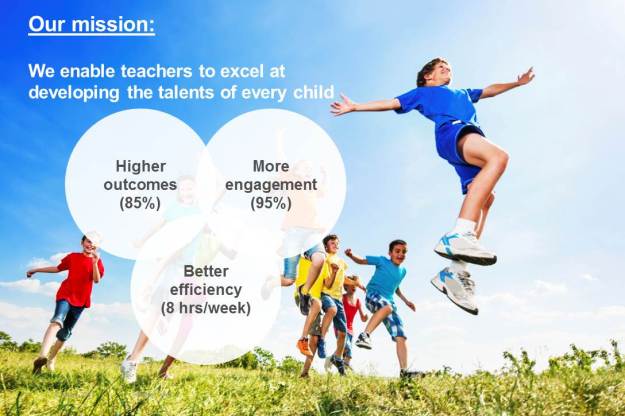
3.   Blended learning supercharges great teachers (and there are many of them in Finland). A Sanoma Learning solution typically saves a teacher about 8 hours of working time each week – time which can be channelled into individual attention to pupils. And with dashboards and personalised learning pathways, teachers have excellent insights and tools to guide interventions.

4.   Blended learning motivates and engages pupils in their learning endeavours. Our learning impact surveys have indicated that 95% of teachers typically report that integrated learning methods help them to engage pupils with learning. Some like printed books while others prefer online materials. Nowadays boys often lag behind girls in learning. Our analytics indicate that gamified solutions integrated into the approach such as bingel are especially motivating for boys, providing a way to bridge this gap.

5.   Blended learning supports pupils’ achievement and outcomes. Blended learning is a step towards personalized learning, which takes pupils’ personal achievement level and preferences into account. In our surveys, 85% of teachers have reported that such solutions help the pupils to achieve their curriculum goals.

 By applying blended learning methods and techniques, Finland can stay on top of its game in education. Teachers can make the most of their teaching and pupils stay motivated, which helps them to achieve their learning goals.

* Blended learning is mix of various event-based activities, including face-to-face classrooms, e-learning and self-paced learning.

The Chinese are coming to a school near you


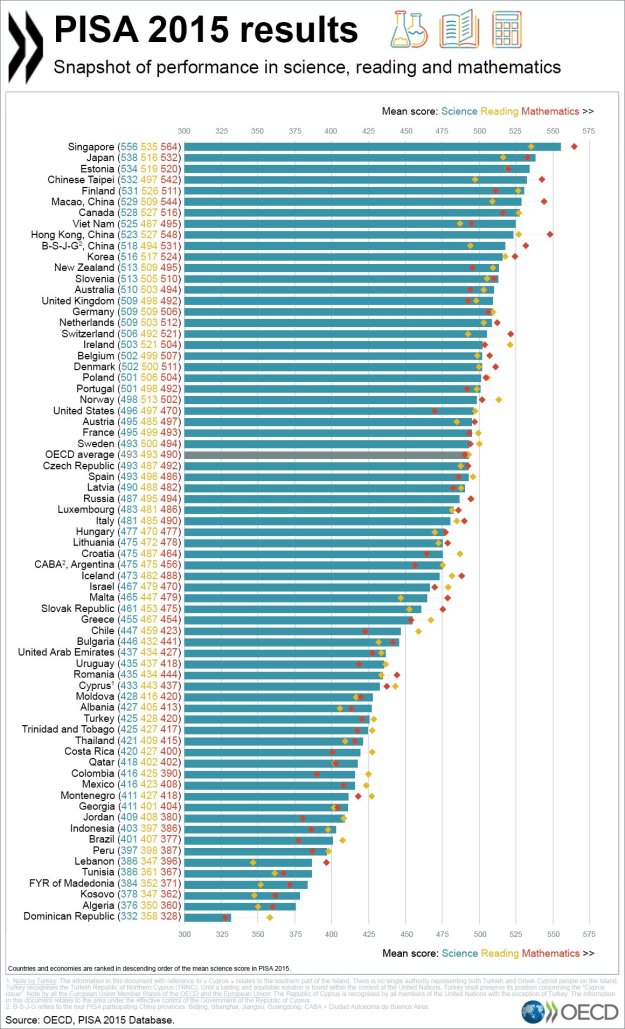
Last week we visited China with a small team to learn more about their education system. The timing was good with today’s announcement of the results of the latest PISA survey,  with the Chinese regions once again performing very well.

china

Amongst others we visited a variety of successful private and state-owned enterprises as well as a government department of education and – best of all – a primary school. It was an inspiring experience and we were greeted warmly and had open discussions everywhere we went.

The primary school felt very similar to those in our home countries, although the class sizes were twice as big at 50 rather than 25 students.  We sometimes have the impression of Chinese children doing heavy duty rote learning, but I was struck by the emphasis on meaning, aspiration and happiness in the school we visited.  Teachers were experimenting with project-based learning and digital, not dissimilar to recent innovations in Finland.

The companies we visited were all proud to present what they were working on, very open to answer questions and to curious to learn about us too.  Finnish education was well respected.  The tech companies looked and felt very similar to those in Silicon Valley but somehow seemed even more keenly commercial.

The government clearly has a big voice in education, with central government setting overall policy through the five year plan and the local authority we visited was actively working to understand and improve school performance across the region, driven by quite a rich set of data.

It made me wonder:

“is China going to lead the next wave of breakthrough innovations in education and learning?”

The scale of the market, commitment of the key players and innovative potential of the ecosystem  create a compelling case.

Scale

With a population of over 1.3 bn inhabitants and about 200 m students in K-12 education this is a huge market.  Each year about 17 m new students join the system, with this number likely to get boosted by up to 6 m each year due to the recent move to a “two-child” policy.

Commitment

The government is highly committed to education and the 13th 5-year plan (2016-2020) focuses on improving quality and access, with a key role for digital. Significant new resourcing is being dedicated to the transformation. At the same time, private spending on education is huge, estimated to be of the order of 1/3 of average household disposable income, driven by the “six adults – one child” phenomenon resulting from the earlier “one child” policy. The commitment to education in China seems unrivalled on the global stage.

Innovative potential

The companies and organisations we met had high quality management and development capabilities at least comparable with what we have seen in the West. There seems to be a “learning culture”, with people keen to try new things and work hard at it. There is everything to win. The transformation need is clearly articulated and well-funded.  Authorities and companies are building large networks of users and rich databases.  Surely the insights that will come from this ecosystem about learning on all levels (individual, class, school, region, nation) will power innovation in education and learning?

China: coming to a school near you

All-in-all I think it’s highly likely that China will become a powerhouse of innovation in education in the coming years – and that our education systems will also benefit from Chinese innovations in education.  Also, given the growing global importance of China, how long will it be before Mandarin is a common second language in our curricula?  One way or another, the Chinese are coming to a school near you pretty soon.

Organising for the digital transformation in Belgium

de boeck blog

I’m really happy that we have acquired the educational publishing activities of De Boeck in Belgium. Welcome to our new colleagues! Click here for a short vlog about it.

logo_deboeck

De Boeck is a trusted brand with a good market position, making about € 17 m of revenues in 2015 and employing about 80 professionals. They share our passion for education and learning and there’s a very good fit with our mission of helping teachers to develop the talents of our children.

mission

Why?

Demand for multi-channel learning solutions is increasing. Our customers tell us that digital can support learning impact: improved engagement and higher learning outcomes for pupils and better workflow efficiency for teachers. A great example of using multi-channel to enable learning impact is bingel. So we made this acquisition to enable the digital transformation of learning and teaching in Belgium. We are working hard to organize ourselves effectively for this.

How?

We intend to combine the complementary high quality portfolios and well-developed learning design capabilities of Van In and De Boeck.

This will bring more scale to our significant investments in digital across these high quality portfolios.

We can realize synergies in our operations as we create a new organization ready for the future.

Looking forward >>

Bringing together two great companies, Van In and De Boeck, will help us to better fulfil the needs of our customers, today and in the future. Good luck to the new team in making this a success!

The Underdog? No, the SuperFox!

People love the underdog.  “Rags-to-riches”, “zero-to-hero”, “The American Dream”: the idea of grit triumphing over inheritance ignites our imagination. From an educational perspective I love underdogs too.  They show us that by using our talents, working hard and playing as a team we can win, sometimes against all odds.

Blue Christmas

The odds against Leicester City (“The Foxes”), the football club of my hometown, winning the Premier League, at the beginning of this season were 5000-to-1.  To put this into perspective: the odds of Christmas Day being the hottest day of the year were also 5000-to-1 and the odds of Elvis Presley being found alive and well were 2000-to-1.

LCFC


Underdog? Underfox? SuperFox!

Leicester City has just won the Premier League for the first time in our 132 year history! I’m super proud of our team!  The city and shire are elated and the country enthralled by this fairytale victory.  This is one of the greatest sporting turnarounds of all time. (Check out the chart below).  The underdog has won and it turns out to be a fox.  It feels disrespectful to call them an “underfox”.  Watch the news: they’re SuperFoxes!

LCFC_Performance

“Arise Sir Jamie Vardy of King Power Stadium”

At Christmas 2014 we were bottom of the Premier League, looking like we were heading south.  However by Christmas 2015 (which was not much warmer than Elvis) we were top of the league and had spirit and momentum. Since then it felt like a dream that was going to come true.  This was because of the dream team, the best “team” in the League, a team of heroes.  Claudio Ranieri, Jamie Vardy, Riyad Mahrez, Wes Morgan, Leonardo Ulloa, Danny Drinkwater and Kasper Schmeichel, to name but a few of the heroes. They all need to be knighted.

fearlessfoxes

Next generation

Is this the dawn of a new era for Leicestershire sporting talent? For example Luke Thompson, signed by Leicester City Academy and featured below next to the Cup after playing for the under 9’s.  The Foxes have shown us that anything’s possible.  (And yes, this is my nephew, so no bias there :)).

luke

Dreaming and doing

It has been said that the “team with the dream” won. Dreams inspire us.  But grit is what delivers. The Foxes dreamed and they delivered. They’re an inspiration. Go Foxes! Go SuperFoxes!

#BooksNotBombs

NYHQ2013-1339

© UNICEF/UNI156500/Noorani

It was shocking to see the terror attacks in Brussels last week.  Condolences to those who have lost someone they loved and I hope for a good recovery of those who were injured. I was relieved that none of our people in Belgium were injured in those terrible events.

There seem to be many people in our societies across the World who are resentful these days. Some people are feeding this resentment and calling out the hate in others. Why? This will not lead us anywhere good.

There is hope too

When you look further, you see that many people did many good things in response to the attacks.  The emergency services did an excellent job in taking care of the victims and restoring order.  People volunteered blood donations.

#ikwilhelpen

I was especially heartened by people volunteering to help others with transport, shelter, food or even a hug through #ikwilhelpen (#IWantToHelp). People volunteered practical help and this was good for the spirit too.  It’s the best answer to those calling out the worst in others.

 “Wouldn’t our societies be happier and healthier if we would more often do as those good people in Belgium did, and volunteer our help?”

#IWantToHelp

I also want to help contribute to making the World better than it is today.  I care a lot about education. UNICEF has launched an appeal to reach 43 million children in humanitarian emergencies worldwide.  The largest portion of the appeal – 25 per cent – is going towards educating children in emergencies.  I support this plan.

I understand from UNICEF that it could typically cost about € 150 to pay for a teacher to give lessons to children in their own language in an emergency zone for one month.  I’ve made a donation to UNICEF today in that amount. #BooksNotBombs.